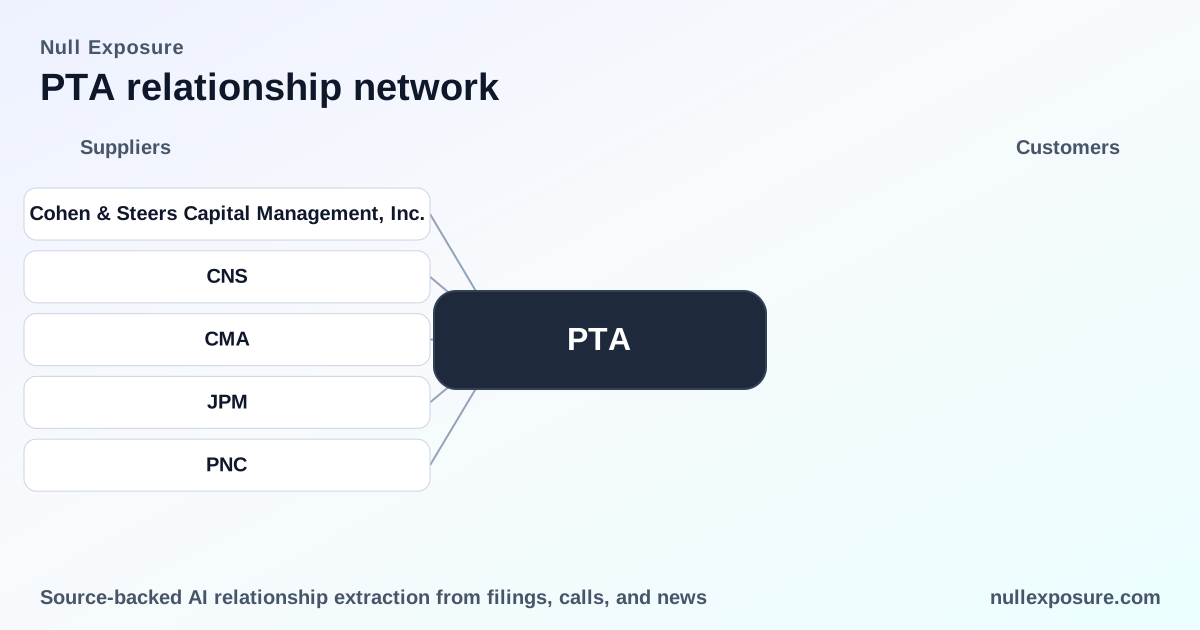
PTA supplier landscape: who supplies exposure to the fund and what it means for investors
PTA operates as a closed‑end, preferred‑securities income vehicle managed by an external asset manager; it monetizes by investing shareholder capital in bank and corporate preferreds and collecting management and administration fees while distributing the coupon income to investors. For an investor or operator evaluating PTA as a supplier relationship, the immediate priorities are manager alignment, counterparty concentration in large banking issuers, and the fund’s product positioning as a yield vehicle.
For a deeper supplier intelligence briefing and ongoing monitoring, visit https://nullexposure.com/.
What PTA actually does and how it makes money
PTA’s economic model is straightforward: raise capital from investors into a closed‑end fund, invest that capital in preferred securities and similar income instruments, and capture the spread between the income on securities and the fund’s operating costs and fee schedule. The fund’s revenue stream is primarily fee income charged by the manager and the realized income distributed to shareholders as yield. That positioning makes the fund dependent on manager capability and the credit characteristics of preferred‑issue issuers, not on proprietary operating assets.
Supplier roll call — the counterparties and managers identified
Below I list every relationship surfaced in the supplied results, with a compact plain‑English explanation and a source note.
-
Cohen & Steers Capital Management, Inc.
The fund is explicitly managed by Cohen & Steers Capital Management, Inc., which is the external manager responsible for portfolio construction and execution. (Finviz quote page, snapshot Mar 2, 2026 — https://finviz.com/quote.ashx?t=PTA%2CRFI&p=m&ty=oc&e=2026-03-02) -
Cohen & Steers, Inc.
The vehicle is described as the Cohen & Steers Tax‑Advantaged Preferred Securities and Income Fund, a closed‑end fixed‑income fund launched and branded by Cohen & Steers, Inc., confirming the manager/brand role in product distribution. (Finviz quote page, snapshot Mar 2, 2026 — https://finviz.com/quote.ashx?t=PTA%2CRFI&p=m&ty=oc&e=2026-03-02) -
Comerica (CMA)
Comerica appears in holdings commentary as a issuer of preferred securities that sit among the fund’s notable positions, indicating exposure to regional banking preferreds. (Contrarian Outlook article, holdings discussion referencing FY2022 — https://contrarianoutlook.com/should-you-pounce-on-these-8-yielding-preferreds/) -
JPMorgan Chase (JPM)
A JPMorgan Chase preferred issue is cited among top holdings, signalling exposure to a large-systemic bank’s preferred capital within the fund’s income mix. (Contrarian Outlook article, holdings discussion referencing FY2022 — https://contrarianoutlook.com/should-you-pounce-on-these-8-yielding-preferreds/) -
PNC Financial (PNC)
PNC Financial’s preferred issuance is likewise listed among top fund holdings, reinforcing the fund’s concentration in bank-issued preferred securities across major and regional banks. (Contrarian Outlook article, holdings discussion referencing FY2022 — https://contrarianoutlook.com/should-you-pounce-on-these-8-yielding-preferreds/)
What these relationships imply for investors and operators
-
Manager reliance is the primary operational dependency. With Cohen & Steers named as manager and brand, PTA’s performance and risk management are tethered to that firm’s strategy and execution. Underwriting, trading, and duration/carousel decisions flow from the manager’s platform. (Finviz, Mar 2026)
-
Issuer concentration drives credit and liquidity risk. The fund’s notable holdings include preferreds from JPM, Comerica, and PNC, which implies investors are exposed to bank balance‑sheet idiosyncrasies and any sector‑wide stress in bank capital instruments. That concentration shapes volatility more than issuer count alone. (Contrarian Outlook holdings commentary, FY2022)
-
Income profile and market sensitivity. Preferred securities deliver yield but are sensitive to interest rate moves and to credit event pricing; the fund’s value and distributable cash are driven by those markets rather than by operating revenue streams. This makes PTA a tactical yield tool, not a replacement for core equity or fixed‑income allocations.
If you want a tracked view of manager dependencies and issuer concentration for PTA, check https://nullexposure.com/ for monitoring tools and supplier reports.
Operating model constraints and company‑level signals
The provided payload includes no formal constraint excerpts; that absence itself is an analytical signal. From the relationship set and the product type, infer the following company‑level characteristics:
- Contracting posture: manager‑contracted product, meaning the firm outsources portfolio management and likely uses third‑party custodians and administrators typical of closed‑end funds. There is limited operational friction for investors but a single point of governance at the manager level.
- Concentration and criticality: issuer concentration in bank preferreds is a critical driver of prospective performance; credit events at major issuers would materially affect NAV and distributable income.
- Maturity and market fit: The fund is presented as a mature product offering (closed‑end preferred/income fund) positioned for yield‑seeking investors; product maturity supports established distribution but also ties performance expectations to market cycles rather than rapid asset‑growth trajectories.
Because the constraints block included no entity‑specific limits, these characteristics should be treated as company‑level operational signals rather than relationship‑specific restrictions.
Practical risk checklist for supplier decisions
- Confirm Cohen & Steers’ fee schedule, lock‑up mechanics, and governance rights in fund documents before committing capital. Management control translates directly into portfolio outcomes.
- Audit the fund’s top issuer list for concentration thresholds (e.g., cumulative exposure to top 5 bank preferreds). A handful of large issuer positions materially changes downside risk.
- Monitor preferred market liquidity and call risk; these instruments can compress NAV or yield differently than straight debt.
If you want a customizable investor brief comparing PTA’s supplier links to peer funds, visit https://nullexposure.com/ and request a supplier comparison.
Bottom line and recommended next steps
PTA is a manager‑run, closed‑end preferred securities vehicle with clear dependency on Cohen & Steers for portfolio construction and measurable exposure to large‑bank preferreds such as JPM, Comerica, and PNC. Investors should focus diligence on manager alignment, issuer concentration, and the fund’s distribution mechanics rather than on operational infrastructure. For portfolio teams integrating PTA exposure, the priority is monitoring manager performance and bank preferential capital trends.
For ongoing coverage and supplier mapping on PTA and comparable vehicles, see https://nullexposure.com/.