PTC Inc.: Cloud-first CAD, recurring software economics, and what suppliers tell investors
PTC monetizes primarily through subscription software and cloud services anchored by its CAD and IoT product lines — notably Onshape, Creo, and ThingWorx — selling recurring licenses and professional services to industrial customers. Revenue is driven by subscription renewal economics and scale in cloud deployment, while margins benefit from high gross profit on software and operating leverage in services. For investors assessing supplier relationships, PTC’s partnerships and infrastructure choices reveal how the company manages product delivery, geographic reach, and operational concentration.
Explore supplier intelligence and relationship risk for PTC on Null Exposure. https://nullexposure.com/
Why supplier relationships matter for a software company like PTC
PTC is not a hardware OEM: its product experience depends on platform availability, cloud performance, and global distribution. A supplier outage or materially adverse change in cloud economics would directly impact customer retention and onboarding velocity for cloud-native products such as Onshape. With a market capitalization north of $18.5 billion and recurring revenue characteristics, PTC’s supplier posture is a lever on both growth (time-to-market for new features) and margin (cloud spend and third-party services).
PTC’s financial profile supports this read: Revenue TTM ~$2.86B, gross margin high at ~84% (implied by gross profit), operating margins above 33%, and analyst sentiment skewing positive with a median target near $195 — signaling investor confidence in durable software economics supported by scalable supplier relationships.
What the supplier signals show (company-level constraints and operating posture)
PTC’s public disclosures and filings point to company-level structural signals that affect supplier strategy:
- Long-term contracting posture: PTC discloses a headquarters lease through June 2037, indicating a willingness to enter extended commercial commitments. This suggests the company pursues multi-year vendor arrangements for predictability and negotiated terms.
- Large-enterprise counterparty exposure: Treasury and derivatives commentary show PTC trades in institutional OTC markets with large financial institutions as counterparties, suggesting mature, high-credit counterparties for cash and hedging operations rather than retail or spot vendors.
- Global operational footprint: Foreign-currency derivative notional positions across EUR, JPY, INR, and others demonstrate PTC’s global revenue and cost mix, implying supplier relationships and SLAs must support a geographically distributed customer base.
These constraints are company-level signals: they shape contracting behavior (favoring longer-term agreements), counterparty selection (large, creditworthy partners), and supplier requirements (global reach, currency hedging considerations). Investors should treat these as evidence PTC negotiates on stability and scale rather than transient, spot-market arrangements.
See supplier intelligence and deeper relationship mapping for PTC. https://nullexposure.com/
Concrete supplier relationships found in recent reporting
PTC’s relationship coverage in the sample results centers on a single, commercially consequential cloud partner. Below are the specific references uncovered and plain-English summaries for each entry.
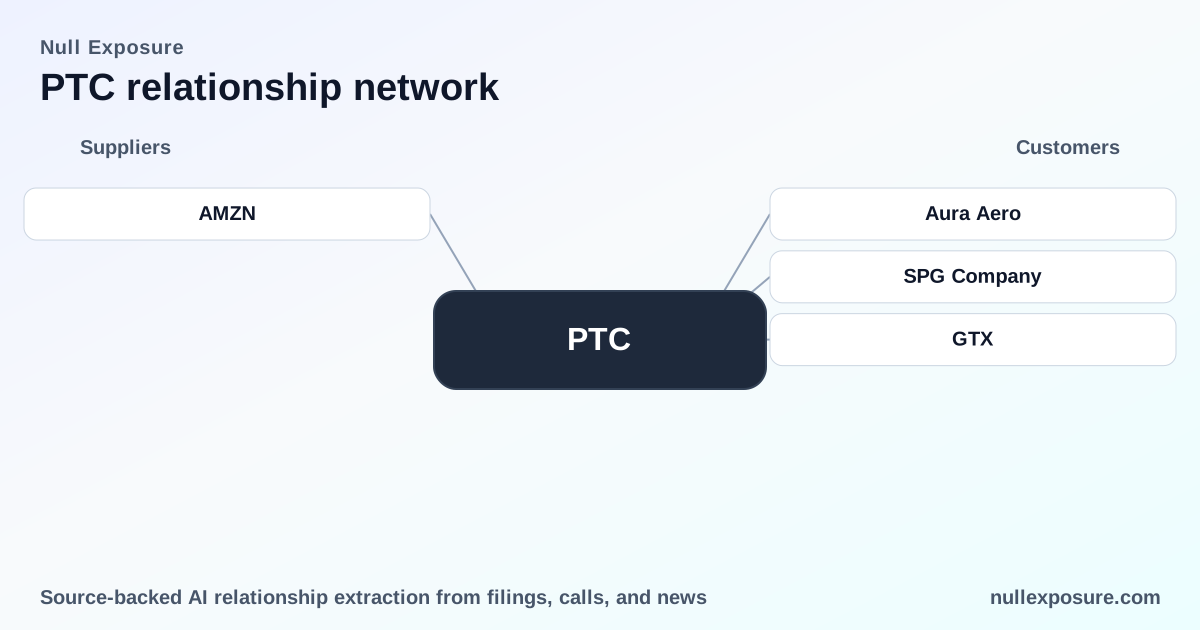
- PTC — Amazon Web Services (AWS). The Onshape cloud-native platform is described as built on Amazon Web Services, enabling teams to work from the same always-up-to-date product definition and accelerating design-to-production workflows; this connection underscores AWS as the infrastructure backbone for Onshape. Source: Finviz news item referencing Onshape’s capability launch, published March 10, 2026.
- PTC — Amazon Web Services (AWS). A Sahm Capital write-up dated February 26, 2026, repeats that Onshape runs on AWS, highlighting cloud-native model-based definition capabilities that reduce errors and speed design cycles — reinforcing AWS’s role as the primary infrastructure provider for that product. Source: Sahm Capital news article, February 26, 2026.
Both items point to the same operational reality: PTC leverages AWS for Onshape’s cloud delivery, concentrating a critical product’s infrastructure on a major hyperscaler.
How to read supplier concentration, criticality, and maturity for investors
PTC’s reliance on AWS for a cloud-native CAD product is consistent with a strategic decision to outsource infrastructure to a top-tier hyperscaler rather than managing a proprietary data-center footprint. From an investor lens:
- Concentration: Using AWS centralizes infrastructure risk with a single hyperscaler for Onshape, creating a concentration exposure that is mitigated by AWS’s scale and enterprise SLAs, but remains a single point of dependency for that product.
- Criticality: Onshape is strategically important as PTC’s cloud-native CAD offering and a key growth engine; therefore, the AWS relationship is operationally critical. Any material service degradation would affect ARR growth and customer satisfaction.
- Maturity: The partnership reflects a mature cloud strategy — adoption of a widely used enterprise cloud provider rather than boutique hosts — aligning with PTC’s large-enterprise risk posture and global footprint.
Investors should weigh these factors against PTC’s healthy margins and recurring revenue base: concentration elevates operational risk but offsets through a stable commercial relationship with a top-tier cloud provider.
Operational and commercial risk checklist for PTC’s supplier posture
- Supplier concentration: High for Onshape, given AWS is called out as the platform.
- Contracting posture: Long-term commitments elsewhere (e.g., real estate) suggest PTC prefers durable agreements with predictable economics.
- Counterparty quality: Large financial institutions and enterprise vendors, consistent with hedging and cloud vendor selection.
- Geographic reach: Global, requiring multi-region cloud coverage and currency management.
These items matter when modeling downside scenarios: assume service-level disruption, contract repricing, or regional outages would impose near-term customer churn and incremental cost to remediate, with recovery dependent on SLA credits and migration complexity.
Final read for investors and operators
PTC runs a pragmatic supplier strategy: outsourced cloud infrastructure on AWS for its cloud-native product, combined with long-term commercial commitments and institutional counterparties, positions the company for scalable delivery but creates a concentrated dependency for Onshape. For investors, that translates into a clear trade-off — operational leverage and faster feature rollouts versus supplier concentration risk.
If you want deeper supplier maps and exposure scoring for PTC or comparable software suppliers, review our platform for business-ready supplier intelligence. Get detailed supplier exposure analysis at Null Exposure. https://nullexposure.com/
Action items: track AWS service-level changes impacting Onshape, monitor PTC’s contract disclosures for explicit cloud agreements, and incorporate supplier concentration into ARR sensitivity analyses.