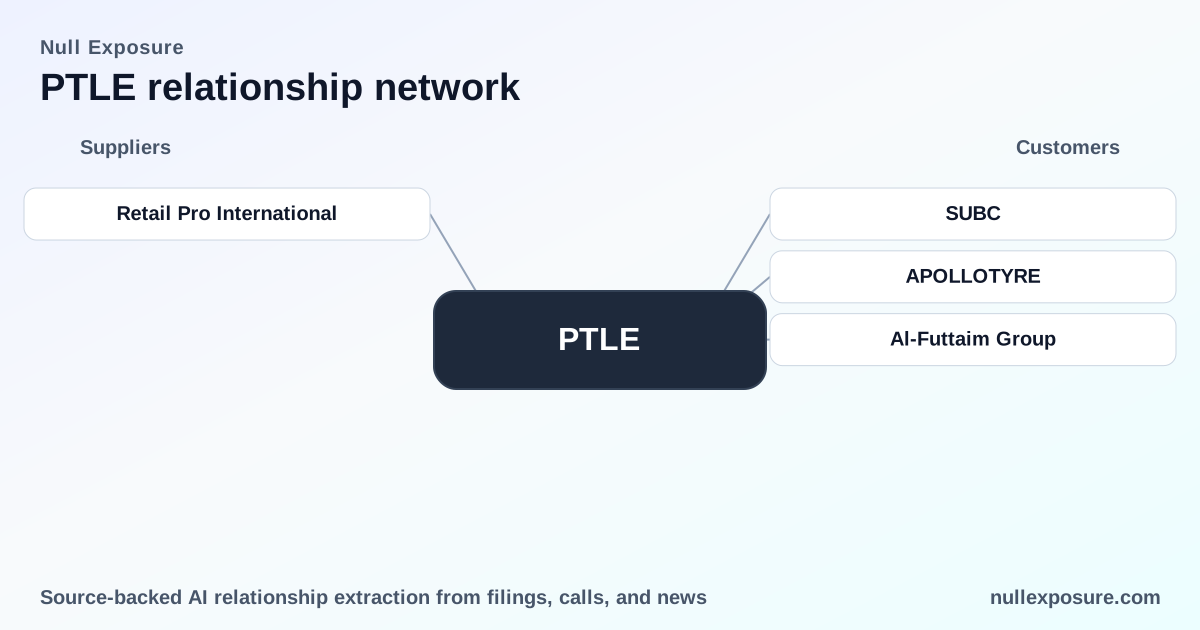
PTL LTD (PTLE) — supplier relationships, strategy, and implications for investors
PTL LTD monetizes a multi-vertical operating model that sells technology, renewable-energy components, and consumer goods through brand partnerships and regional distributors; revenue comes from product sales and channel agreements while the company invests in market expansion to drive top-line growth. PTLE is a small-cap, revenue-generating but loss-making issuer (Revenue TTM $91.4M; Diluted EPS TTM -8.72; Market Cap ~$44.5M), and its supplier and partner relationships are pivotal to distribution rollouts and regional penetration.
Explore more supplier intel at https://nullexposure.com/ before you conclude underwriting or vendor selection.
How PTLE’s supplier posture translates to earnings
PTLE operates as a distribution- and partnership-led commercial engine rather than a pure manufacturing integrator. The firm leverages brand partners and channel suppliers to enter geographies and verticals, which keeps fixed capital intensity lower but increases dependency on third-party route-to-market capabilities. Company-reported trailing figures through 2025-09-30 show positive operating margin (4.07%) but a negative net profit margin (-4.47%), indicating operating-level revenue coverage but net losses driven by non-operating items or scale-dependent costs. The balance between those two margins is the structural risk vector for supplier contracts: PTLE needs reliable partner flows to close the gap between operating cash generation and net profitability.
Key business-model drivers:
- Channel partnerships to access new regions without full local infrastructure build-out.
- Low institutional ownership (7.3%) and small public float that make supplier disruptions and contract news material to the trading profile.
- High price-to-book (5.28) relative to a modest market cap, indicating investor expectations priced into the equity despite current losses.
What the supplier footprint looks like and what it signals
PTLE’s public information lists at least one named partner in the supplier results, and company-level signals fill out the rest of the portrait. With no constraint statements reported, treat the following as company-level characteristics rather than relationship-specific clauses:
- Contracting posture: Partnership-driven, with emphasis on brand alliances that provide market access rather than full upstream integration. This reduces capex but elevates commercial dependency.
- Concentration: Small market capitalization and limited institutional ownership concentrate risk among a thin liquidity base; loss of a major brand partner would have outsized operational and market-effect consequences.
- Criticality: Supplier relationships are operationally critical because PTLE executes market rollouts through partners; partner performance therefore directly affects revenue realization and margin conversion.
- Maturity: Mixed-stage company — generating meaningful revenue but not yet delivering positive EPS; this indicates a growth-aggregation phase rather than a mature, self-sustaining supplier network.
These signals are company-level and should be used to evaluate the robustness of specific supplier agreements during diligence calls.
Relationship: Retail Pro International — regional market entry partner
PTLE’s publicly reported supplier relationship list includes Retail Pro International. In plain terms: Retail Pro International served as a brand partner that enabled PTLE (through Philip Toledo) to expand product distribution into the Middle East, leveraging Retail Pro’s brand channels to create a market for PTLE’s offerings. This linkage was documented in a Times of Malta article reporting on the Middle East expansion (Times of Malta, March 10, 2026: https://timesofmalta.com/article/Philip-Toledo-goes-multinational-expands-into-the-Middle-East.362601).
This partnership is a classic example of PTLE’s model: using an established brand to access a new market without building full local sales infrastructure.
Why the Retail Pro relationship matters for operators and investors
Operationally, the Retail Pro tie demonstrates PTLE’s go-to-market playbook: brand partnerships accelerate geographic expansion while ceding distribution control, which improves speed-to-market at the expense of margin control and supplier dependency. For operators, that means procurement and supply-chain teams will need clear performance indicators in contracts (shipment SLAs, returns handling, co-marketing commitments). For investors, the Retail Pro example underscores that revenue growth is directionally linked to the success and durability of these external alliances.
Financially relevant facts from company reporting:
- Revenue TTM $91.4M — shows commercial scale but not yet profitable net income.
- Shares outstanding ~6.14M with a small float — governance and liquidity dynamics amplify the market reaction to partner announcements or terminations.
Explore supplier risk scoring and partner concentration analysis at https://nullexposure.com/ for a quick health-check before committing capital.
Material risks and operational red flags
Highlighting what matters most for underwriting or strategic sourcing:
- Concentration risk: A thin investor base and small float increase the market impact of any supplier news; operators should demand contractual remedies for partner nonperformance.
- Profitability gap: Operating margin is positive while net margin is negative, so non-operating costs, financing, or exceptional charges are eroding the bottom line — a structural issue that amplifies the impact of supplier cost inflation or lost volume.
- Governance and disclosure: Limited public analyst coverage and sparse institutional ownership reduce the flow of independent third-party diligence; counterparty diligence must therefore move on primary contractual and on-site verification.
Practical takeaways for relationship diligence teams
- Negotiate performance milestones and recourse into distribution contracts to protect revenue recognition and cash flow.
- Prioritize partners that can demonstrate repeatable regional fulfillment and inventory management rather than single-event market entries.
- Monitor KPIs tied to partner performance (order fill rate, days to market, return rates) and link them to commercial triggers in supplier agreements.
Bottom line and recommended next steps
PTLE’s supplier strategy is growth-oriented and partner-dependent: the firm deliberately leverages brand alliances like Retail Pro International to enter markets quickly while keeping capital intensity low. That strategy drives revenue growth opportunities but introduces concentration and partner-performance risk that directly affect profitability and liquidity. For investors and procurement teams, the key decision is whether contractual protections and partner diversity are adequate to convert incremental revenue into sustainable earnings.
For a structured supplier risk assessment and a tailored report on PTLE’s partner map, visit https://nullexposure.com/ and request the PTLE supplier dossier.
For immediate action: prioritize contract-level protections, verify partner distribution performance in target geographies, and model sensitivity of PTLE’s margins to partner churn before adding exposure. More detailed supplier analytics are available at https://nullexposure.com/.