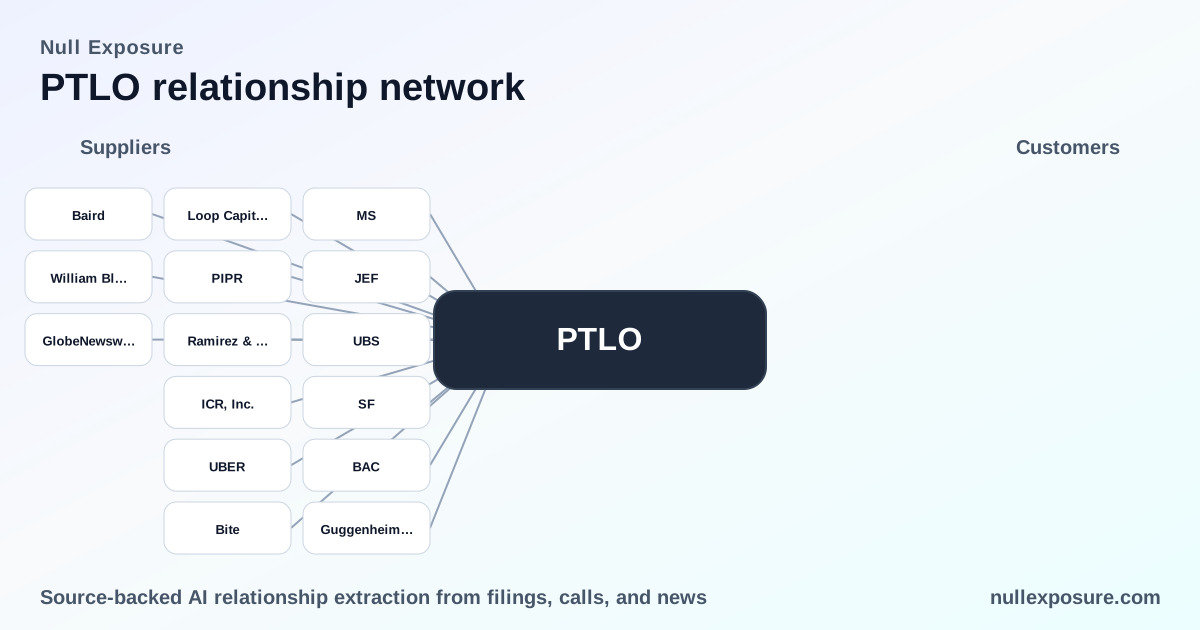
Portillo’s (PTLO) supplier map: who moves product, money and messaging
Portillo’s operates and monetizes a vertically integrated quick-service restaurant chain: it owns and operates restaurants, runs two commissaries that produce signature products, sells through company-controlled channels and third‑party marketplaces, and generates revenue from restaurant sales and company-controlled delivery (recognized on a gross basis). Revenue run‑rate sits near $732 million with EBITDA around $80.6 million and a tax receivable agreement (TRA) liability that drives meaningful long‑term cash obligations. For investors and operators evaluating supplier relationships, the commercial picture is a mix of captive manufacturing, distributed logistics partners, and a broad set of investment banks and communications firms that supported the company’s public offering and ongoing PR cadence. Visit the NullExposure homepage for consolidated supplier intelligence: https://nullexposure.com/.
Why suppliers matter for Portillo’s value chain
Portillo’s is not a simple franchise roll-up. The company controls critical inputs through two commissaries to guarantee product consistency, and routes distribution through independently operated foodservice partners under the UniPro umbrella, creating dependence on third‑party logistics and foodservice wholesalers for nationwide availability. Delivery is a hybrid: Portillo’s operates its own Dispatch delivery channel (recognized gross) while also using marketplace partners for incremental reach. These structural choices produce concentrated, material counterparty exposure—both operationally and financially—so supplier relationships are strategic rather than incidental.
Explore deeper supplier intelligence on the NullExposure homepage: https://nullexposure.com/.
The relationships that shape operations and market access
Below I list every relationship flagged in available reporting and provide a plain‑English summary with source attribution.
Morgan Stanley
Morgan Stanley served as one of the lead joint book‑running managers on Portillo’s IPO process, positioning the bank as a principal underwriter in the offering syndicate. This participation is described in QSR Magazine’s coverage of the proposed IPO (FY2021).
Jefferies
Jefferies acted as a lead joint book‑running manager for Portillo’s proposed offering alongside other major underwriters, giving it an underwriting and distribution role in the company’s capital markets transaction (reported by QSR Magazine, FY2021).
BofA Securities
BofA Securities was named as a lead joint book‑running manager and representative on the proposed offering, tying Portillo’s to a top‑tier investment banking syndicate (QSR Magazine, FY2021).
Piper Sandler
Piper Sandler participated as a lead joint book‑running manager for the proposed IPO, supporting syndicate distribution and pricing functions in the offering (QSR Magazine, FY2021).
UBS Investment Bank
UBS Investment Bank was listed among lead book‑running managers for the proposed offering, broadening institutional placement capability for Portillo’s IPO (QSR Magazine, FY2021).
Baird
Baird was named as a lead book‑running manager in the offering group, supporting mid‑market distribution and investor outreach during the IPO process (QSR Magazine, FY2021).
William Blair
William Blair joined the lead book‑running managers for the proposed offering, contributing to institutional sales and advisory execution around the IPO (QSR Magazine, FY2021).
Guggenheim Securities
Guggenheim Securities acted as a co‑manager for the proposed offering, participating in syndicate co‑management responsibilities during the IPO (QSR Magazine, FY2021).
Stifel
Stifel was named a co‑manager on the proposed offering, providing support for placement and sell‑side execution (QSR Magazine, FY2021).
Loop Capital Markets
Loop Capital Markets served as a co‑manager in the proposed offering, contributing to distribution across its investor networks (QSR Magazine, FY2021).
Ramirez & Co., Inc.
Ramirez & Co. participated as a co‑manager for the proposed offering, supporting syndicate efforts to distribute shares to institutional and regional investors (QSR Magazine, FY2021).
Piper Sandler (duplicate mention)
Piper Sandler appears again in IPO coverage as a lead joint book‑running manager; its repeated listing underscores a sustained role in Portillo’s capital markets activity (QSR Magazine, FY2021).
ICR, Inc.
ICR, Inc. is listed as Portillo’s media contact in multiple press releases, indicating an active retained relationship for investor and public relations services (press releases via Sahm Capital / Portillo’s corporate communications, FY2025–FY2026).
GlobeNewswire
GlobeNewswire is the distribution vehicle Portillo’s used to publish corporate press releases, including promotional and partnership announcements (Portillo’s releases distributed via GlobeNewswire, FY2025–FY2026).
Uber Eats
Portillo’s named Uber Eats as an exclusive delivery partner for certain promotional delivery orders, using Uber Eats’ marketplace for reach and promotional exclusivity in targeted campaigns (coverage via FinancialContent/WRAL, Dec 2025).
Bite
Portillo’s piloted self‑serve kiosks designed with Bite in select restaurants, indicating a vendor relationship for in‑store ordering hardware and UX integration (Provisioner Online, FY2024).
Operating constraints and what they imply for suppliers and investors
- Long‑term financial obligations are contractually significant. Portillo’s TRA requires payments equal to 85% of certain tax benefits, with company disclosures estimating total future payments of approximately $324.6 million as of December 29, 2024—payments scheduled primarily over the next 15 years and declining thereafter. This is a company‑level cash commitment that constrains free cash flow available to invest in expansion or supplier diversification.
- Distribution is regional but national in reach. The company’s main line distribution runs through independently operated partners aligned under UniPro, signaling reliance on third‑party wholesalers for national supply fulfillment.
- Materiality of supplier commitments. Portillo’s identifies material cash requirements beyond twelve months—debt, lease obligations and TRA liabilities—meaning certain supplier contracts and capital plans must be calibrated to limited near‑term free cash flow.
- Company controls manufacturing for core SKUs. Operating two commissaries makes Portillo’s both a manufacturer of signature inputs and a purchaser of broader supply‑chain goods; suppliers supporting commissary operations are strategically important.
- Delivery is a hybrid model. Portillo’s recognizes Dispatch Sales on a gross basis and uses third‑party marketplace partners for incremental reach—this creates operational integration with logistics and technology vendors for both owned and partner delivery channels.
- Spend scale signals: large future cash outflow. The TRA total positions Portillo’s in a >$100 million future spend band on tax obligations alone, which is a company‑level signal about overall financing headroom.
These constraints form the backdrop against which supplier negotiations, service levels, and credit terms will be evaluated by investors and operators.
Risks, opportunities and practical takeaways
- Risk — concentrated obligations: The TRA and fixed lease/debt schedule compress balance sheet flexibility and increase the importance of reliable suppliers and predictable operating margins.
- Opportunity — operational control through commissaries: Owning production for signature items protects brand quality and supports margin capture if commissary scale increases.
- Operational priority — delivery and distribution partnerships: Relationships with platforms such as Uber Eats and hardware/service vendors like Bite are tactical levers to expand reach without equivalent capex.
If you are assessing counterparty risk, focus on the commissary suppliers, UniPro distribution partners, and delivery/tech vendors whose service continuity would materially affect sales and margins.
For structured supplier intelligence and ongoing monitoring of Portillo’s commercial counterparties, visit the NullExposure homepage: https://nullexposure.com/.
Conclusion — what investors and operators should do next
Portillo’s combines controlled manufacturing with outsourced distribution and public‑markets financing relationships that influence liquidity and strategy. Prioritize due diligence on commissary supply continuity, distribution contract terms with UniPro‑aligned partners, and delivery partner economics. For a consolidated view of these relationships and proactive alerts for changes, return to the NullExposure homepage and subscribe for updates: https://nullexposure.com/.