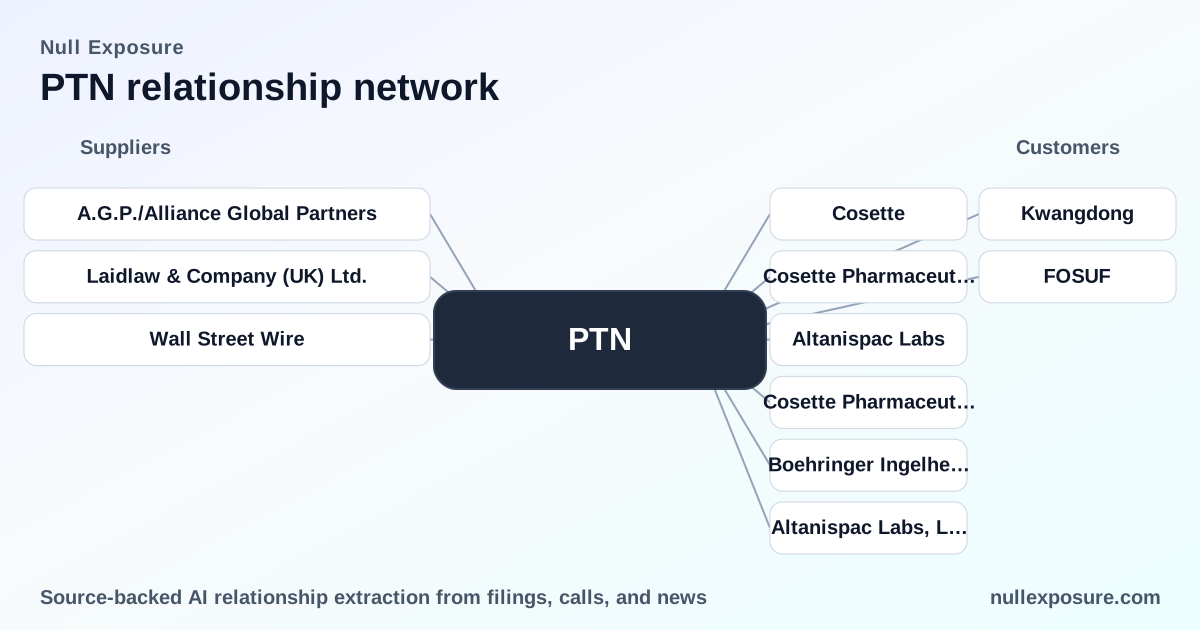
Palatin Technologies (PTN): Supplier relationships that shape a capital- and clinic-driven small‑cap biotech
Palatin Technologies is a clinical‑stage specialty biopharmaceutical company that develops receptor‑targeted peptide therapies and funds operations through a combination of licensing, partnered development and direct public capital raises. The company monetizes by advancing clinical candidates to value‑creating inflection points and by accessing capital markets and paid awareness channels to fund trials and commercial planning. This supplier map shows a financing and services posture as important as manufacturing, and it changes how investors should evaluate operational and execution risk. For a concise supplier risk brief and ongoing alerts, visit https://nullexposure.com/.
How suppliers reflect Palatin’s operating model
Palatin operates with a typical small‑biotech contracting posture: core development work is outsourced, regulatory and audit services are provided by established firms, and capital markets intermediaries are engaged to supply liquidity. The constraints in regulatory and supplier excerpts point to four actionable characteristics:
- Critical clinical supply dependence. The company’s filings highlight that a failure by a manufacturer to meet FDA GMP or QSR standards would force alternative sourcing and could interrupt development timelines—this is a company‑level signal of operational criticality.
- Outsourced development and service reliance. Palatin explicitly uses third‑party contractors for R&D, manufacturing, clinical management and regulatory strategy; this produces execution leverage but increases vendor management risk.
- Moderate vendor spend concentration. Audit and tax fees indicate supplier spend in the $100k–$1M band for key professional services (audit fees of $670k in FY2025 and $504k in FY2024; tax fees ~$62.7k in FY2025), suggesting a mix of strategic but not blockbuster outsourcing relationships that are material but controllable.
- Use of established external partners. Constraints explicitly name Lonza as a contract manufacturer and KPMG as the independent auditor, signaling mature, institutional supplier choices rather than early‑stage boutique providers.
These signals combine to show a company that is operationally lean—highly dependent on a few trusted vendors for compliance and manufacturing—while substituting capital‑market engagement and paid media to manage funding and awareness.
Who’s in Palatin’s vendor mix — the relationships investors should track
A.G.P./Alliance Global Partners — the book‑running underwriter
A.G.P. acted as sole book‑running manager for Palatin’s upsized $15.8 million public offering, a clear indication that Palatin uses institutional underwriters to execute equity raises and broaden market access. According to a PR Newswire release announcing the offering (March 2026), A.G.P. was the lead manager on the deal. Key takeaway: underwriter selection directly affects cost of capital and investor reach. Source: PR Newswire, March 2026.
Laidlaw & Company (UK) Ltd. — lead manager on the offering
Laidlaw & Company (UK) Ltd. served as lead manager alongside A.G.P. for the same upsized public offering, showing Palatin’s willingness to combine U.S. and international boutique managers to syndicate capital. The PR Newswire announcement for the transaction lists Laidlaw as lead manager (March 2026). Key takeaway: multi‑manager syndication broadens distribution but dilutes single‑desk control of pricing. Source: PR Newswire, March 2026.
Wall Street Wire — paid coverage and awareness services
Palatin compensates Wall Street Wire for coverage and awareness services under an ongoing subscription arrangement, which is disclosed in investor‑directed media. A TradingView-hosted Wall Street Wire piece notes that Wall Street Wire receives cash compensation from Palatin on a subscription basis (March 2026). Key takeaway: paid media is part of the company’s capital‑access and investor‑relations playbook. Source: TradingView copy of Wall Street Wire coverage, March 2026.
What these relationships imply for investors and operators
Palatin’s supplier relationships reveal a two‑pronged operating model: outsourced execution for clinical and compliance functions, and active capital‑market engagement for funding and visibility. That structure carries definable strengths and risks:
- Strengths: engaging reputable manufacturers and auditors (Lonza, KPMG noted in company excerpts) indicates process maturity and regulatory seriousness; underwriter and lead manager relationships enable rapid capital access.
- Risks: manufacturing noncompliance or disruption is explicitly material to program timelines, and reliance on paid media increases sensitivity to perception and disclosure timing. The company’s spend profile (audit fees ranging from ~$504k to $670k across recent years) suggests these partners are material to operations but not so large as to be untouchable; transition is possible but costly.
Investors should treat supplier events—audit changes, manufacturing inspection findings, or shifts in underwriter participation—as catalysts that can materially affect valuation and time to key clinical milestones.
How to monitor these relationships effectively
- Watch regulatory filings and press releases for any changes to manufacturing arrangements or auditor status; manufacturing and audit provider changes are high‑value signals.
- Track capital markets activity: follow underwriter and manager appointments when the company raises equity, since manager quality and syndicate depth affect pricing and execution.
- Monitor compensated media coverage and disclosure language around it; paid coverage introduces disclosure and perception dynamics that impact retail and institutional demand.
If you need structured alerts on supplier changes and their likely financial impact, see Palatin’s supplier map and alerts at https://nullexposure.com/.
Final investment posture and recommended actions
Palatin is a clinical‑stage, capital‑intensive biotech that runs a lean internal operation while outsourcing critical functions and using the capital markets to fund execution. The supplier list—underwriters for financing and paid media for awareness—signals a company that prioritizes access to finance and investor engagement as highly as technical execution. Investors should incorporate supplier continuity and underwriter syndicate strength into valuation models and scenario analyses. For investors tracking multiple small‑cap supplier risk vectors, NullExposure provides consolidated supplier risk views and alerts — review the Palatin supplier brief at https://nullexposure.com/ for ongoing intelligence.
Bold takeaway: supplier continuity (manufacturing and audit) and capital‑market partnerships are primary drivers of execution risk and near‑term valuation for PTN.