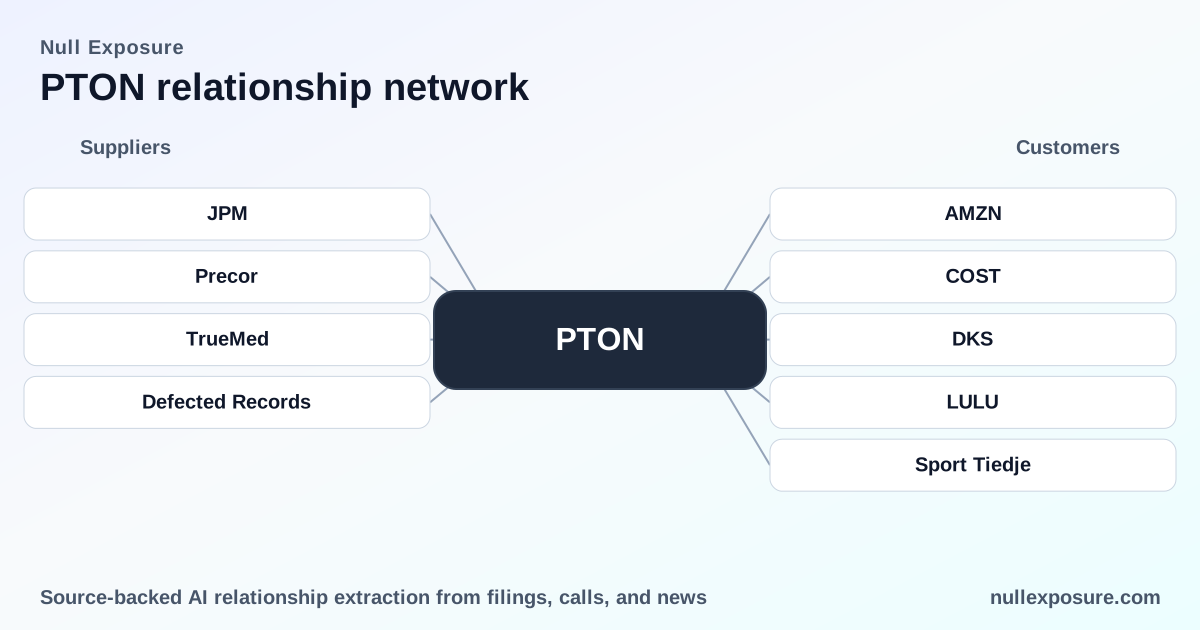
Peloton’s supplier footprint: what investors need to know about PTON’s third‑party dependencies
Peloton Interactive sells connected fitness equipment and a recurring subscription service; it monetizes through hardware sales, subscription content, and ancillary services (installation, maintenance, and corporate/healthcare programs). For investors, supplier relationships matter because Peloton outsources manufacturing, logistics, cloud hosting, music licensing, and increasingly financing and channel partnerships — each relationship feeds revenue growth opportunities or operational fragility depending on contract terms and concentration.
Explore supplier exposures and counterparty posture in depth, or run a focused supplier diligence on Peloton at https://nullexposure.com/.
How Peloton’s operating model forces supplier reliance
Peloton’s economics combine one‑time hardware revenue with high‑margin recurring subscription revenue; the company reported roughly $2.44 billion in trailing revenue and $1.26 billion in gross profit, which underpins a hybrid capital and working‑capital intensity. That structure creates two supplier pressures:
- Product supply and manufacturing are directly tied to unit throughput and refurbishment programs — Peloton uses third‑party contract manufacturers for core finished goods and components, supported by commitments (roughly $96.1 million of contract manufacturer and component commitments as of June 30, 2025).
- Service and content supply (music licensing, cloud hosting, streaming infrastructure, and logistics/last‑mile) are mission‑critical for the subscription experience and retention.
Peloton’s outsourcing posture gives the company operational flexibility but also concentrates risk in a handful of external providers and regions. For a deeper look at supplier risk signals and contractual footprints, see https://nullexposure.com/.
Who’s on Peloton’s supplier list (what the news shows)
Below are the supplier and partner relationships surfaced in recent reporting and industry coverage, with a concise description and source note for each.
JPMorgan Chase & Co.
Peloton hired JPMorgan Chase to manage an $850 million loan sale intended to refinance existing debt, indicating an active financing relationship that affects capital structure and lender appetite. This was reported in March 2026 via ConnectTheWatts citing Bloomberg coverage. (ConnectTheWatts, March 2026)
Precor
Peloton is partnering with Precor for installation and maintenance support of Peloton‑branded equipment in gym environments, and Precor staff are testing new go‑to‑market models to bring Peloton into commercial gyms. This collaboration expands Peloton’s channel and service footprint into commercial fitness. (SGB Online, March 2026)
TrueMed
Peloton has a partnership with TrueMed, a healthcare reimbursement facilitator, to enable HSA/FSA reimbursement for Peloton purchases — a direct play on affordability and corporate/healthcare distribution channels. (ConnectTheWatts guide, March 2026)
Defected Records
Peloton announced a branded content partnership with Defected Records that includes live DJ rides and curated music for members, supporting content differentiation and engagement in Peloton’s subscription offering. (ConnectTheWatts guide, March 2026)
Operational constraints and how they shape supplier risk
Company filings and disclosures present concrete constraints that define supplier negotiation dynamics and operational vulnerability.
-
Licensing posture and renewal frequency: Peloton’s music licenses are typically one to three years in term and Peloton recognizes music royalty fees under those license agreements; this indicates short‑term flexibility but recurring renewal risk where music rights directly influence member experience and content cost. (Peloton filing through FY2025 disclosures, year ended June 30, 2025)
-
Material and measurable music obligations: The company disclosed future minimum music license payments of $93.2 million (total) with $91.1 million due in the 2026 fiscal year — this is material to operating cash flow and content continuity. (Peloton filing, June 30, 2025)
-
Manufacturing concentration and spend band: Peloton relies primarily on contract manufacturers and reported ~$96.1 million in commitments to third‑party manufacturers and component purchases as of June 30, 2025; this places contract manufacturing spend squarely in the $10M–$100M band and creates supplier leverage points for lead times and cost variability. (Peloton filing, FY2025)
-
Global operations and APAC manufacturing exposure: Peloton’s contract manufacturing includes facilities in Taiwan and it operates a global logistics and service network spanning the United States, UK, Canada, Germany, and Australia, meaning currency, geopolitical, and logistics disruptions in APAC and EMEA have direct operational impacts. (Peloton filing disclosures)
-
Critical external dependencies: Peloton outsources cloud infrastructure, streaming, and last‑mile distribution to third parties, which makes these vendors critical to subscriber experience and retention; any interruption in hosting or logistics would be immediately visible in churn and service metrics. (Peloton filing, FY2025)
These constraints tell an investment story: Peloton trades off capital intensity and fixed commitments for speed and scale through contracts that are short enough to allow strategic pivoting but large enough to create concentrated vendor risk. For a full risk map, visit https://nullexposure.com/.
What that means for investors and operators
- Negotiating leverage is mixed. Short license durations give Peloton the ability to renegotiate content terms quickly, but the scale of near‑term license commitments and manufacturing purchase commitments reduces flexibility in the immediate term.
- Liquidity and financing are active levers. Engaging JPMorgan for an $850M loan sale is a clear sign management is using external finance to reshape capital structure and preserve operational runway; lenders and underwriters are therefore important counterparties for near‑term solvency. (Bloomberg coverage cited via ConnectTheWatts, March 2026)
- Operational continuity is the single largest counterparty risk. Cloud hosting providers, 3PLs, and contract manufacturers are operationally critical; a disruption in any of these functions would be visible in shipping, subscription quality, and customer support metrics.
Bottom line: focus diligence on contracts, renewal timing, and geography
Peloton’s supplier base is operationally deep but financially concentrated: material, short‑term license obligations for content, mid‑range manufacturing commitments, and global logistics dependence. Investors should prioritize reviewing license renewal schedules, manufacturing lead times and penalties, and the status of any financing arrangements tied to JPMorgan. Operators should map single points of failure in hosting and last‑mile logistics and ensure contingency plans for APAC manufacturing disruptions.
If you need a structured supplier risk report or a counterparty exposure dashboard for Peloton, start your vendor diligence at https://nullexposure.com/.
For hands‑on investor tooling and focused supplier transparency on Peloton and its counterparties, visit https://nullexposure.com/ and request the Peloton supplier pack.