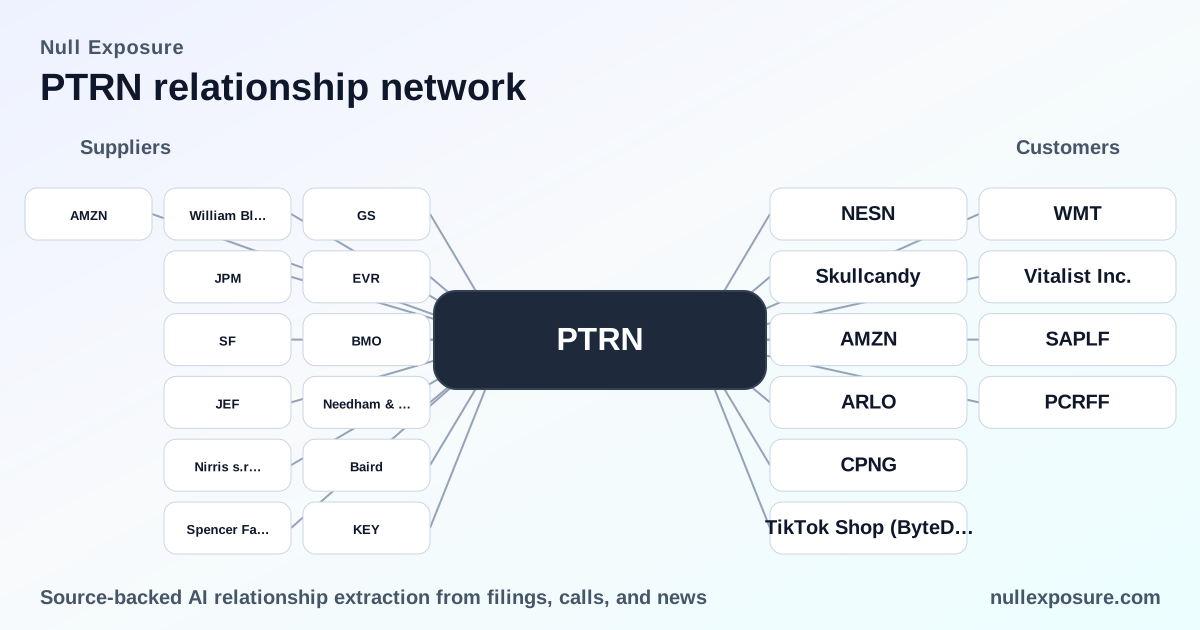
Pattern Group (PTRN) — supply relationships that shape an e‑commerce marketplace operator
Pattern Group operates and monetizes as a merchant and marketplace operator: it sources consumer goods, lists and sells inventory across third‑party marketplaces (primarily Amazon), and captures margin through merchandising, pricing and fulfillment choices while also running its own direct channels. Revenue comes from product sales on marketplaces plus gross margin uplift from fulfillment and proprietary pricing tools, and the company has leaned on capital markets and legal advisors to support a rapid growth and M&A cadence around its FY2025–FY2026 IPO and acquisition activity. For investors evaluating supplier and partner risk, the critically relevant facts are concentration of distribution through marketplaces, a recent shift to public‑market financing, and a roster of top‑tier advisors that underwrite and legal‑advise strategic transactions.
Read more company and relationship intelligence at Null Exposure.
Why the partner roster matters for operators and investors
Pattern’s commercial model is simple in concept and nuanced in execution: it sources inventory (notably heavy in health & wellness based on filings), lists at scale across marketplaces, and trades margin for placement and speed through either marketplace fulfillment or its own fulfillment partners. That operating posture makes certain supplier and service relationships effectively critical: marketplace platforms, logistics and fulfillment partners, capital markets underwriters for liquidity and signaling, and legal advisers for M&A. The roster of advisors observed around the IPO and an acquisition closing signals a company moving from private, founder‑led execution to institutionalized governance and external accountability.
If you want ongoing tracking of these supplier relationships, visit Null Exposure for regular updates.
Key relationships observed and what they imply
Below are every partner and advisor mentioned in the source materials and the plain‑English implication for investors and operators.
-
Goldman Sachs & Co. LLC — Pattern retained Goldman Sachs as a lead book‑running manager for its IPO process, underlining the company’s access to top‑tier capital‑markets distribution for equity liquidity and institutional placement. According to a TradingCalendar IPO preview and subsequent press announcements, Goldman acted as a primary underwriter around the FY2025 offering (TradingCalendar, March 2026; Thailand Business News press release, March 2026).
-
J.P. Morgan — J.P. Morgan served alongside Goldman as a lead book‑running manager for the offering, providing complementary institutional sales coverage and syndicate reach for the IPO allocation (Thailand Business News, March 2026).
-
Evercore ISI — Evercore ISI was named as a joint book‑running manager in the IPO syndicate, indicating strategic advisory depth on investor outreach and pricing decisions during the FY2025 offering (TradingCalendar and Thailand Business News, March 2026).
-
Jefferies — Jefferies acted as a joint book‑running manager, contributing middle‑market sales distribution for the IPO syndicate and reinforcing capital markets execution capacity (TradingCalendar and Thailand Business News, March 2026).
-
William Blair — William Blair was listed as an additional book‑running manager, supporting syndicate coverage and institutional placement for the IPO (TradingCalendar; Thailand Business News, March 2026).
-
Stifel — Stifel participated as an additional book‑running manager, expanding the syndicate’s retail and institutional reach for the offering (TradingCalendar; Thailand Business News, March 2026).
-
BMO Capital Markets — BMO Capital Markets acted as an additional book‑running manager, adding further distribution channels for the IPO execution (TradingCalendar; Thailand Business News, March 2026).
-
KeyBanc Capital Markets — KeyBanc was part of the additional book‑running group, providing coverage breadth and institutional relationships in the syndicate (TradingCalendar; Thailand Business News, March 2026).
-
Needham & Company — Needham participated as an additional book‑running manager, offering specialized investor relationships for growth‑oriented retail and institutional buyers (TradingCalendar; Thailand Business News, March 2026).
-
Baird — Baird rounded out the syndicate as an additional book‑running manager, supplying regional and institutional distribution capabilities for the IPO (TradingCalendar; Thailand Business News, March 2026).
-
Nirris s.r.o. — Nirris acted as legal advisor to Pattern on the acquisition of ROI Hunter A/S, showing Pattern uses external counsel with European practice to support cross‑border M&A (MarketScreener coverage of the acquisition closing, March 2026).
-
Spencer Fane LLP — Spencer Fane LLP served as legal counsel to Pattern Group for the same acquisition, demonstrating use of U.S. legal firms for transactional governance and closing work (MarketScreener, March 2026).
-
Amazon — Amazon is referenced as a dominant marketplace channel where Pattern sells inventory and where Pattern will either leverage Amazon’s fulfillment or opt to self‑fulfill when marketplace economics demand it; filings and an earnings transcript explicitly state Pattern sells primarily on marketplaces and will fulfill via Amazon where competitive, or substitute its own fulfillment when necessary (The Globe and Mail transcript and SahmCapital summary citing IPO filings, FY2025–FY2026).
Operating model signals and contracting posture
Pattern’s partner roster and corporate metrics create a coherent set of business‑model signals for risk and opportunity analysis:
-
Concentration and go‑to‑market dependency. Public disclosures and press coverage note that the vast majority of revenue flows through third‑party marketplaces, principally Amazon. This distribution concentration raises platform dependency risk and makes marketplace contract terms, fulfillment economics and repricing dynamics strategically critical.
-
Capital markets institutionalization. The presence of Goldman, J.P. Morgan, Evercore, Jefferies and a broad syndicate signals a deliberate shift to institutional governance and market liquidity. That underwriting depth improves access to capital while also increasing external scrutiny on execution metrics and disclosure.
-
M&A and legal maturity. Engagement of both international and U.S. legal advisors (Nirris and Spencer Fane) for the ROI Hunter acquisition demonstrates a hybrid approach to inorganic growth — local counsel where needed, U.S. transactional counsel for structuring and compliance.
-
Operational flexibility in fulfillment. Management commentary specifies willingness to use marketplace fulfillment when economics are favorable and to self‑fulfill otherwise, indicating a modular logistics posture that can control margin but requires reliable 3PL or internal capability.
-
Financial profile consistent with growth stage. FY2025 figures show significant revenue scale (RevenueTTM $2.5B) and positive gross profit, but negative diluted EPS and elevated insider ownership, signaling founder and early investor stake concentration alongside a growth‑at‑scale profile.
Investment implications and risk checklist
- Opportunity: Pattern commands scale across marketplaces with a playbook to control margin through fulfillment and sourcing; institutional underwriters enhance capital access for expansion and M&A.
- Risk: Platform concentration (Amazon) is a single‑point strategic risk for distribution and pricing power; earnings remain loss‑making on a per‑share basis while gross margins are positive, so execution and margin recovery are critical.
- Governance: The broad IPO syndicate and external legal counsel improve market credibility and reduce executional legal risk for cross‑border deals.
For a continuing feed of supplier and counterparty signals that matter to operators and investors, visit Null Exposure.
Final take: what to watch next
Monitor three vectors closely: marketplace economics (placement fees and Buy Box dynamics on Amazon), fulfillment cost trends and 3PL availability, and post‑IPO capital deployment (how underwriters and management use proceeds for M&A or buy‑and‑scale operations). Partnerships with top underwriters support liquidity and credibility, but platform concentration remains the principal commercial risk.
Gain ongoing visibility into PTRN’s supplier exposures and counsel relationships at Null Exposure.