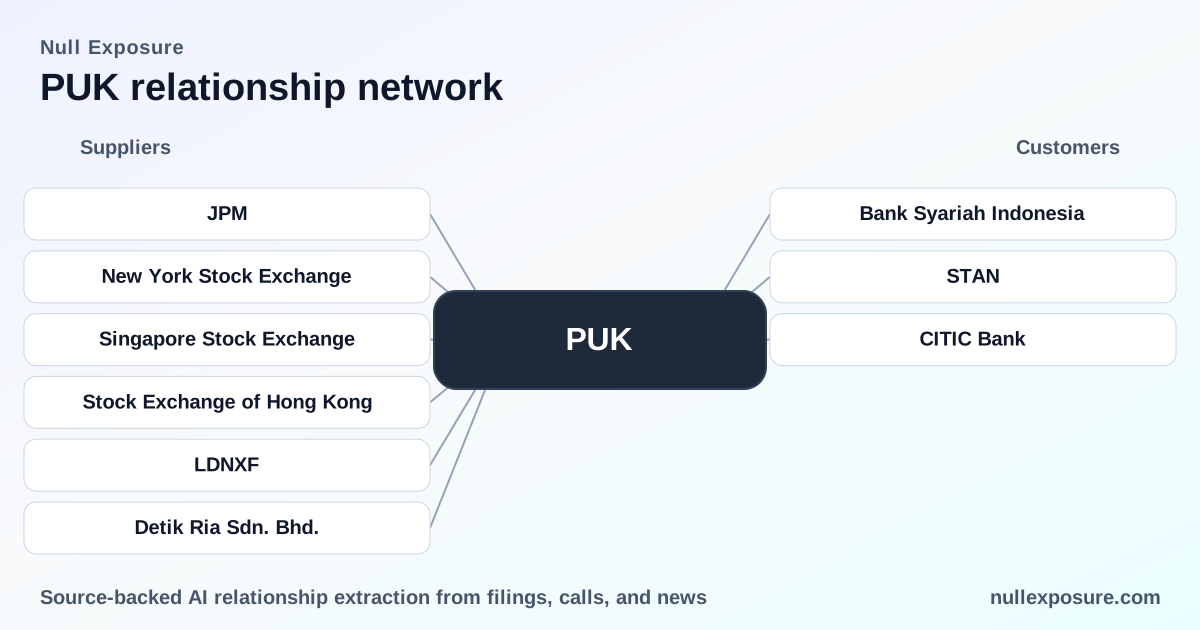
Prudential PLC (PUK): Supplier relationships and what they reveal about capital allocation and market access
Prudential plc operates as a multinational life and health insurer and asset manager, monetizing through premium income, investment spread and asset-management fees across Asia, the U.S. and Africa. The company’s capital-allocation profile is visible in its public counterparty activity: Prudential is executing active share buybacks via global broker-dealers while operating with multi-exchange listings that support liquidity and investor access. For a concise vendor-risk view and supplier mapping, visit the Nillexposure homepage: https://nullexposure.com/.
Market facts underline the operating thesis: Prudential reported trailing twelve‑month revenue of $13.342 billion and a profit margin of 25.9%, with a market capitalization around $36.97 billion (company data through mid‑2025). The business blends underwriting cashflow with sizeable investment income and periodic capital returns to shareholders; broker-dealers and public exchanges are consequential suppliers for execution and market access.
Broker-driven buybacks: capital returns routed through global dealers
Prudential’s most visible third‑party interactions in FY2026 are buyback executions routed through J.P. Morgan entities. Filing disclosures and market reports show repeated repurchases executed by J.P. Morgan, with explicit share counts and prices disclosed in public filings. These flows illustrate a contractual posture oriented around standard broker relationships for share repurchase execution rather than bespoke, long‑term supplier dependency.
- J.P. Morgan/JP Morgan Securities (multiple name variants)
- Prudential repurchased blocks of ordinary shares executed via J.P. Morgan entities across January and February FY2026, with specific transactions cited — for example, 263,713 shares on Jan. 27 paid between £11.775 and £11.970 per share, and other repurchases at similar prices and sizes. Reports and filings identify J.P. Morgan as the execution agent for the company’s announced buyback program (see filings and coverage on TS2 and Sharecast in Feb–Mar 2026: https://ts2.tech/en/prudential-plc-share-price-rises-on-buyback-update-as-investors-look-to-march-results/ and https://www.sharecast.com/amp/news/Transaction-in-Own-Shares/Transaction-in-Own-Shares--dl35671645.html).
- Prudential disclosed further repurchases executed via JP Morgan Securities on Feb. 10 (305,305 shares at an average £11.7651) and multiple late‑January tranches (300,151 shares at ~£12.05), reinforcing that J.P. Morgan is serving as the primary executing broker for the FY2026 repurchase program (transaction reports via TS2: https://ts2.tech/en/prudential-share-price-dips-after-fresh-buyback-disclosure-as-march-results-loom/ and https://ts2.tech/en/prudential-plc-share-price-malaysia-stake-deal-is-done-what-could-move-the-stock-next-week/).
Exchange listings: multi-market liquidity and investor reach
Prudential maintains a deliberately multi‑jurisdictional public-market footprint that supports global investor access and underwriting distribution.
- New York Stock Exchange
- Prudential is listed on the NYSE in the form of American Depositary Receipts under the ticker PUK, providing U.S. dollar liquidity for international investors (research‑tree coverage, March 2026: https://www.research-tree.com/newsfeed/article/prudential-plc-sir-douglas-flint-effective-date-of-appointment-3173807).
- Singapore Stock Exchange
- The company maintains a secondary listing on SGX (K6S), extending investor access in Southeast Asia (research‑tree, March 2026: https://www.research-tree.com/newsfeed/article/prudential-plc-sir-douglas-flint-effective-date-of-appointment-3173807).
- Stock Exchange of Hong Kong (HKEX)
- Prudential’s dual primary listing on HKEX (2378) anchors its capital-raising and local market presence in Greater China (research‑tree, March 2026: https://www.research-tree.com/newsfeed/article/prudential-plc-sir-douglas-flint-effective-date-of-appointment-3173807).
- London Stock Exchange
- The business retains a primary LSE listing (PRU), preserving access to UK institutional pools and governance oversight consistent with London listing standards (research‑tree, March 2026: https://www.research-tree.com/newsfeed/article/prudential-plc-sir-douglas-flint-effective-date-of-appointment-3173807).
Strategic counterparty: Detik Ria Sdn. Bhd. and the Malaysia stake
- Detik Ria Sdn. Bhd.
- Prudential announced an acquisition related to a Malaysia stake that involves a payment of roughly 1.52 billion ringgit (~$377 million) to Detik Ria Sdn. Bhd., indicating a material, one‑off supplier/counterparty relationship tied to regional M&A and strategic portfolio positioning (transaction coverage: TS2, Jan 2026: https://ts2.tech/en/prudential-plc-share-price-malaysia-stake-deal-is-done-what-could-move-the-stock-next-week/).
What the relationship map says about Prudential’s operating posture
- Contracting posture: The company uses standard capital-markets counterparties (global broker-dealers and major exchanges) for execution and market access; these relationships are transactional and operational rather than long‑tail strategic supplier contracts.
- Concentration: Broker execution appears concentrated with J.P. Morgan for the FY2026 buyback program; this indicates operational reliance on a primary execution partner for significant capital-return activity.
- Criticality and maturity: Exchange listings across London, Hong Kong, Singapore and New York are critical, high‑maturity supplier relationships that reduce liquidity and access risk; the Detik Ria payment is a discrete transactional counterparty event associated with M&A activity.
- Disclosure signal: Public filings and press reports provide explicit transaction-level transparency for execution and M&A counterparties, consistent with regulated capital-market practices.
For a deeper supplier-risk view that ties these public signals to counterparty exposure and continuity planning, explore Nillexposure’s supplier intelligence hub: https://nullexposure.com/.
Investment implications: capital allocation, execution risk and liquidity
Prudential’s FY2026 disclosures show a company actively returning capital via structured buybacks executed by J.P. Morgan, while preserving broad market access via multi‑exchange listings. Key investment takeaways: the buyback activity signals management confidence in valuation and excess capital availability; the concentration of execution through J.P. Morgan increases operational efficiency but raises single‑counterparty execution risk during periods of market stress. The Malaysia transaction with Detik Ria is a material cash outflow tied to regional strategy that investors should track as part of capital‑allocation cadence.
If you are evaluating Prudential as a customer, partner or part of a portfolio, use supplier‑level disclosures to stress‑test counterparties and liquidity channels. For a practical supplier-mapping and alerts workflow, Nillexposure has tailored coverage and monitoring — start here: https://nullexposure.com/.
Bottom line
Prudential operates with a hybrid model of underwriting and asset management revenues and uses global capital-market counterparties to execute capital returns and maintain liquidity. Broker-dealer relationships (notably J.P. Morgan) and multi‑exchange listings are material operational suppliers; the Detik Ria transaction represents a separate, sizeable counterparty payment tied to strategic M&A. Investors and operators should treat execution concentration and cross‑market complexity as primary supplier-risk vectors when assessing PUK.