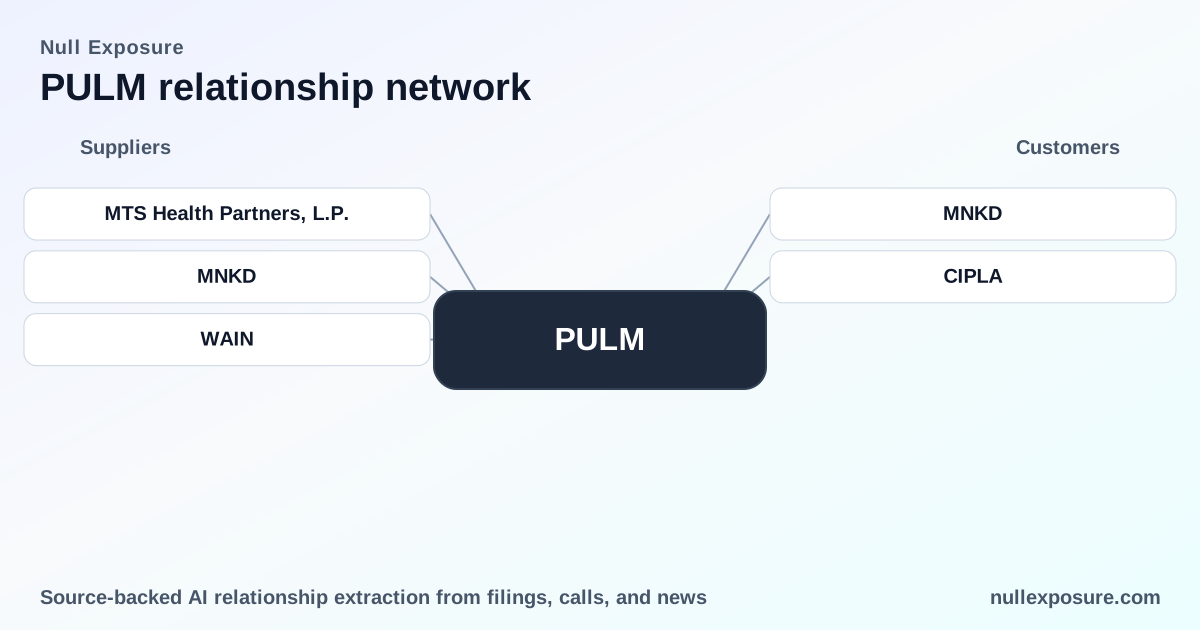
Pulmatrix (PULM) — Supplier Relationships and What They Signal for Investors
Pulmatrix is a clinical-stage biopharmaceutical company that discovers and develops inhaled therapies and monetizes primarily through collaborative development agreements, licensing pathways, and capital markets activity (equity offerings and ATM programs) while outsourcing manufacturing and development execution to third parties. For investors evaluating supplier counterparty risk and strategic optionality, the company’s active partnerships with a development contractor (MannKind), a sales agent (H.C. Wainwright) and a retained financial advisor (MTS Health Partners) define both its operational runway and the levers management can use to conserve cash or realize value. Explore the supplier map and implications below, or visit NullExposure for ongoing coverage and supplier intelligence. https://nullexposure.com/
What the supplier footprint tells you at a glance
Pulmatrix’s operating model is built on outsourcing and partnership rather than vertical integration. The company does not manufacture APIs or finished product internally; it relies on contract manufacturers and third‑party development service providers to execute clinical programs. This posture produces a small direct spend profile in absolute dollars but high operational criticality for the partners that provide drug substance, formulation services and clinical support.
Key company‑level signals derived from public disclosures:
- Contracting posture: Pulmatrix relies on long‑standing relationships with CMOs and service providers to supply APIs, drug product and clinical services; the firm expects to continue that reliance through development phases.
- Geographic exposure: Supply chain relationships are global, exposing the company to port, logistics and cross‑border disruption risks.
- Materiality of supplier risk: Supply interruptions are explicitly defined as material to clinical timelines and financial results.
- Role mix: The supplier base includes manufacturers and service providers (CMOs, CROs, formulation contract services) rather than distributors or direct sales channels.
- Spending profile: Public information situates direct spend bands in the low six‑figure to mid six‑figure range for certain items (audit fees cited), consistent with a small‑cap clinical company that outsources execution.
These signals combine into a profile of a small market‑cap biotech that is operationally dependent on a narrow set of external suppliers to execute its clinical-stage product roadmap.
Relationship rundown — who Pulmatrix is working with now
MTS Health Partners, L.P.
Pulmatrix retained MTS Health Partners as a financial advisor to the Board to review and evaluate strategic alternatives intended to maximize long‑term value for stockholders, a move disclosed in a company press release in March 2026. This relationship positions Pulmatrix to pursue sale, merger, licensing or structured financing options with advisor support. Source: BioSpace press release (March 10, 2026).
MannKind Corporation (MNKD)
Pulmatrix has a Master Services Agreement with MannKind under which MannKind provides development services, including activities to develop dry powder formulations using MannKind’s iSPERSE™ platform; the arrangement is disclosed in Pulmatrix’s quarterly filing for the period ending September 30, 2025. That technical collaboration materially underpins Pulmatrix’s formulation capability and reduces the need for Pulmatrix to build in‑house formulation infrastructure. Source: Pulmatrix Form 10‑Q (quarter ending Sep 30, 2025) reported via MarketScreener (FY2025).
H.C. Wainwright
Pulmatrix entered an At‑The‑Market (ATM) Sales Agreement with H.C. Wainwright to act as sales agent for up to $20 million of common stock, reflecting an explicit, ongoing capital‑markets channel to raise equity on an as‑needed basis; this arrangement is described in the company’s Form 10‑Q filing for fiscal 2025. The ATM relationship is a direct liquidity lever for management to fund development and preserve runway. Source: Pulmatrix Form 10‑Q (May 2021 Sales Agreement described; referenced in FY2025 filing) via MarketScreener.
Why these relationships matter to investors and operators
- Strategic flexibility via advisors: The MTS engagement signals active evaluation of strategic options and implies management recognizes constrained organic funding pathways; that creates optionality to accelerate a liquidity event or strategic partnership. This is a governance signal that management is pursuing value‑realization paths rather than incremental self‑funding alone.
- Outsourced technical capability reduces capex but increases vendor dependency: The MannKind MSA gives Pulmatrix access to a formulation platform (iSPERSE) without capital investment in equipment, which lowers fixed costs but concentrates technical risk in a single contracted provider for dry powder formulation work.
- Capital markets channel is active and material to runway: The ATM with H.C. Wainwright is an explicit monetization mechanism; ongoing access to equity markets through a sales agent is a core element of Pulmatrix’s funding strategy given low revenue and negative EBITDA.
Operational constraints and risk posture you must price in
Pulmatrix’s public statements identify several operational constraints that should be incorporated into valuation or vendor risk models:
- Supply chain fragility is a material risk. Management warns that global logistics and supplier disruptions can delay trials, increase costs and negatively impact revenue and reputation — a company‑level constraint that elevates the importance of vendor continuity planning.
- No internal API manufacturing increases vendor criticality. Pulmatrix relies on third‑party vendors for APIs and drug product; any CMO failure or capacity constraint directly halts development progress and de‑rations expected milestone timing.
- Relationship maturity and spend profile are consistent with a small, outsourced biotech. Contracts are active and service‑oriented; spend appears modest in absolute terms, but the criticality to program timelines is high, which amplifies the operational and market risk from even small vendor disruptions.
- Concentration and governance read as low diversification. A narrow set of named partners (MannKind, H.C. Wainwright, MTS) suggests concentrated counterparty exposure; investors must weigh the benefits of tightly integrated providers against concentration risk.
Mid‑read recommendation: for a structured supplier risk report, see NullExposure’s supplier intelligence collection and monitoring tools at https://nullexposure.com/.
Practical implications for procurement, BD and investors
- Procurement and business development teams should secure redundancy for any manufacturing steps that are not commoditized, and negotiate explicit continuity clauses and supply‑chain SLAs with CMOs.
- Investors should value the MannKind technology collaboration for its technical de‑risking effect on formulation but price in the strategic signaling of the MTS engagement — management actively pursuing value‑maximizing alternatives typically correlates with funding stress or a desire to accelerate exit timing.
- The ATM program removes the near‑term liquidity cliff but dilutes equity when used; model runway scenarios with and without ATM draws to test dilution and milestone funding outcomes.
Bottom line and next steps
Pulmatrix runs as a lean, outsourced R&D organization where external partnerships are both the engine of product development and the primary source of operational risk. The MannKind MSA secures essential formulation capability, H.C. Wainwright provides an on‑demand financing channel, and MTS Health Partners indicates the Board is actively exploring strategic pathways. Investors and operators should treat supplier counterparty continuity, contractual protections and alternative provider options as core components of any investment thesis.
For continuing coverage and tailored supplier risk assessments, visit NullExposure and request a briefing: https://nullexposure.com/. If you want a supplier‑level risk memo or a supplier continuity checklist built from Pulmatrix’s public filings, start here: https://nullexposure.com/.