PURR (Hyperliquid Strategies): Strategic advisory link shifts treasury posture toward digital assets
Hyperliquid Strategies Inc. operates a biotechnology-capable platform through subsidiaries while trading in capital markets under the ticker PURR; it monetizes through the development and commercialization of biologic medicines and through market-facing capitalization as a public issuer. The company’s current public profile is small-cap with a market capitalization of roughly $548.8 million and limited operating disclosure, and recent supplier/supplier-advisor activity signals an explicit move to professionalize digital‑asset treasury strategy. For investors and operators evaluating supplier relationships, the practical takeaway is that Hyperliquid is positioning external advisory relationships to manage non-core but strategically sensitive functions—most notably digital assets and treasury operations.
Explore supplier intelligence and relationship mappings at https://nullexposure.com/.
What the transaction means in plain terms
Hyperliquid executed a Strategic Advisor Agreement engaging an external advisory firm to advise on the company’s exposure to digital assets and on treasury operations. This is not a manufacturing vendor or clinical partner; it is a specialist advisory engagement intended to steer financial strategy and operational controls around cryptocurrency and other digital-asset holdings. That orientation changes risk vectors from R&D and product execution toward treasury governance and financial-opportunity governance.
The single disclosed supplier relationship — who, what, why
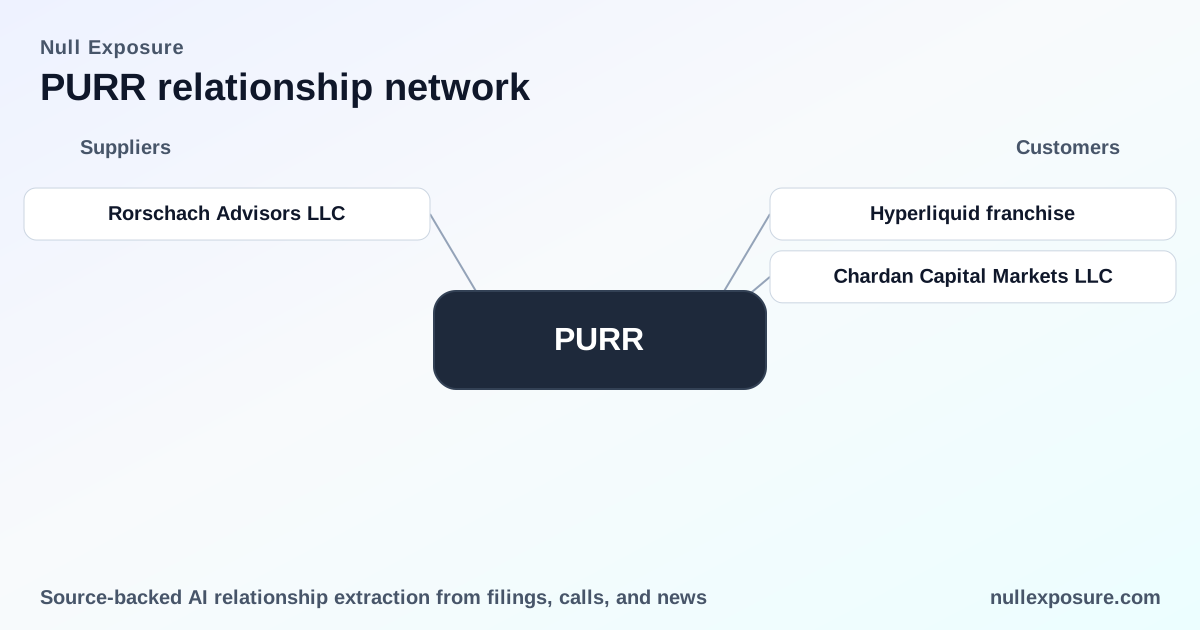
Hyperliquid’s supplier-scope search returned one relationship: Rorschach Advisors LLC.
- Hyperliquid retained Rorschach Advisors LLC under a Strategic Advisor Agreement to provide technical advisory services related to the digital asset ecosystem, including strategic advice on digital assets treasury operations, according to the company’s FY2026 disclosure reported via TradingView and the referenced SEC 10‑Q filing (reported March 10, 2026).
Source: TradingView news summarizing Hyperliquid’s FY2026 SEC 10‑Q (Mar 10, 2026).
This is an advisory arrangement rather than a capital‑intensive supplier contract. The engagement is aimed at governance and strategy rather than product delivery, and therefore its materiality is primarily financial-policy risk and reputation management rather than supply-chain continuity.
How this supplier relationship changes investor calculus
The Rorschach engagement telegraphs three practical shifts:
- Treasury sophistication becomes a primary operational focus. Engaging a specialist advisory firm for digital assets indicates that Hyperliquid will either hold or is assessing holdings of digital assets that require bespoke custody, accounting, and compliance frameworks.
- Risk profile shifts from biotech execution risk toward financial and regulatory risk. Advisory contracts do not eliminate risk; they reallocate it. The company’s exposure will be judged on treasury controls, counterparty selection, custody arrangements, and disclosure quality.
- Operational concentration is low but strategic criticality is high. A single advisor is not a high supplier concentration, but for governance areas like treasury, a single external advisor can disproportionately influence policy.
Investors should recalibrate due diligence to include treasury-level assessments—counterparty risk, custody choices, accounting treatment, and compliance with SEC guidance on digital assets.
Company-level signals and constraints to consider
There are no explicit supplier constraints disclosed in the relationship record. That absence itself is a signal: Hyperliquid has not reported multiple contracted external suppliers in this scope, and there are no flagged constraints that would suggest supply fragility or vendor immaturity. Treat that as a neutral company-level signal: contracting posture and supplier concentration are not fully visible to the market.
Other company-level facts relevant to supplier risk and strategy:
- Market capitalization: approximately $548.8 million.
- Analyst consensus: two Buy ratings and an analyst target price of $7.22.
- Public disclosure posture: limited operating metrics (no revenue reported in recent TTM fields), which increases the relative importance of governance and financial strategy disclosures for valuation.
These signals combine into a profile where supplier and advisor choices are more significant because operating disclosure is sparse; external advisors can materially impact perceived financial prudence without changing product fundamentals.
Practical implications for risk management and operational teams
Operators and risk officers should treat this advisory relationship as a trigger to update several governance artifacts:
- Review and codify custody and segregation policies for any intended digital-asset holdings.
- Require deliverables and KPIs for the advisory engagement: audit-grade recommendations, implementation roadmaps, and third-party custody counterparty due diligence.
- Map regulatory exposures (SEC, state money-transmitter rules, tax authorities) and set disclosure triggers for material digital‑asset positions.
These actions convert an advisory engagement from an abstract risk into a controllable operational program.
Investment implications and concise verdict
- Positive: Engaging a specialist advisor increases the company’s capacity to manage a complex new asset class and reduces the chance of ad-hoc decisions. That has value for a public company with significant market capitalization and limited operating disclosure.
- Negative: The move expands Hyperliquid’s exposure to regulatory and market volatility associated with digital assets. Advisory agreements do not remove counterparty, custody, or valuation risk.
For investors, the immediate priority is clarity: demand transparency on the scope of digital-asset exposure, custodian selection, and the timetable for any treasury allocations. A disciplined disclosure regime converts advisory work into measurable value.
If you’re mapping supplier and advisor exposure across portfolios, see full supplier mappings and relationship analytics at https://nullexposure.com/—we catalog supplier roles, contract types, and potential operational impact.
Closing guidance for evaluators
Hyperliquid’s Rorschach engagement is a deliberate, finance-driven pivot that elevates treasury governance as a core operational priority. It reduces some execution risk by bringing expertise in-house via advisors, but it enlarges regulatory and market‑price risk implicitly. For investors and partner operators, the next steps are simple and actionable: insist on specific disclosure of any digital‑asset holdings, demand clear custody and audit arrangements, and monitor how advisory recommendations are operationalized.
For a deeper look at supplier relationships and their portfolio-level implications, visit https://nullexposure.com/—our platform surfaces the relationships that matter and the real operational consequences for investors.