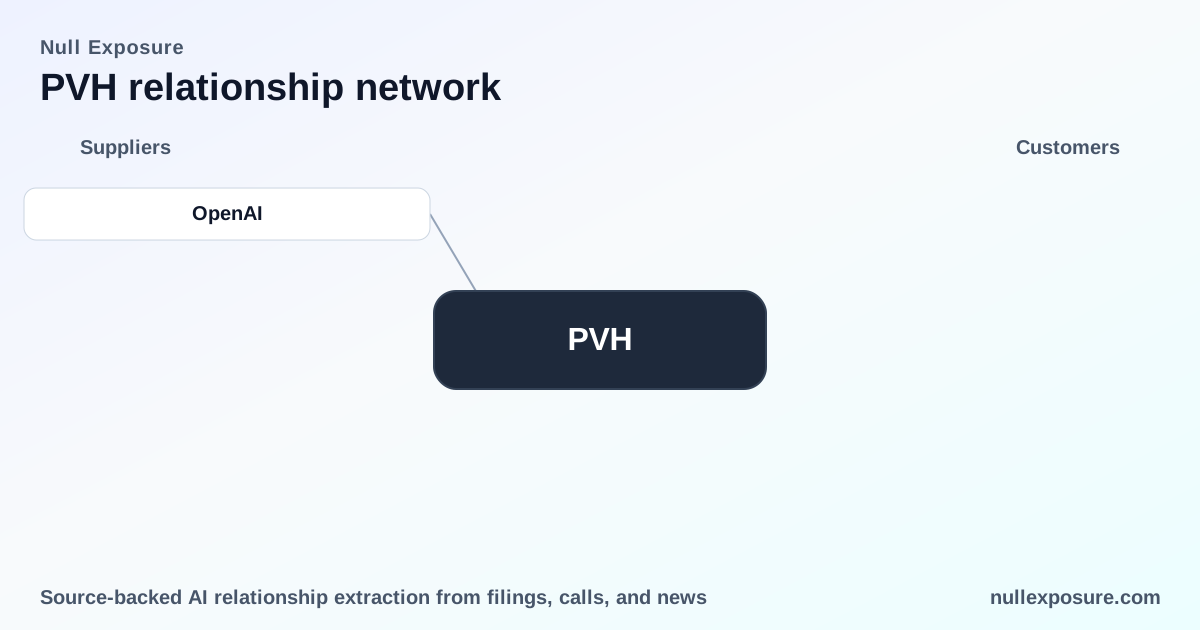
PVH and OpenAI: A supplier relationship that reframes operations and risk
PVH Corp. runs a global apparel business that monetizes through brand-led wholesale and retail sales (Calvin Klein, Tommy Hilfiger, Van Heusen, etc.), capturing margin on product design, manufacturing orchestration, and distribution. The company extracts value by coordinating design-to-shelf cycles, securing fabric and finished-goods commitments, and optimizing inventory across markets; recent disclosures show PVH is now embedding advanced AI capabilities into demand planning, product design, consumer engagement, and inventory optimization to lift operating leverage and shorten the decision cycle. For investors and operators, the OpenAI collaboration is not a marketing co-sign — it is a vendor relationship positioned squarely inside PVH’s revenue-generating engine. Learn more at https://nullexposure.com/.
Why this matters: technology suppliers that touch demand planning and inventory are functionally material to margin and working capital. That elevates contract design, data governance, and continuity planning to board-level topics.
How PVH monetizes AI integration — operationally and financially
PVH’s business monetizes through product cycles and channel distribution; AI integration affects three monetization levers directly:
- Gross margin through better assortments and pricing: improved forecasting and design signals reduce markdowns and increase sell-through.
- Working capital efficiency: inventory optimization shrinks excess stock and fabric commitments, improving cash conversion.
- Revenue upside from customer engagement: targeted consumer engagement increases conversion in owned and wholesale channels.
PVH communicates that it will “co-create custom AI capabilities with OpenAI” to embed these functions into its demand- and data-driven operating model, indicating a strategic, cross-functional engagement rather than a point solution. According to retail coverage, PVH’s integration of OpenAI spans product design, planning, inventory, and consumer interaction (Retail Tech Innovation Hub, Jan 28, 2026).
If you want organized supplier intelligence on PVH and its partners, visit https://nullexposure.com/ to see how these relationships map to contract risk and continuity.
Company-level operating constraints and what they imply for supplier risk
PVH’s supplier posture is a hybrid of short-term transactional commitments and selective long-term strategic partnerships. The company’s filings indicate:
- Short-term commercial cadence: payment terms and finished-goods commitments are typically short — finished product commitments are often made two to six months before production and payment obligations generally do not exceed 90 days. This points to a high-frequency procurement rhythm and limited long-dated payment exposure.
- Long-term strategic relationships: PVH also maintains longer-term strategic partnerships that support global scale and consistent sourcing across countries, which indicates vendor consolidation for critical capabilities.
- Manufacturing concentration in APAC: the apparel supply base is geographically concentrated in Asia; PVH produced goods in about 1,000 independent factories across 30+ countries with most facilities located in Asia.
- Supplier role mix and cyber risk: suppliers are primarily manufacturers, but PVH also relies on service providers who access confidential data — these vendors introduce cybersecurity risk that PVH recognizes but cannot fully control.
These signals describe a company that balances high-volume short-cycle procurement with select strategic supplier relationships; any supplier that touches forecasting, design, or consumer data therefore becomes both commercially and operationally critical.
Every reported supplier relationship in the coverage (all entries)
PVH’s supplier coverage in the record set points exclusively to OpenAI. Each mention is listed below with a plain-English summary and source.
- PVH announced a collaboration with OpenAI, and Finviz reported that the news contributed to PVH shares trading lower on the day the collaboration was disclosed. The article framed the announcement as market-moving news on March 10, 2026 (Finviz, Mar 10, 2026).
- PVH said it will co-create custom AI capabilities with OpenAI to embed tools across demand planning, product and design, consumer engagement, and inventory optimization; analysts and street commentary on this integration were summarized in a Finviz piece on March 10, 2026 (Finviz, Mar 10, 2026).
- Retail Tech Innovation Hub reported that PVH integrated OpenAI across its business, emphasizing the breadth of the implementation across Calvin Klein and Tommy Hilfiger brands and naming the announcement date as January 28, 2026 in their coverage (Retail Tech Innovation Hub, Jan 28, 2026).
- Simply Wall St highlighted that PVH shares returned to investor focus after the company announced the OpenAI collaboration, explicitly stating that PVH intends to embed custom AI tools across product design, demand planning, inventory, and consumer engagement (Simply Wall St, Mar 10, 2026).
- InsiderMonkey summarized the street reaction and noted that PVH reported a collaboration with OpenAI on January 27, 2026, positioning the partnership as a combination of OpenAI capabilities with PVH’s brand portfolio (InsiderMonkey, Mar 10, 2026).
All five results reference the same supplier partner — OpenAI — and the coverage consistently frames the relationship as integration of AI across core operating functions.
Strategic and risk implications for suppliers and investors
The OpenAI collaboration reframes supplier criticality at two levels: technology and execution.
- Technology-critical supplier: a partner that touches demand planning and inventory is directly tied to margin and working capital. Contract terms should therefore include service-level guarantees, data provenance clauses, and exit provisions that protect continuity.
- Data and cyber risk: PVH acknowledges limits to its control over third-party providers who access confidential information; when AI suppliers process consumer or planning data, the cybersecurity and privacy exposure is elevated.
- Contracting posture: the company’s mix of short-term product commitments and selective long-term partnerships suggests PVH will negotiate performance-based terms for critical service providers while preserving agility for manufacturing and seasonal buying cycles.
- Geographic supply concentration: manufacturing centered in Asia increases operational dependency on APAC ecosystems; technology that optimizes APAC production flows is strategically useful but increases the stakes of any supplier disruption in that geography.
Investors should treat this partnership as an operational investment, not a marketing exercise. Performance metrics to monitor: changes in inventory turns, markdown rate, working capital days, and sell-through after AI milestones are implemented.
If you track supplier exposures and want a concise map of PVH’s partner implications for operations and risk, explore our analysis at https://nullexposure.com/.
Investor takeaways and actions
- This is a material, business-driving supplier relationship: OpenAI’s role is present in functions that directly influence PVH’s margins and working capital.
- Monitor operational KPIs post-implementation: inventory turns, markdown cadence, and forecast accuracy will show whether the engagement delivers financial leverage.
- Demand contractual protections and auditability: given PVH’s recognition of third-party data risk, investors should look for disclosure on data governance, SLAs, and continuity planning in upcoming filings.
For a structured supplier-risk profile and to compare PVH’s relationships across peers, visit https://nullexposure.com/ and review the supplier mapping tools we publish.
PVH’s OpenAI collaboration is a strategic move to digitize the core operating model. For investors this raises the upside for margin improvement but also increases dependency on a technology supplier that controls critical analytical workflows — oversight and transparent KPIs are now essential to validate the promise.