Perella Weinberg Partners (PWP) — supplier relationships and what they mean for investors
Perella Weinberg Partners (PWP) is a global independent advisory and asset-management franchise that monetizes primarily through advisory fees, underwriting engagements and asset-management carry and management fees. Its go-to-market is deal-driven: the firm wins discrete mandates (M&A, restructuring, capital raises) and converts expertise into fee income while its growth equity and advisory practices create occasional longer-term capital relationships. For investors, the firm’s supplier picture—who underwrites its offerings, who advises its growth funds, and how it distributes press and appointments—sheds light on execution risk, market access and reputational leverage.
Explore deeper profiles and supplier maps at https://nullexposure.com/.
A compact financial backdrop that frames supplier importance
PWP is a mid-cap capital markets operator: FY TTM revenue of $750.9m, market capitalization roughly $1.54bn, and a trailing P/E around 35.8. Advisory income is inherently lumpy and dependent on deal flow and third‑party execution partners—underwriters, placement agents and strategic communications distributors. The firm’s profit margin and ROE (about 4.7% and 19.6% respectively) reflect both the premium pricing of boutique advisory and the cyclicality of capital markets activity. Accordingly, supplier relationships for specific transactions can materially affect near‑term results without changing the long‑term franchise economics.
What the public relationship signals show
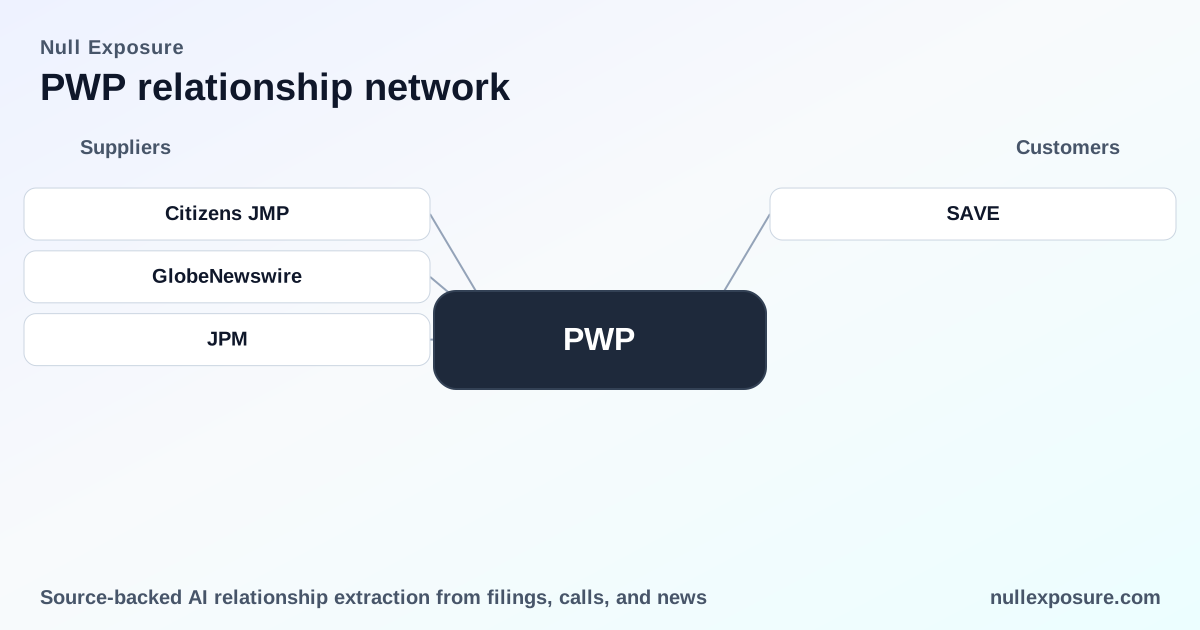
The public record for supplier relationships in the provided data includes three discrete items: an underwriting engagement, a press-distributed appointment notice, and a historical advisory role for a growth-equity transaction. Each item is small but informative: they illustrate transaction-based supplier usage, reliance on established distribution channels for news and the use of major banks as advisors to affiliated funds.
Citizens JMP — sole underwriter for a public offering
According to a GlobeNewswire press release dated February 27, 2024, Citizens JMP acted as the sole underwriter for Perella Weinberg Partners’ public offering of Class A common stock, indicating a transaction-level underwriting mandate for that capital raise. (GlobeNewswire, Feb 27, 2024)
GlobeNewswire-distributed press release announcing leadership hire
A press release distributed via GlobeNewswire and summarized on QuiverQuant in FY2025 announced David Wyles joining PWP as a partner to lead UK and European initiatives, reflecting use of established press-distribution services for leadership and market-entry messaging. (Press release via GlobeNewswire; summary on QuiverQuant, FY2025)
J.P. Morgan Securities LLC — advisor to PWP Growth Equity transaction (historical)
TicketNews reported in August 2019 that J.P. Morgan Securities LLC acted as exclusive financial advisor to PWP Growth Equity in the $40m investment into TickPick, showing that PWP’s growth-equity activities have used major investment banks as external advisors on transactions. (TicketNews, Aug 2019)
How these relationships illuminate PWP’s operating model
No supplier constraints are listed in the provided disclosures, so company-level signals come from transaction patterns and the nature of counterparties. From those patterns we infer these operating-model characteristics:
- Contracting posture: project-based and transactional. PWP engages external underwriters and investment banks on a mandate-by-mandate basis rather than long-term vendor contracts; this implies flexible but intermittent sourcing needs.
- Concentration: low to moderate supplier concentration at the firm level. The three records reference different counterparties (a regional underwriter, a global bank and a press distributor), suggesting diversified supplier usage across functions rather than dependence on a single vendor.
- Criticality: high for discrete transactions, low for day-to-day operations. Underwriters and advisory partners are critical to execution and timing for capital raises and investments, but not to PWP’s ongoing advisory capability.
- Maturity: established marketplace relationships. Engagements with major distribution services and large banks indicate market-tested relationships that support credibility and reach on deals.
These characteristics point to a business that is resilient to a single supplier failure but still exposed to execution risk on individual mandates where counterparties directly affect pricing, timing and distribution outcomes.
Risks that investors should monitor
- Transaction execution risk: When a single underwriter or advisor is appointed for a material transaction, the firm’s timing and pricing hinge on that partner’s syndication and distribution capacity. The Citizens JMP-only underwriting engagement is an example of such concentrated execution reliance.
- Reputational exposure: Use of third-party distributors and advisors amplifies or constrains PWP’s market narrative—leadership hires and capital raises reach investors via these channels.
- Cyclicality of fee revenue: Advisory and underwriting fees are deal-dependent; supplier friction at a critical moment can reduce deal capture and near-term revenue recognition.
Near-term monitoring priorities:
- Track upcoming filings and press releases for named underwriters and advisors on material capital-market transactions.
- Review transaction-level disclosures (offer prospectuses, press releases) for fee structures and exclusivity terms.
- Watch for recurring counterparties—patterns can signal strategic alliances or emergent concentration risk.
If you want a supplier-centric risk scorecard or an alert setup tied to PWP’s counterparties, see https://nullexposure.com/ for tailored coverage.
Practical investor actions and final assessment
For investors and operators evaluating PWP relationships, the checklist is straightforward:
- Confirm counterparties on any material offerings or growth-equity investments and assess their delivery track record.
- Evaluate whether engagement terms (exclusive underwriter, sole advisor) increase execution risk for that mandate.
- Monitor communications distribution (press-wire usage) as a signal of market positioning and outreach efficiency.
Perella Weinberg Partners runs a deal-driven, low-lock-in supplier model that supports flexibility but creates event-level dependency on third-party execution partners. The public relationships in the record — an underwriting mandate with Citizens JMP, a GlobeNewswire-distributed hire announcement, and a historical advisory role for J.P. Morgan on a growth-equity deal — are consistent with a firm that outsources transaction execution and message distribution when strategic. From an investor perspective, these relationships are normal for a boutique advisory platform but warrant close monitoring around material capital-market events.
For structured supplier mapping, bespoke alerts and deeper counterparty analytics, visit https://nullexposure.com/ and request PWP coverage.