Quanta Services (PWR): Supplier Relationships that Drive Execution and Margin
Quanta Services operates and monetizes by delivering large-scale engineering, procurement and construction projects across electric power, pipeline, industrial and communications networks, capturing revenue through project fees, maintenance contracts and increasingly through in-house manufacturing of critical components. The company converts scale and field capability into predictable backlog turnover and outsized valuation multiples driven by infrastructure spending and grid modernization. For a deeper look at supplier and counterparty exposure, visit NullExposure.
How Quanta’s commercial model actually works for investors
Quanta is a project-centric services company that earns operating leverage from scale, repeat customers and selective vertical integration. The public metrics tell the story: market capitalization of roughly $85.9 billion, trailing revenue of $28.48 billion, EBITDA of $2.497 billion, and a trailing P/E of 84.8 that compresses to a forward P/E of 42.6 — a valuation reflective of strong growth expectations embedded in its electric division. Revenue growth is meaningful (quarterly revenue growth +19.7% YoY in the latest period), but margins are thin by services standards (operating margin ~5.2%, profit margin ~3.6%), so execution and supplier control translate directly into earnings volatility and upside.
Quanta’s business model characteristics signal a hybrid posture between prime contractor and integrated manufacturer:
- Contracting posture: company-level disclosures and filings show reliance on long-term capital instruments and multi-year project commitments, indicating structured, long-duration contract exposures rather than purely spot work. Evidence includes references to long-dated senior notes and contract-cost treatment in filings.
- Service-role concentration: Quanta performs as a prime service provider while subcontracting about 20% of services, which establishes a two-way dependence: Quanta needs subcontract capacity; subcontractors can become competitors on prime bids.
- Vertical integration: the company has invested in domestic manufacturing of critical components, including high- and low-voltage transformers, which shifts some supplier risk in-house but increases capital intensity and exposure to manufacturing cycle risk.
- Supply-chain criticality: Quanta flags that transformer and component availability are sensitive to manufacturer capacity, global trade and geopolitical conditions — a company-level constraint that amplifies the strategic value of manufacturing relationships.
If you want a consolidated view of supplier exposures and counterparty signals, see our platform at NullExposure.
The relationships on record and what they mean for execution
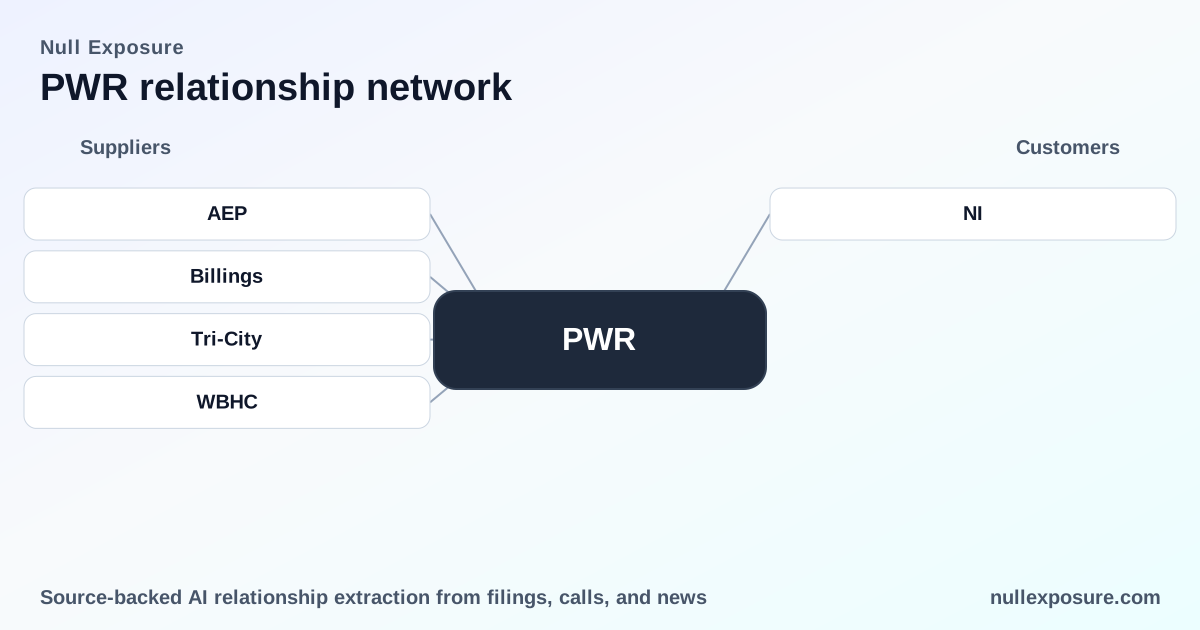
Below are every supplier or partner mention surfaced in the reviewed coverage, with concise, plain-English takeaways and source context.
AEP — collaboration on transformer builds
Quanta disclosed during its Q4 2025 earnings call (March 7, 2026) that it collaborated with client AEP on building transformers to AEP’s specifications, highlighting direct engineering/manufacturing integration with a major utility customer and the role Quanta plays beyond field services. This was discussed on the 2025 Q4 earnings call.
Billings — helicopter operations for field logistics
An InsiderMonkey recap of FY2026 activity (published March 10, 2026) noted that Quanta’s deals included Billings for helicopter operations, indicating Quanta outsources aerial logistics and inspection work to specialist providers to support field crews and expedite outage response. Source: InsiderMonkey FY2026 coverage, March 10, 2026.
Tri‑City — internal electric work partner
The same March 10, 2026 InsiderMonkey article listed Tri‑City as a counterparty for internal electric work, suggesting usage of localized contractors for distribution and internal utility-related projects where regional expertise and workforce availability matter. Source: InsiderMonkey FY2026 coverage, March 10, 2026.
Wilson (WBHC) — delivery and distribution services
InsiderMonkey’s FY2026 summary also referenced Wilson for delivery and distribution, which points to third-party logistics and line-of-business distribution partners supporting Quanta’s fleet and material handling requirements; Wilson is identified with the inferred symbol WBHC. Source: InsiderMonkey FY2026 coverage, March 10, 2026.
What these relationships imply for investors and operators
Collectively, these relationships demonstrate a deliberate mix of in-house manufacturing for strategic components and selective outsourcing for specialized field tasks. The AEP transformer collaboration is a signal that Quanta leverages manufacturing capabilities to win utility-level scope and capture higher-margin engineering content. Conversely, reliance on helicopter operators and regional contractors for logistics and field execution preserves flexibility and limits fixed labor cost escalation.
Key investment implications:
- Execution risk is operationally concentrated. Subcontracting ~20% of services gives Quanta access to scalable capacity but also creates a potential pathway for subcontractors to compete for prime contracts. This is a company-level constraint disclosed in SEC filings.
- Manufacturing is both a hedge and a lever. Domestic transformer manufacturing reduces dependence on third-party suppliers but increases exposure to production bottlenecks and capital cycle volatility; Quanta’s filings specifically note risks around manufacturers meeting demand and macro trade conditions.
- Valuation premia require delivery. The elevated multiples (high trailing and forward P/E) embed sustained margin improvement and backlog conversion; any slippage in supplier performance, transformer availability, or subcontractor disputes will feed directly into operating margin compression.
If you evaluate vendor risk, counterparty concentration, or supplier maturity as part of investment or procurement due diligence, our platform surfaces these signals and their provenance — explore more at NullExposure.
Tactical takeaways and final recommendation
- For equity investors: treat Quanta as a growth-at-a-price infrastructure operator; the valuation reflects both the pipeline of utility modernization projects and the necessity of flawless supplier orchestration.
- For operators and procurement teams: prioritize continuity of helicopter/logistics suppliers and validate transformer manufacturing capacity in contract terms, since these are operational chokepoints highlighted across filings and earnings commentary.
- For credit and risk analysts: long-term financing presence and manufacturing capex require monitoring of leverage and working capital cycles; Quanta’s senior note and contract-cost disclosures are company-level signs of extended funding horizon and project duration.
Quanta’s supplier footprint blends strategic vertical integration with tactical outsourcing, and these relationships materially influence execution risk and upside. For a systematic supplier exposure view tailored to institutional use cases, visit NullExposure.