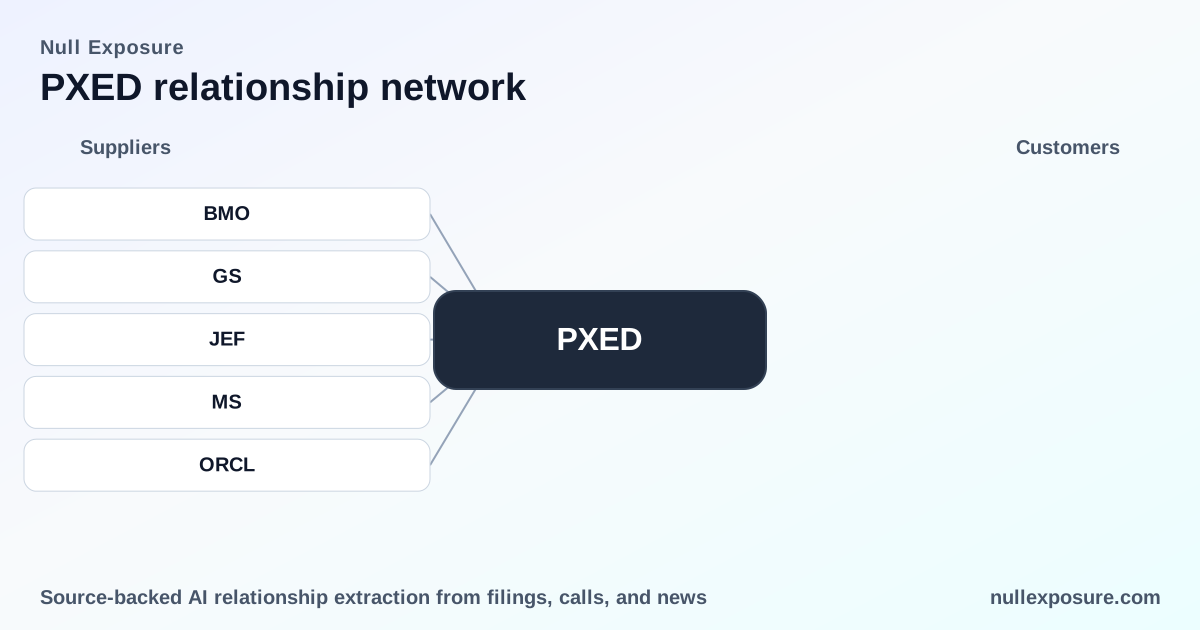
PXED supplier note: what Phoenix Education’s counterparties tell you about operational leverage and risk
Phoenix Education Partners monetizes an online-first education platform by contracting with financial markets advisors and third‑party service providers to scale student acquisition, learning management and back‑office processing; revenue is driven by tuition and platform services, while margins reflect high gross profit on digital delivery and material operating dependence on external IT and ERP suppliers. For investors and operators, the supplier set is a mix of capital‑markets partners tied to Phoenix’s IPO and strategic service vendors that are critical to daily operations. Read on for a concise map of every supplier relationship disclosed in public reporting and what it means for counterparty risk and valuation.
Visit our homepage for more supplier intelligence: https://nullexposure.com/
The supplier footprint in plain language: what investors should internalize
Phoenix’s operating model is service‑centric and vendor‑dependent. The company outsources core elements of delivery and back‑office processing — notably its learning management system, IT services, and financial aid processing — which drives scale but concentrates operational risk in a small set of partners. Public disclosures signal a contracting posture that mixes long‑dated financing with active third‑party service arrangements.
- Long‑term financing available: Phoenix put in place a senior secured revolving credit facility for $100 million that matures in November 2030, indicating a multi‑year liquidity runway and a willingness to structure long‑term, secured counterparty relationships to support growth and working capital.
- Vendor relationships are material and critical: The company explicitly ties vendor compliance to core eligibility for Title IV programs and warns that vendor failures could have a material adverse effect on revenue and operations, elevating counterparty criticality.
- Service provider reliance and active stage: Management discloses ongoing reliance on third‑party IT, LMS, and financial aid processors and has historically purchased consulting services (notably from owners’ affiliates) which were terminated at IPO, suggesting an evolution from private‑equity era advisory arrangements to a public‑company vendor posture.
These characteristics — secured long‑term financing, high vendor criticality, and active service provider reliance — create a profile where operational execution is the dominant non‑market risk for equity holders and counterparties.
Every public supplier relationship and what it means for your model
Morgan Stanley — IPO book‑runner and capital markets partner
Morgan Stanley served as a lead book‑running manager on Phoenix’s IPO, underwriting the company’s market debut and helping set public valuation and distribution. According to MarketMinute coverage of Phoenix’s NYSE debut on October 9, 2025, Morgan Stanley was named among the lead underwriters. (Markets FinancialContent, Oct 9, 2025)
Goldman Sachs & Co. LLC — underwriting and distribution
Goldman Sachs acted as one of the lead book‑running managers for Phoenix’s initial public offering, providing distribution and syndicate support that underpinned the company’s liquidity event and public capitalization. (Markets FinancialContent, Oct 9, 2025)
BMO Capital Markets — underwriting partner supporting the IPO
BMO Capital Markets was listed as a lead book‑running manager on the IPO syndicate, contributing to the equity raise that established Phoenix’s public market footprint and institutional investor access. (Markets FinancialContent, Oct 9, 2025)
Jefferies — syndicate role on the IPO
Jefferies completed the syndicate of lead book‑running managers for Phoenix’s NYSE listing, participating in the underwriting and distribution that set the company’s public equity base. (Markets FinancialContent, Oct 9, 2025)
Oracle — implicated in a cybersecurity incident affecting core systems
Phoenix disclosed a cybersecurity incident on December 2, 2025 involving Oracle EBS, signaling an operational interruption tied to a core enterprise application and highlighting the concentration and criticality of vendor software in Phoenix’s back‑office. (TradingView report relaying Phoenix’s Dec 2, 2025 disclosure)
What these relationships imply for risk, governance and valuation
The capital‑markets relationships with Morgan Stanley, Goldman, BMO and Jefferies are transactional but strategically important: they reduced fundraising execution risk and brought institutional ownership, which showed up in a high institutional ownership reading post‑IPO. These counterparties do not represent ongoing operational vendors, so their impact is concentrated around liquidity, signaling and market access rather than day‑to‑day delivery.
By contrast, the Oracle incident is an operational red flag. A breach or ERP disruption in Oracle EBS has immediate implications for billing, financial reporting and regulatory compliance — especially in a business that must maintain Title IV eligibility. That incident validates the company disclosure that vendor failures are material to operations and suggests investors should underwrite an operational premium (or discount) around vendor continuity and cyber resilience.
Company‑level signals from public filings should shape counterparty diligence:
- Phoenix has a long‑dated, secured credit facility through November 2030 that reduces near‑term liquidity stress but increases the importance of covenant and counterparty management.
- Vendor relationships are classified as material and active, and Phoenix explicitly relies on third‑party IT, LMS and financial aid processors — an operational model that trades capital efficiency for external dependence.
- Management consulting and advisory services provided by affiliates of private owners were terminated at IPO, reflecting a transition in governance and potential reduction in related‑party operational ties.
These items combined mean investors should price Phoenix not simply as an attractive gross margin edtech franchise but as a company whose upside is conditional on vendor resilience, cyber controls, and continued access to capital.
Investment checklist: what to monitor going forward
- Operational continuity metrics: uptime and incident remediation timelines for LMS, ERP and financial aid processors. Oracle‑related issues are particularly relevant.
- Vendor concentration: number of suppliers that could materially interrupt Title IV eligibility or billing flows.
- Covenant and liquidity runway: utilization and covenants on the $100M revolving facility that runs to November 2030.
- Counterparty governance: third‑party audit outcomes and contractual indemnities for breaches or compliance failures.
For deeper supplier mapping and counterparty risk scoring, see our platform: https://nullexposure.com/
Bottom line: how to incorporate supplier signals into PXED valuation
Phoenix’s supplier universe is bifurcated: investment‑bank relationships de‑risk the capital story; service vendors determine operational delivery and regulatory exposure. The company’s long‑term secured financing provides a buffer for growth investments, but the Oracle cybersecurity disclosure and explicit warnings about vendor materiality impose a persistent operational haircut on forecasts unless Phoenix demonstrates hardened vendor governance and remediation.
Key takeaways:
- Capital markets risk is low — IPO underwriting relationships established public access and institutional ownership.
- Operational vendor risk is high — reliance on third‑party IT/ERP/LMS and a documented cybersecurity incident create a measurable execution risk.
- Contracting posture is mature and long‑term on financing but active and dependent on vendors for service delivery.
If you are evaluating PXED as a supplier counterparty or building a model that includes operational downside, track vendor incident disclosures and covenant metrics closely. For more supplier intelligence and relationship analytics, visit https://nullexposure.com/ — we provide the targeted counterparty context institutional investors use to price operational risk.