Pixelworks (PXLW) — Supplier Relationships That Drive Delivery Risk and Governance Workflows
Pixelworks develops and markets software and semiconductor solutions as a fabless designer that monetizes through the sale of integrated silicon solutions, IP licensing and complementary software — while outsourcing wafer fabrication and assembly to third parties. The company's operating model is highly dependent on external manufacturers and a small set of service providers, so supplier relationships are both operationally critical and strategically consequential for investors evaluating execution risk and corporate governance outcomes. For a concise briefing and further supplier analytics, visit https://nullexposure.com/.
Why suppliers determine whether Pixelworks can execute
Pixelworks’ economics are defined by two structural facts: it does not own fabrication capacity, and revenue and product delivery flow through a limited number of third‑party manufacturers and service providers. That contracting posture produces concentrated counterparty risk: suppliers are operationally critical, contract relationships are likely tight and bespoke, and failures in the supply chain will immediately impact revenue recognition and product availability.
- Geographic concentration in APAC is an explicit company-level signal: Pixelworks states that most manufacturing is outside the U.S., with a concentration in Taiwan and the People’s Republic of China, which increases exposure to regional disruptions.
- Sole‑source and low vendor redundancy are part of the operating model: Pixelworks describes dependence on a limited number of foundries and assembly/test vendors, which elevates the potential for shortages, long lead times, and price volatility.
- Fabless maturity and active dependency: Pixelworks identifies itself as a fabless company that actively contracts out production — a mature industry posture that substitutes manufacturing capital for supplier management skill.
These structural constraints turn supplier relationships into more than procurement line items; they are core strategic assets that influence margins, timing of product launches, and customer retention.
Direct relationships: what investors need to know
Below I cover every supplier or service relationship that shows up in the available intelligence.
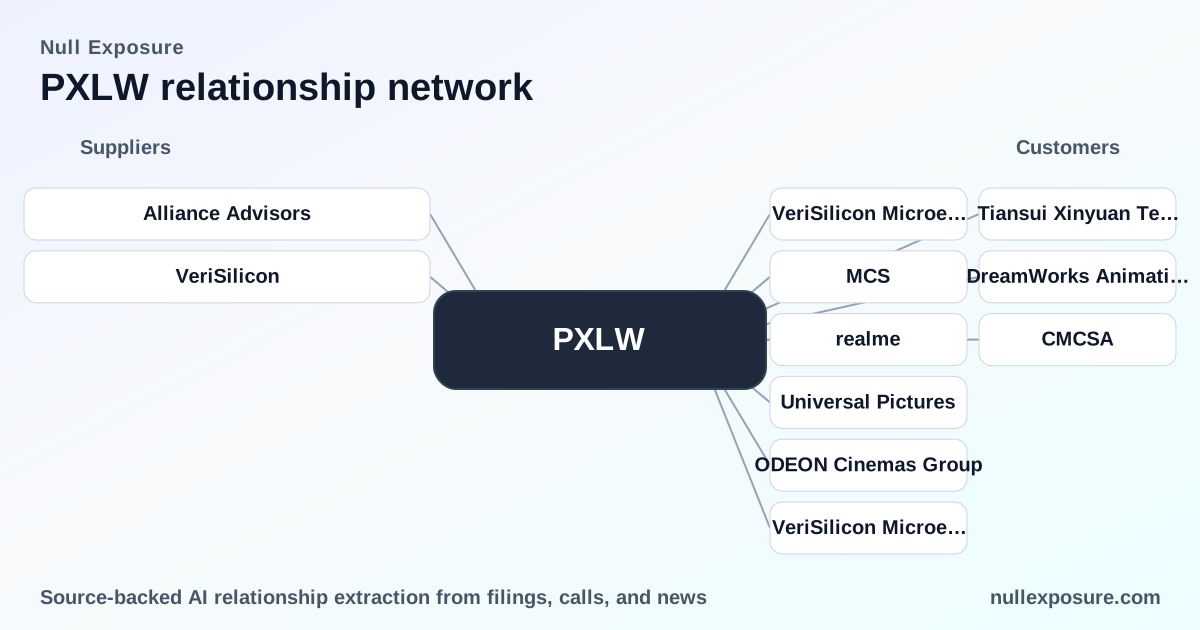
Alliance Advisors — proxy solicitor for shareholder meetings
Pixelworks engaged Alliance Advisors as its proxy solicitor for reconvening a special meeting of shareholders, and the firm is the contact point for voting assistance and replacement proxy materials. According to a Sahm Capital press release dated November 27, 2025, Alliance Advisors was listed as the toll‑free contact for shareholders, and a Quantisnow notice referenced the same proxy contact information in March 2026. (Source: Sahm Capital, Nov 27, 2025; Quantisnow notice, first seen Mar 10, 2026.)
VeriSilicon — platform-based custom silicon services and IP partner
Pixelworks referenced VeriSilicon on its Q3 2025 earnings call, describing VeriSilicon as a well‑established Chinese company that provides platform‑based custom silicon services and semiconductor IP licensing. This positions VeriSilicon as a supplier of design platforms and IP or a technology partner in custom silicon development rather than a traditional foundry. (Source: Pixelworks 2025 Q3 earnings call transcript, 2025Q3.)
Operational implications and the risk matrix
Investors should treat the constraints below as company-level operational signals that define the supplier risk profile rather than metrics attributed to a single counterparty.
- Contracting posture — outsourced with concentrated vendors: Pixelworks operates with a fabless model and depends on a limited set of foundries and assembly/test vendors. This creates high switching costs and contractual stickiness, making supplier performance and commercial terms central to margin recovery.
- Concentration — APAC‑centric manufacturing footprint: The preponderance of manufacturing in Taiwan and greater China concentrates geopolitical, natural‑disaster, and logistics risk in a single region. Continuity planning and alternative sourcing are therefore strategic priorities for operating resilience.
- Criticality — supplier failure equals revenue disruption: Company disclosures identify supplier failure as a driver of severe operational impact; a single vendor underperformance can lead to product delays, higher costs, and lost revenue. Investors should price a material probability of supply disruption into valuation models.
- Maturity and role — fabless but reliant on established partners: While fabless model maturity means Pixelworks can scale design without capex, that maturity relies on service provider sophistication; VeriSilicon’s platform credentials indicate the type of third‑party technical partner Pixelworks uses.
What this means for investors and operators
Given Pixelworks’ small scale — revenue reported TTM of $693,000 and market capitalization near $38 million — supplier failures would disproportionally affect short‑term cash flows and operational continuity. Two practical actions are essential:
- Monitor contract disclosures and supplier concentration metrics. Confirm whether Pixelworks has multi‑sourcing agreements or long‑term capacity commitments with foundries; absence of such arrangements increases downside risk in stressed markets.
- Validate governance and proxy workflows. The engagement of Alliance Advisors for proxy solicitation is a clear signal about active shareholder processes; track filings and special meeting outcomes for governance‑related supplier impacts.
If you want a deeper, interactive supplier map or alerts tied to supplier events and filings, see https://nullexposure.com/ for tailored intelligence.
Checklist for near‑term monitoring
- Review upcoming SEC filings for explicit foundry names, lead times and contractual terms.
- Watch for supply‑chain disclosures tied to Taiwan/PRC operations and any newly negotiated backup capacity.
- Track VeriSilicon‑related announcements to determine whether the relationship expands into IP licensing, turnkey platform deliveries, or deeper co‑development arrangements.
- Follow shareholder materials and proxy solicitor notices for governance outcomes that could affect board composition and strategic supplier decisions.
Bottom line: concentrated suppliers create asymmetric execution risk
Pixelworks is a fabless semiconductor company that monetizes through silicon offerings and software/IP, but its ability to execute depends on a tight roster of external manufacturers and technical partners. Alliance Advisors is serving a governance/service role (proxy solicitation), and VeriSilicon is a technical supplier for platform and IP services. Company-level signals — APAC manufacturing concentration, sole‑source dependencies, and an active outsourcing posture — collectively argue for conservative operational risk assumptions in valuation and a focus on contract and contingency disclosure in upcoming filings.
For a detailed supplier dossier, scenario analysis, or continuous monitoring feeds tailored to investor due diligence, visit https://nullexposure.com/ and request a briefing today.