PayPal’s supplier footprint: banks, trust partners, and why they matter to investors
PayPal operates a global online payments platform that monetizes primarily through transaction and service fees charged to merchants and consumers, plus interest and financing income tied to embedded credit products. The company routes payments, holds customer balances, and offers financing and issued digital cash (PayPal USD) through regulated financial partners; those partner contracts and processing fees are a direct driver of margins and operating leverage for the business. For investors evaluating PYPL’s supplier risk and opportunity, the supplier map is less about commodity vendors and more about regulated banking and credit partners that are operationally critical and fee-bearing.
Discover supplier risk intelligence at https://nullexposure.com/.
Why suppliers are strategic for a payments franchise
PayPal is not a vertically integrated bank. It relies on a mix of payment processors, trust banks, and credit partners to accept funding sources, issue balances, and underwrite consumer credit. The company’s own filing language identifies transaction expense as primarily fees paid to payment processors and other financial institutions, which confirms that supplier costs are a material and recurring line item. That contracting posture creates four practical characteristics that investors should track:
- High criticality: processing and issuing partners are necessary for core service delivery — outages or regulatory problems at these partners have immediate customer and revenue implications.
- Fee concentration: transaction expenses are structurally embedded in gross margin; supplier pricing power can compress net take-rate.
- Regulatory coupling: partners are regulated entities (banks, trust companies); regulatory actions affecting those partners transmit to PayPal operationally and reputationally.
- Maturity and replacement friction: established banking relationships are stable but costly to replace quickly; termination or renegotiation creates transitional risk.
These are company-level signals grounded in PayPal’s own description of transaction expense and in the supplier relationships documented below.
The specific supplier relationships on the record
Below I cover every supplier relationship listed in the available results and what each means for investors.
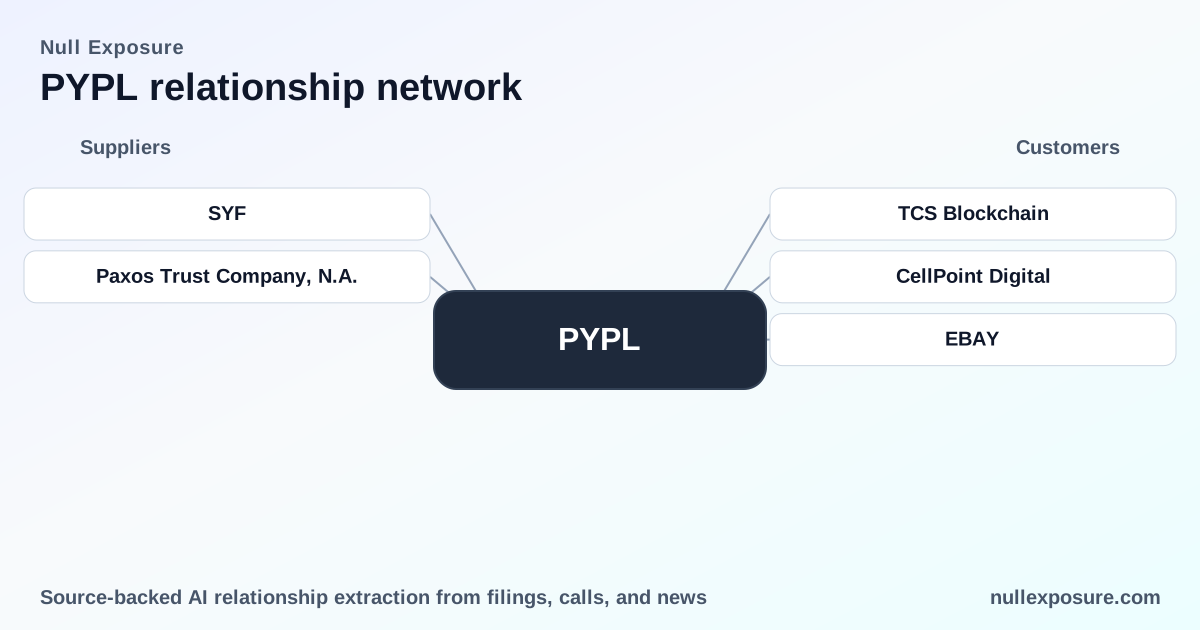
Synchrony Financial — credit partner for consumer financing and co-branded cards
Synchrony provides credit cards, installment loans, and other banking products through partnerships with retailers and digital platforms; market reporting notes Synchrony’s partnerships include PayPal for consumer financing programs that extend credit to customers. This relationship indicates PayPal outsources a portion of its consumer credit and card issuance capability to a specialized bank partner, which affects credit economics and product reach. (Source: Finviz news coverage, March 10, 2026.)
Paxos Trust Company, N.A. — issuer of PayPal USD (regulated trust)
PayPal USD is issued by Paxos Trust Company, N.A., a fully-chartered trust company regulated by the Office of the Comptroller of the Currency, which positions Paxos as the regulated issuer and custodian for PayPal’s USD-denominated instrument. Using a chartered trust for issuance ties PayPal’s wallet liquidity and any digital-cash products to a regulated custody partner and therefore to bank/regulatory risk and compliance regimes. (Source: PayPal investor news release, March 2026.)
What these relationships mean for margins, risk, and strategy
PayPal’s supplier set is concentrated in financial service providers rather than traditional vendors, and that distinction defines both upside and downside for shareholders.
- Margins are supplier-sensitive. PayPal’s transaction expense consists largely of fees paid to processors and financial institutions; any upward pressure on those fees directly compresses take-rates. This is a structural margin lever rather than a one-off cost item. (Company filing language on transaction expense, FY2026.)
- Regulatory and reputational transmission is immediate. Working with chartered trusts like Paxos puts PayPal in a regulated chain; enforcement or operational issues at the trust level translate to wallet availability and customer trust. That creates a non-financial risk vector that affects GMV and retention.
- Credit economics are delegated. Partnering with Synchrony for card and installment products means credit performance, underwriting agility, and losses sit with or are shared with a third party, changing PayPal’s earnings volatility profile. That delegation also enables scale for customer financing without taking the full on-balance-sheet capital cost.
- Contracting posture favors continuity with friction to change. These partners are mature, regulated providers; while relationships are long-lived, renegotiation or replacement is operationally difficult — a factor that increases the effective bargaining power of entrenched suppliers over time.
Bold takeaway: PayPal’s operations are supplier-constrained where supplier pricing, regulatory health, and credit performance drive both revenue composition and margin outcomes.
Explore supplier exposure further at https://nullexposure.com/.
Practical steps for investors and operators
- Monitor quarterly disclosures and management commentaries for any changes in transaction expense composition and for updates on partner arrangements or concentration.
- Track regulatory developments affecting trust banks and chartered issuers in the U.S., as those have an outsized operational impact on wallet products.
- Evaluate credit partner performance metrics (charge-offs, delinquencies) where disclosed, since Synchrony-style arrangements shift credit risk dynamics.
- Prioritize scenario analysis: model margin sensitivity to incremental basis points of supplier fee inflation and to temporary disruptions at an issuing partner.
Final read: supplier relationships are core to valuation
PayPal’s supplier relationships are not peripheral procurement items; they are integral to product delivery, regulatory compliance, and margin structure. Investors should view PYPL as a platform whose revenue mix and cost base are co-determined by third-party banks and processors, making supplier diligence a necessary complement to traditional top-line and active-user analysis.
For a focused supplier risk view and ongoing monitoring tools, visit https://nullexposure.com/.