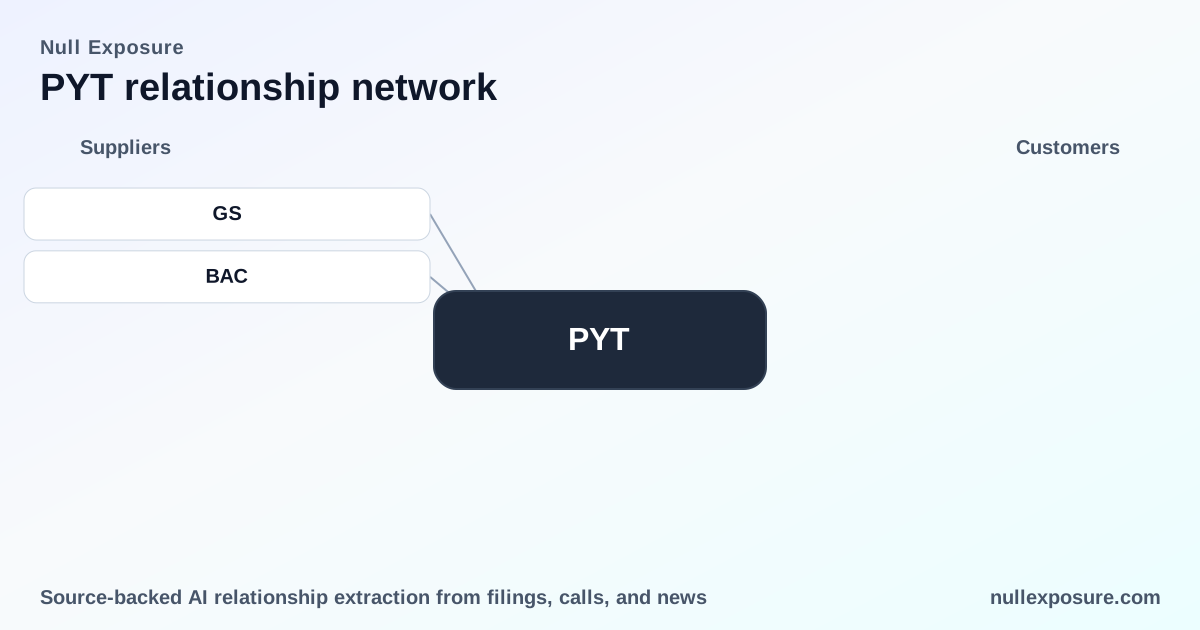
PYT (PPLUS Trust Series GSC 2 Pref) — counterparty map and investor implications
PPLUS Trust Series GSC 2 Pref (Ticker: PYT) is a preferred-equity trust that monetizes by holding income-producing securities and structured contracts while issuing preference certificates that pay fixed quarterly distributions; its economics derive from coupon receipts on the underlying securities plus net receipts under a swap agreement, with investors obtaining superior claim on cash flows relative to common equity. The trust’s yield profile (reported dividend yield ~4.34%) is driven directly by the performance of a small set of underlying instruments and the swap counterparty’s payments, not by a diversified operating business. Learn more about the supplier relationship data and sourcing at https://nullexposure.com/.
How PYT’s operating model produces cash and where the risk concentrates
PYT operates as a pass-through income vehicle: it receives interest on held securities and payments under a swap, then distributes available cash to certificate holders. This structure produces steady distributions when the underlying securities and the swap perform; it also creates a single-point-of-failure dynamic because the trust has essentially no other assets beyond the underlying securities, the underlying guarantee, and the swap. That concentration makes counterparty and asset performance the primary drivers of return and default risk.
Contracting posture is tight: the trustee is contractually required to sell underlying securities under certain triggers even if market conditions are adverse, removing discretionary liquidity management in stressed markets. The swap counterparty is a direct service provider to the trust’s distribution mechanics—its payment performance directly determines the trust’s ability to make quarterly interest distributions.
Key operational constraints that shape supplier and counterparty risk
These company-level signals define how investors should think about supplier relationships and operational resilience:
- Critical materiality: The trust’s assets are limited to the underlying securities and the swap guarantee; if those cash flows are insufficient, there are no residual assets to cover shortfalls. This elevates counterparty exposure to a first-order risk for certificate holders.
- Service-provider dependency: The trustee and the swap counterparty are functioning service providers in the trust’s payment waterfall: the trustee executes mandatory sales and the swap counterparty provides offsetting payments that fund distributions.
- Active-stage relationships: The trust’s counterparty arrangements are operational and producing payments in the current fiscal period, so real-time monitoring of payments and legal triggers is necessary for risk oversight.
These constraints translate into practical characteristics: low asset diversification, high counterparty concentration, contractual rigidity (limited trustee discretion), and high sensitivity of distributions to single-counterparty performance.
For a deeper supplier-risk view, visit https://nullexposure.com/.
Counterparties and payments reported (FY2026)
Goldman Sachs Capital I — interest on capital securities
According to a TradingView news item dated March 10, 2026, the trust received $1,110,375.00 in interest from 6.345% Capital Securities due 2034 issued by Goldman Sachs Capital I, reflecting a coupon payment flowing directly from a rated issuer to the trust’s cash pool (TradingView, 2026-03-10). This is a core cash inflow that underwrites part of the trust’s quarterly distribution.
Merrill Lynch International — net swap payment after netting
A TradingView report on March 10, 2026 notes that Merrill Lynch International received a net swap payment of $666,424.66 after netting with the trust, indicating the swap counterparty and the trust are actively exchanging payments and netting exposures under their derivative arrangement (TradingView, 2026-03-10). The swap netting outcome is a direct determinant of distributable cash in the period.
Both counterparties were reported in the same news item covering the trust’s declared distribution and principal outstanding for the period.
What investors should read into these specific relationships
These two reported counterparties illustrate the trust’s dual-income mechanics: coupon receipts from fixed-income capital securities and netted swap flows. The Goldman Sachs coupon payment provides straightforward credit exposure to an issuer-level bond; the Merrill Lynch net payment reflects derivative counterparty credit exposure and collateral/netting dynamics.
Key implications:
- Credit exposure split: One exposure is to the issuer credit and bond structure (Goldman Sachs instrument); the other is to the swap counterparty and the legal robustness of netting agreements (Merrill Lynch International).
- Cashflow dependency: Both payment streams are currently active and materially affect the trust’s distribution capability in FY2026.
- Operational execution: The trustee’s contractual obligation to sell assets under certain triggers enforces mechanical behavior that could crystallize losses in stressed markets.
Practical next steps for investors and operators
- Perform counterparty credit monitoring on both issuer and swap provider; track coupon payments and swap netting outcomes each quarter.
- Review trust documentation to confirm triggers that force trustee sales and to test scenarios where underlying securities and swap receipts are insufficient.
- Run a liquidity stress test that assumes reduced coupon receipts and delayed swap payments to quantify distribution shortfall probabilities and recovery paths.
For a focused supplier-risk briefing and document-level sourcing, see https://nullexposure.com/.
Bottom line: concentrated income with bilateral counterparty exposure
PYT delivers a clear, yield-driven proposition by converting coupon and swap receipts into fixed distributions, but the trade-off is material concentration and direct dependence on a small set of counterparties plus contractual trustee mechanics that limit discretionary response in stress. Investors should treat counterparty performance and legal triggers as primary value drivers when assessing PYT and prioritize active monitoring and stress scenario analysis before committing capital.
For ongoing supplier intelligence and relationship-level sourcing on PYT and similar vehicles, visit https://nullexposure.com/.