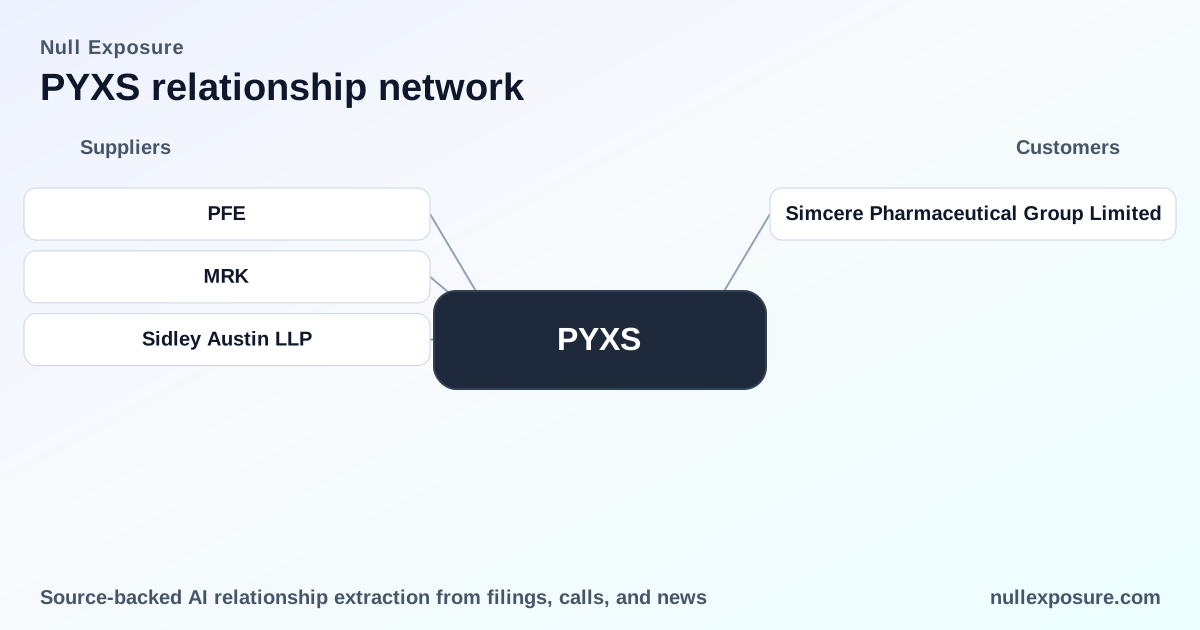
Pyxis Oncology: supplier relationships that shape a small ADC biotech’s runway and risk profile
Pyxis Oncology develops antibody-drug conjugates (ADCs) and monoclonal antibody immunotherapies and monetizes through clinical advancement, licensing, and eventual out-licensing or commercial partnerships for approved assets. The company operates as a research and development–focused biotech that relies heavily on third-party licensors, contract manufacturers and clinical partners to advance programs like MICVO (micvotabart pelidotin) and PYX-201; revenue to date is minimal and value is driven by milestone and strategic collaboration optionality. For a concise supplier intelligence view for asset managers and procurement teams, review how each external relationship affects program continuity, spend exposure and clinical de‑risking. Learn more about supplier relationship signals at https://nullexposure.com/.
How Pyxis runs the business: outsourced R&D, licensed intellectual property, and milestone economics
Pyxis deliberately keeps capital intensity low on fixed assets: it does not own cGMP manufacturing facilities and contracts out development and manufacture to CDMOs and CROs, while licensing core technology in and out where strategic. Financial obligations include sizable contingent milestone commitments tied to licensed ADCs; these are material to modeling long-term cash needs and dilution risk. The company’s limited current revenue and negative operating margin mean external partnerships and licensing terms determine both upside (milestone receipts, co-development) and downside (contingent payments, manufacturing spend).
- Contracting posture: externalized manufacturing and clinical operations; non‑discretionary reliance on third parties for GMP supply and trials.
- Concentration/criticality: a small number of program-level partners (notably Merck and Pfizer-origin IP) drive clinical progress for lead assets and therefore are mission-critical.
- Maturity: preclinical-to-early clinical stage; relationships tilt toward research, licensing and clinical collaboration rather than commercialization today.
- Spend profile: milestone obligations in the hundreds of millions create potential future cash outflows and contingent liabilities that matter to valuation.
Explore supplier impact frameworks and operational exposure at https://nullexposure.com/.
Relationship run‑down — each mention, with an investor‑facing interpretation
Pfizer — GlobeNewswire press release (May 24, 2023)
Pyxis’s FACT ADC toolkit of linkers, payloads and conjugation chemistries was previously obtained from Pfizer, indicating Pyxis’s ADC platform incorporates Pfizer‑origin technology that enables its conjugation strategies. According to a Pyxis acquisition announcement (May 24, 2023), the FACT toolkit provenance traces to Pfizer’s prior work, underpinning technical capability for some ADC candidates. Source: GlobeNewswire press release, May 24, 2023 (https://www.globenewswire.com/news-release/2023/05/24/2675054/0/en/Pyxis-Oncology-to-Acquire-Apexigen.html).
Merck & Co., Inc. — GlobeNewswire release (Dec 18, 2025)
Pyxis has a Clinical Trial Collaboration Agreement with Merck to evaluate MICVO in combination with Keytruda in dose‑escalation cohorts across multiple tumor types, positioning Merck as a strategic clinical partner validating combination potential. The company announced positive preliminary Phase 1 data and explicitly cited the collaboration with Merck in the Dec 18, 2025 release. Source: GlobeNewswire press release, Dec 18, 2025 (https://www.globenewswire.com/news-release/2025/12/18/3207556/0/en/Pyxis-Oncology-Announces-Positive-Preliminary-Phase-1-Data-for-Micvotabart-Pelidotin-MICVO-in-Recurrent-Metastatic-Head-and-Neck-Squamous-Cell-Carcinoma.html).
Merck — GlobeNewswire investor notice (Nov 3, 2025)
Investor communications reiterate that MICVO is in Phase 1 studies as both monotherapy and in combination with Merck’s KEYTRUDA, reinforcing Merck’s ongoing operational role in clinical development rather than a mere commercial agreement. Source: GlobeNewswire investor release, Nov 3, 2025 (https://www.globenewswire.com/news-release/2025/11/03/3179791/0/en/Pyxis-Oncology-to-Participate-in-Upcoming-Investor-Conferences.html).
Pfizer — FierceBiotech coverage (article date in 2026)
Industry coverage links PYX-201 back to an in‑license from Pfizer and notes PYX-201 uses an optimized auristatin payload that originated with Pfizer; this shows Pyxis’s program lineage leverages large‑cap pharma chemistry. FierceBiotech reported that PYX-201 was originally in‑licensed from Pfizer following an ADC readout that impacted shares. Source: FierceBiotech (news article), 2026 (https://www.fiercebiotech.com/biotech/pyxis-shares-tumble-after-adc-readout-6-solid-tumors-fails-spark-inspiration-analyst).
Merck & Co. (Merck Sharp & Dohme LLC) — GlobeNewswire leadership release (Feb 3, 2026)
Pyxis’s Feb 3, 2026 leadership update reiterates MICVO’s Phase 1 monotherapy and MICVO/Keytruda combination studies; the repeated citation of Merck and its pembrolizumab program frames Merck as a continuing collaborator across corporate announcements. Source: GlobeNewswire press release, Feb 3, 2026 (https://www.globenewswire.com/news-release/2026/02/03/3230875/0/en/Pyxis-Oncology-Announces-Interim-CEO-Appointment-and-Leadership-Transition-to-Support-Strategic-Focus-and-Program-Continuity.html).
Merck — CityBiz article on leadership transition (Feb 2026)
Local business press covering the interim CEO appointment also emphasizes the MICVO + pembrolizumab combination in first‑ and second‑line R/M HNSCC, demonstrating that strategic communications consistently position Merck as the combo partner. Source: CityBiz (article), Feb 2026 (https://www.citybiz.co/article/801398/pyxis-oncology-appoints-thomas-civik-as-interim-ceo/).
Sidley Austin LLP — GlobeNewswire acquisition note (May 24, 2023)
Sidley Austin serves as legal advisor to Pyxis in the Apexigen acquisition, signaling engagement with top‑tier external legal counsel for corporate transactions and IP work. Source: GlobeNewswire press release, May 24, 2023 (https://www.globenewswire.com/news-release/2023/05/24/2675054/0/en/Pyxis-Oncology-to-Acquire-Apexigen.html).
Merck — Yahoo Finance coverage (Dec 18, 2025)
Financial media coverage of Pyxis’s positive preliminary data again cites the Clinical Trial Collaboration Agreement with Merck, reinforcing the same partnership details for investor audiences. Source: Yahoo Finance, Dec 18, 2025 (https://finance.yahoo.com/news/pyxis-oncology-announces-positive-preliminary-120000786.html).
Merck Sharp & Dohme LLC — GlobeNewswire leadership release (Feb 3, 2026) — duplicate entry
The Feb 3, 2026 GlobeNewswire item also lists Merck Sharp & Dohme LLC as the formal entity for the pembrolizumab collaboration, indicating the legal entity under which the clinical trial collaboration is executed. Source: GlobeNewswire press release, Feb 3, 2026 (https://www.globenewswire.com/news-release/2026/02/03/3230875/0/en/pyxis-oncology-announces-interim-ceo-appointment-and-leadership-transition-to-support-strategic-focus-and-program-continuity.html).
Merck & Co. — FierceBiotech (FY2024 mention)
Earlier FierceBiotech reporting noted Pyxis teaming up with Merck to test PYX-201 plus Keytruda in dose-escalation and expansion cohorts, documenting the collaboration predates some more recent positive-data headlines and is material to program timelines. Source: FierceBiotech (news article), 2024 (https://www.fiercebiotech.com/biotech/pyxis-shares-tumble-after-adc-readout-6-solid-tumors-fails-spark-inspiration-analyst).
What these relationships mean for investors and operators
- Clinical de‑risking via Merck collaboration is the most consequential relationship: Merck’s Keytruda combination trials move MICVO and PYX-201 from isolated proof-of-concept toward broader commercial relevance if efficacy signals sustain; that makes Merck both a strategic partner and a gating factor for upside.
- IP and payload lineage tied to Pfizer technology increases technical depth but creates dependency on licensed chemistry and milestone terms: multiple mentions that core conjugation chemistries and payloads originate from Pfizer indicate Pyxis’s innovation is augmented by acquired pharma IP.
- Operationally, Pyxis is a high‑outsource company: the company explicitly relies on CROs and CDMOs and engages outside counsel for transactions, so supplier continuity and contract terms are critical to execution.
- Cashflow risk tied to contingent milestones: company statements disclose aggregate milestone obligations in the hundreds of millions, which is material to forecasting future financing needs and potential dilution.
If you manage counterparty risk, procurement or investment exposure, align your diligence to clinical timelines with Merck, licensing economics tied to Pfizer-origin IP, and CDMO/CRO capacity planning. For a structured supplier risk brief and to prioritize monitoring, visit https://nullexposure.com/.
Bottom line and recommended monitoring
Pyxis is a small-cap, R&D-oriented biotech whose near-term valuation is driven by clinical progress with Merck and licensed technology from Pfizer, while contracted manufacturing and significant contingent milestone obligations create execution and financial risk. Track Merck trial readouts, any Pfizer licensing clarifications, and CDMO agreements as the highest-impact supplier signals. For tailored supplier intelligence and ongoing monitoring, consider starting a supplier profile at https://nullexposure.com/.
Bold takeaways: Merck collaboration is mission‑critical; Pfizer-origin chemistry underpins ADC programs; outsourced manufacturing and large contingent payments create concentrated operational and financial exposure.