Papa John’s (PZZA) — supplier relationships and what they mean for investors
Papa John’s operates and monetizes as a hybrid restaurant franchisor and operator: the company generates steady royalty and supply revenues from a global franchise base while capturing higher-margin sales through corporate-owned stores and delivery/takeout channels. Revenue streams are anchored by franchise fees, supplier agreements, and omnichannel ordering economics; recent investments in in-store technology and cloud analytics are designed to compress operating costs and accelerate digital ordering growth. For investors, the critical questions are how supplier concentration and technology partners shape margins, execution risk, and capital intensity.
Explore deeper supplier intelligence at https://nullexposure.com/ for more context and comparable supplier profiles.
Supplier relationships that move the P&L
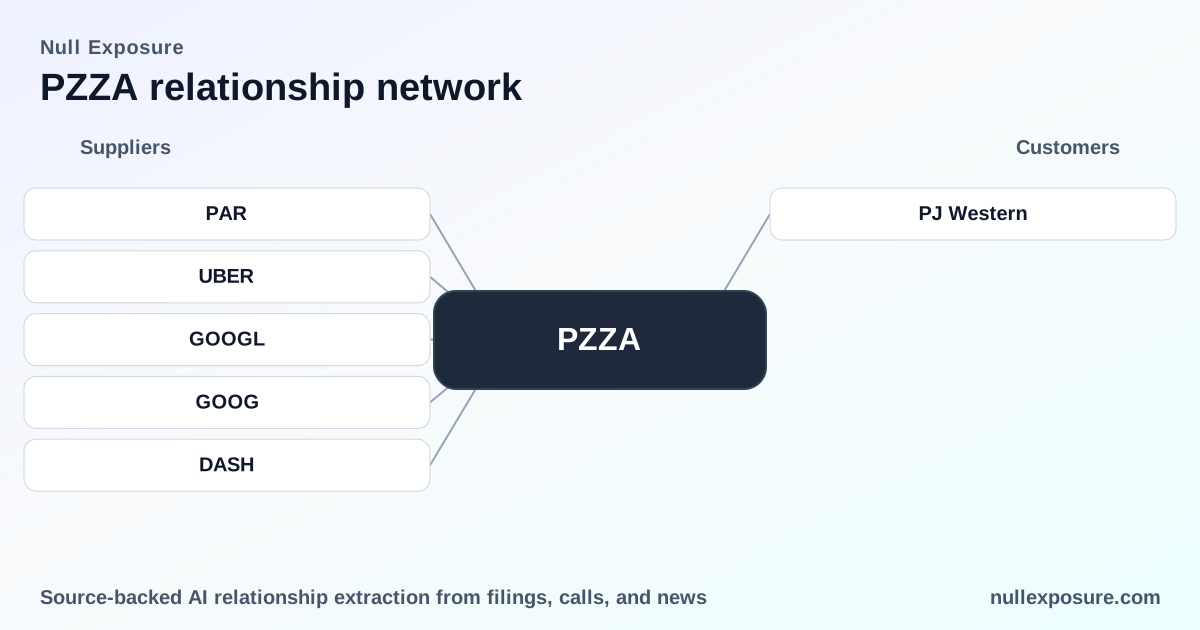
Below I cover every supplier relationship surfaced in the company’s public disclosures and reporting. Each entry is a plain-English investor summary with the source cited.
PAR Technology — core in-restaurant POS and ops platform
Papa John’s selected PAR Technology’s PAR POS and PAR OPS to serve as the standardized point-of-sale and restaurant operations backbone across roughly 3,200 U.S. corporate and franchise locations, positioning PAR as a strategic technology supplier for front-of-house ordering, kitchen operations, and above-restaurant management. According to company commentary and trade press in January 2026, this is a multi-year technology modernization to unify make-line, labour, and inventory workflows. (Sources: Q4 2025 earnings call; January 2026 coverage in Restaurant Technology News and Franchising.com.)
Google Cloud — enterprise AI and analytics partner
Papa John’s is expanding its partnership with Google Cloud to bring AI, analytics, and agentic ordering capabilities into its unified platform, enabling voice and text ordering unification and advanced analytics across stores. Retail-systems and Restaurant Technology News reported in early 2026 that Google Cloud is being used to drive the company’s AI roadmap alongside the in-store tech stack. (Sources: Q4 2025 earnings call; January 2026 coverage in Retail-Systems and Restaurant Technology News.)
Uber Eats — delivery channel strength and demand contribution
Management cited notable strength in Uber Eats performance on the Q4 2025 call, signaling that Uber remains a material channel for digital sales and delivery demand capture. Aggregator performance like Uber Eats drives incremental delivery volume and is an important component of the company’s digital revenue mix. (Source: Q4 2025 earnings call, March 2026.)
DoorDash — aggregator presence and market access
Industry reporting notes that Papa John’s is active on aggregator apps including DoorDash, reflecting broad distribution via third-party delivery platforms that contribute to omnichannel reach, especially in markets where in-house delivery is constrained. Aggregators remain a channel cost to monitor, but they also extend customer access. (Source: Restaurant Business Online, January 2026.)
What the supplier picture reveals about Papa John’s operating model
The supplier relationships show a deliberate shift: Papa John’s is centralizing technology and analytics while relying on third-party aggregators for delivery reach. That mix has distinct operational and financial consequences:
- Contracting posture: The company is moving from a patchwork of legacy systems to a consolidated vendor stack (PAR + Google Cloud), implying longer-term, strategic contracts and higher switching costs for point-of-sale and cloud services.
- Concentration and criticality: Food ingredient sourcing exhibits concentration that is operationally critical — the company discloses sole-source dependencies for certain ingredients; technology partners are likewise becoming mission-critical as they anchor store-level operations and AI-enabled ordering.
- Maturity and capital posture: The vendor program is in a modernization phase: capital spending for property and equipment has been consistent and material, indicating ongoing investment cycles to roll out new systems at scale.
- Vendor mix: A blend of enterprise software (PAR, Google Cloud) and marketplace partners (Uber Eats, DoorDash) reduces single-vendor dependence for distribution but increases exposure to aggregator economics.
If you want a side-by-side view of vendor-level risk factors across chains, visit https://nullexposure.com/ for comparative supplier intelligence.
Company-level supply constraints and investor implications
Papa John’s public disclosures include supplier constraints that are meaningful at the company level:
- Critical single-source for mozzarella cheese. Management states the company is dependent on a sole supplier for domestic mozzarella and substantially all international mozzarella, which creates high operational risk if supply is disrupted.
- Notable sole source for garlic sauce. Garlic sauce is supplied from a sole source and represents a small but specific continuity risk for product consistency and menu offerings.
- CapEx and spend band signal. Purchases of property and equipment totaled approximately $72–78 million annually from 2022–2024, placing capital and vendor technology spend in the $10M–$100M range, consistent with multi-year rollout programs for POS and store modernization.
These are company-level constraints: they indicate supplier concentration and capital commitment that investors must factor into scenario analysis for cost disruption, inflation pass-through, and recovery timelines.
What it means for margins and risk management
- Margin upside from tech consolidation. Standardizing on PAR and integrating Google Cloud analytics create the potential for lower labor and inventory costs through AI-driven scheduling and inventory controls, which improves operating margin if rollout and franchise adoption execute on plan.
- Risk from ingredient concentration. Sole-source cheese exposure is a direct operational risk that can pressure cost of goods sold abruptly; supply diversification or contractual protections should be a board-level focus.
- Aggregator economics remain a double-edged sword. Uber Eats and DoorDash drive volume but compress net revenue per order through fees; monitoring commission trends and in-house delivery economics is essential.
Strategic questions for investors and operators
- How enforceable are long-term rollout commitments with franchisees for the PAR/Google Cloud implementations?
- What contractual protections or alternatives exist for the mozzarella and garlic sauce supply chains?
- What sensitivity does EBITDA have to aggregator fee inflation versus gains from technology-driven labor efficiencies?
If you want tailored supplier risk assessments or comparative vendor exposure across the restaurant sector, start here: https://nullexposure.com/.
Bottom line
Papa John’s is executing a clear technology-driven play to standardize in-restaurant operations and unlock AI-enabled ordering economics while relying on aggregators for distribution reach. Investors should weigh the upside from operational efficiency against clear supplier concentration risks in critical ingredients and the ongoing cost dynamics of third-party delivery. Active monitoring of rollout progress, supplier contract terms, and aggregator commission trends will determine whether the technology investments translate into durable margin improvement.
For ongoing supplier monitoring and alerts on material relationship changes, visit https://nullexposure.com/ and subscribe for updates.