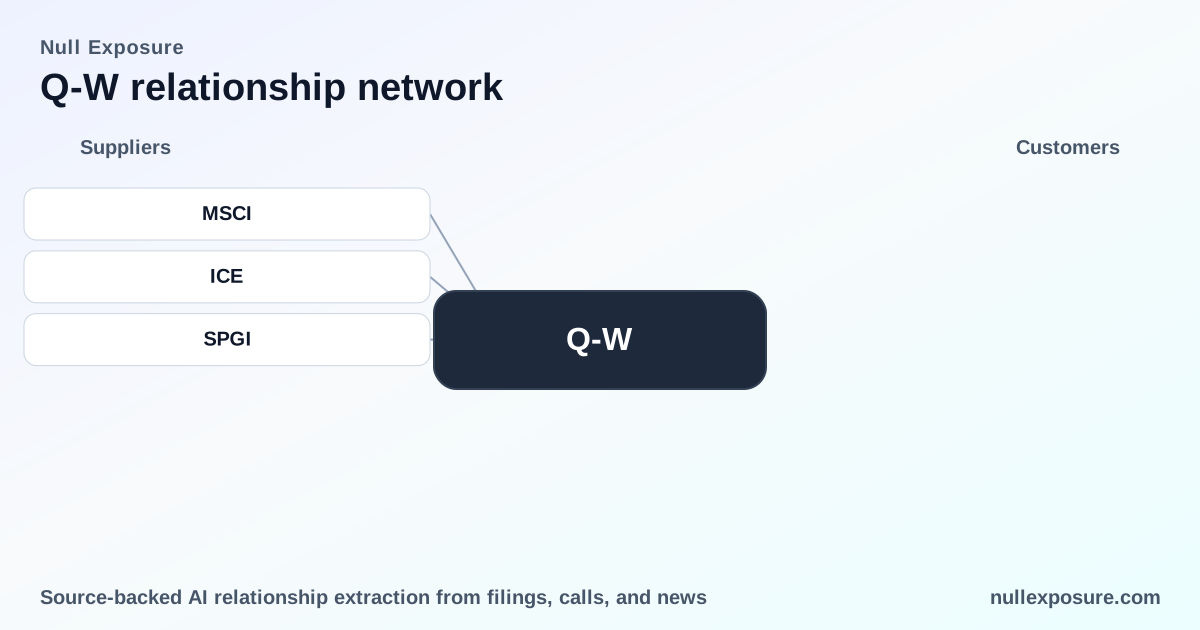
Q-W Supplier Profile: What investors need to know about the company’s market plumbing
Q-W operates as a public company classified in the Information Technology – Semiconductors & Semiconductor Equipment segment and monetizes primarily through the sale of semiconductor-related products and services to OEMs and industrial customers, with its market access and investor flows tightly influenced by exchange listing and index classification. This profile focuses on the external supplier and market-provider relationships that shape liquidity, passive investor exposure, and narrative risk for Q-W.
For an integrated view of supplier relationships and market signals, visit https://nullexposure.com/.
Why the exchange and index providers matter to a supplier like Q-W
The mechanics of being listed and indexed are not peripheral for a capital-intensive supplier; they directly affect share demand, trading liquidity, and the cost of capital. Listing on a major exchange and inclusion in GICS categories determine which passive funds and benchmarks automatically consider Q-W, which in turn drives sizeable flows into (or out of) the stock independent of operating performance. Investors evaluating Q-W must treat these market infrastructure relationships as de facto commercial counterparts that influence valuation and volatility.
What the data shows about Q-W’s market providers
The records returned for Q-W identify three market infrastructure relationships reported in November 2025. Each relationship below is summarized in plain English with the originating source.
MSCI
- MSCI provided the GICS classification that places Q-W within the Semiconductors & Semiconductor Equipment industry, which dictates how index products treat the company for passive allocations and screens. According to a MarketMinute report on FinancialContent (Nov 3, 2025), MSCI’s classification contributed to Q-W’s sector positioning. Source: MarketMinute, FinancialContent, 2025-11-03 — https://markets.financialcontent.com/stocks/article/marketminute-2025-11-3-qnity-electronics-ignites-nyse-trading-on-a-day-of-significant-market-shifts
New York Stock Exchange (NYSE)
- The New York Stock Exchange facilitated Q-W’s listing, anchoring its primary market liquidity and regulatory framework; the NYSE relationship governs continuous disclosure, trading venue rules, and listing eligibility. The MarketMinute article on FinancialContent notes the NYSE listing event tied to Q-W’s market debut (Nov 3, 2025). Source: MarketMinute, FinancialContent, 2025-11-03 — https://markets.financialcontent.com/stocks/article/marketminute-2025-11-3-qnity-electronics-ignites-nyse-trading-on-a-day-of-significant-market-shifts
S&P Global
- S&P Global, alongside MSCI, supplied the GICS classification placing Q-W in the Information Technology sector and the Semiconductors & Semiconductor Equipment subgroup, affecting how S&P index-linked funds and analytics cover the company. The classification detail is reported in the same MarketMinute FinancialContent dispatch (Nov 3, 2025). Source: MarketMinute, FinancialContent, 2025-11-03 — https://markets.financialcontent.com/stocks/article/marketminute-2025-11-3-qnity-electronics-ignites-nyse-trading-on-a-day-of-significant-market-shifts
Company-level constraints and operating model signals
There are no explicit contractual constraints disclosed in the records provided. Treat the absence of listed constraints as a company-level signal about reporting and public visibility: Q-W operates under standard public-company obligations rather than under bespoke, disclosed supplier contracts with market providers.
From an operating-model perspective, several characteristics follow from Q-W’s supplier and market-provider footprint:
- Contracting posture: Interaction with index providers and exchanges is governed by standardized listing and classification frameworks rather than bespoke bilateral commercial contracts; this produces a predictable, rules-based external interface.
- Concentration: Market access is concentrated in a handful of infrastructure providers (major exchanges and index providers), creating single-point exposures in investor flows and classification outcomes.
- Criticality: These relationships are highly critical for capital access and investor demand; reclassification or delisting events would have material implications for liquidity and passive fund holdings.
- Maturity: Presence on the NYSE and coverage by S&P/MSCI imply a degree of market maturity and institutional visibility that supports broader analyst coverage and potential inclusion in benchmarked funds.
What investors and operators should watch next
The interplay between listing venue and index classification creates predictable channels for flow-driven volatility and re-rating events. For an investor or operator evaluating exposure to Q-W, focus on three actionable areas:
- Liquidity and passive flow sensitivity: Index inclusion/exclusion events drive step changes in demand regardless of near-term revenue performance.
- Governance and disclosure cadence: NYSE listing subjects Q-W to strict disclosure timelines, which investors can use to anticipate flow triggers around earnings and material events.
- Classification risk: GICS changes at MSCI or S&P have outsized valuation effects for a sector-specific supplier; tracking reclassification proposals is essential.
Key risk and opportunity drivers:
- Passive fund flows tied to GICS and index rules.
- Listing venue rules and trading liquidity managed by the NYSE.
- Visibility and analytics framing provided by S&P Global and MSCI coverage.
Quick risk checklist for portfolio teams
- Rapid index reclassification can change the marginal buyer universe overnight.
- Concentration in a small set of market providers creates systemic exposure to policy changes.
- Listing and governance demands increase short-term reporting discipline and potential activist interest.
For more granular supplier relationship mapping and real-time monitoring, explore our tools at https://nullexposure.com/.
Bottom line and recommended next steps
Q-W’s market relationships — listing on the NYSE and classification by S&P Global and MSCI — are fundamental determinants of investor demand rather than peripheral vendor contracts. Investors and corporate operators must treat these market providers as strategic partners whose decisions materially affect liquidity, valuation multipliers, and passive ownership composition.
Recommended actions:
- Maintain an indexed-watch process to flag GICS review windows at MSCI and S&P Global.
- Model passive fund flow scenarios tied to index inclusion thresholds.
- Monitor NYSE compliance calendar for disclosure events that could trigger re-rating.
Investigate these relationships in depth at https://nullexposure.com/ for a structured view of how market infrastructure shapes supplier valuation and capital access.