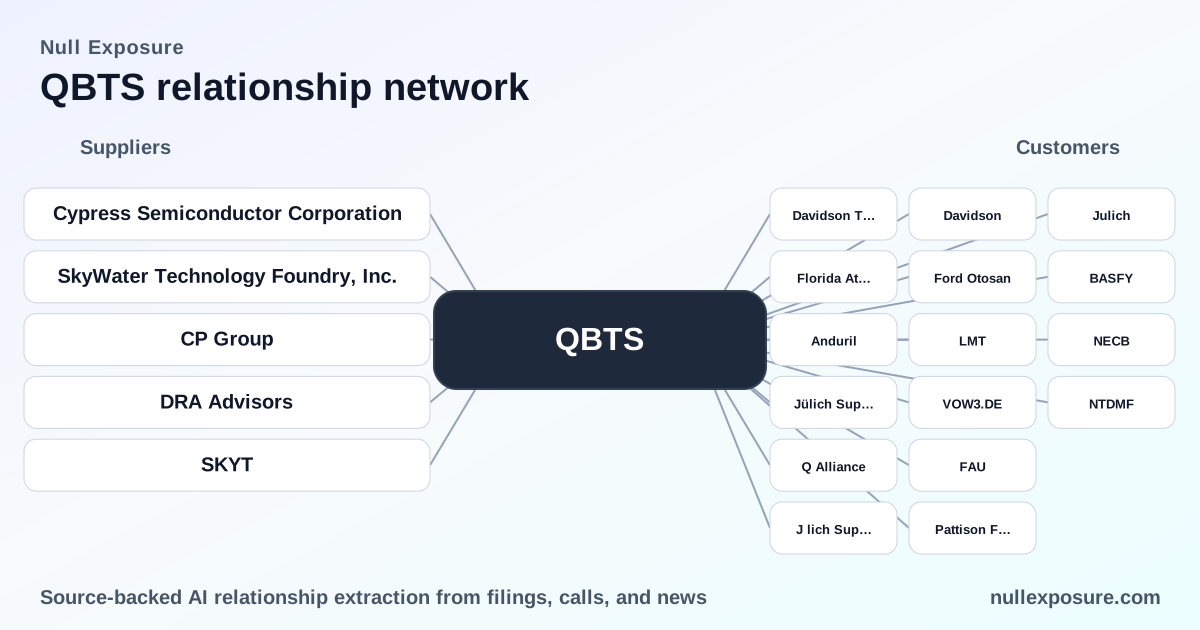
D-Wave’s supplier map: which partners drive capacity, cash and operational risk
D-Wave Quantum (QBTS) sells quantum computing systems, software and cloud services and monetizes through hardware sales, recurring software/cloud subscriptions, support services and periodic capital raises. Its operating model depends on long-standing fabrication capacity agreements for critical wafer processing, third‑party professional and capital markets service providers, and more recent real estate/lease relationships tied to corporate relocation — each relationship directly affects supply continuity, cost structure and execution risk for commercialization.
If you evaluate counterparty risk or supplier concentration for quantum hardware investments, start here and then review underlying filings and press releases on NullExposure: https://nullexposure.com/
How D-Wave contracts and where the real risks live
D-Wave’s supplier posture is a hybrid of long-term capacity commitments for semiconductor processing and outsourced professional services for financing, security reviews and leasing. That mix produces the following operational characteristics investors should price:
- Contracting posture: historic capacity purchase agreements dating back to 2012 that were later assigned — these are structural, not spot procurements, which reduces short-term supply volatility but creates lock‑in and renewal risk.
- Concentration and criticality: wafer fabrication partners handle wiring and active device processing that are critical to system performance; single-source elements (Josephson junctions and specific process steps) create outsized operational leverage.
- Service-provider dependency: capital markets agents and third-party security reviewers are integral to liquidity and compliance workflows; their commercial terms can influence dilution pace and governance optics.
- Geopolitical exposure: company filings explicitly call out supplier locations in APAC as a business risk vector, translating macro trade policy into a potential supply shock.
These are company-level signals drawn from recent filings and disclosures; they shape capital allocation and supplier-management strategy rather than single-contract minutiae. For direct company documents and an organized supplier view visit https://nullexposure.com/
The relationships investors need on their radar
Below I list every supplier relationship cited in D‑Wave’s supplier disclosures and associated news items, with plain-English takeaways and source citations.
Cypress Semiconductor Corporation
D‑Wave has a capacity purchase agreement dating to December 31, 2012 for Cypress’s 8‑inch wafer semiconductor line — a long-term capacity arrangement that underpinned early fabrication needs. This is documented in D‑Wave’s FY2024 Form 10‑K, which records the original purchase-of-capacity agreement. (Source: D‑Wave 2024 Form 10‑K, FY2024)
SkyWater Technology Foundry, Inc. (assignment of Cypress agreement)
On September 30, 2017, Cypress assigned its Semiconductor Line Operation Agreement to SkyWater, and D‑Wave consented to that assignment; the assignment effectively transferred operational responsibility for the wafer line to SkyWater. The assignment is recorded in the FY2024 10‑K and represents a structural shift of manufacturing counterparty. (Source: D‑Wave 2024 Form 10‑K, FY2024)
SkyWater (fabrication role described in earnings commentary)
In a Q4 2025 earnings call transcript, D‑Wave executives explained that SkyWater fabricates the wiring for their annealing systems but does not fabricate the Josephson junction active components, which are the most critical IP‑sensitive elements. That public commentary clarifies the fabrication split: SkyWater handles key but not all process steps. (Source: Q4 2025 earnings call transcript, reported by InsiderMonkey, March 2026)
CP Group (leasing partner for headquarters and R&D)
CP Group, together with DRA Advisors, signed a landmark lease with D‑Wave as the company moved headquarters and R&D operations to Florida — this is a material real estate relationship that affects operating cost base and regional footprint. The lease was announced in a January 28, 2026 press release covered by The Quantum Insider. (Source: The Quantum Insider press release, January 28, 2026)
DRA Advisors (co‑lessor / transaction partner)
DRA Advisors joined CP Group in the announced lease agreement with D‑Wave, positioning itself as a financial/real‑estate partner on the headquarters relocation; this ties D‑Wave’s physical expansion and occupancy economics to these owner‑operators. The lease announcement is reported in the same January 28, 2026 press release. (Source: The Quantum Insider press release, January 28, 2026)
What these ties mean for valuation and execution risk
The supplier set reflects a predictable maturity curve: legacy capacity deals secured in 2012 and reassigned in 2017 provide continuity but create renewal and technology‑migration risk; SkyWater’s role as the fabricator of wiring (but not junctions) reveals a split supply chain where the most IP‑sensitive steps remain concentrated and must be managed internally or through a different supplier strategy.
Key investor takeaways:
- Upside engine: long-term fabrication arrangements reduce short-term production uncertainty and enable roadmap execution for annealing systems.
- Dilution and liquidity mechanics: D‑Wave’s use of ATM agents and third‑party capital markets providers is a service‑provider relationship that directly influences capital availability and issuance economics. Evidence of these service relationships and the ATM program is present in company disclosures.
- Geopolitical and manufacturing risk: a company filing explicitly flags suppliers located in APAC and the trade environment as a material business risk; this is a corporate-level constraint that amplifies the impact of supply interruptions on product timelines.
If you’re constructing a supplier-sensitive model for quantum hardware revenue and margin ramp, factor in single‑step manufacturing scarcity, capital markets dependency and the fixed-cost implications of the new Florida lease. Detailed supplier intelligence and contract timelines are available at NullExposure: https://nullexposure.com/
Watch list: triggers that will change the thesis
- Renewal or expansion of wafer capacity agreements with SkyWater or a transfer of Josephson junction fabrication to an alternate supplier.
- Public updates on APAC supplier exposure, tariffs, or export controls that affect wafer processing or materials sourcing.
- Lease activation and occupancy details from CP Group/DRA Advisors that change SG&A run‑rate and operating leverage.
- Changes to the ATM program or new underwriting arrangements that materially affect dilution pacing.
Bottom line
D‑Wave’s supplier ecosystem is a mix of legacy, high‑criticality manufacturing relationships and service providers tied to financing and real estate — together these relationships define execution risk for product delivery, capital structure and operating cost. Investors should already be pricing manufacturer concentration, APAC geopolitical exposure, and the company’s reliance on third‑party agents for capital execution into any valuation or operational due diligence. For a consolidated view of these supplier relationships and primary source documents, visit https://nullexposure.com/ and start your due diligence.