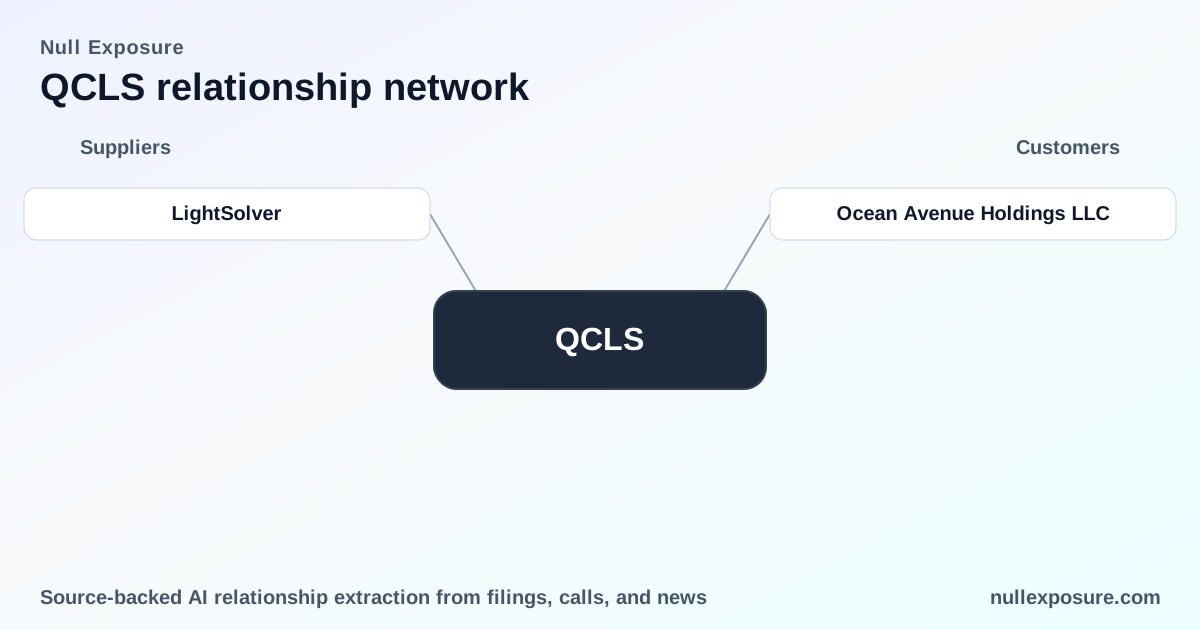
Q/C Technologies (QCLS): Strategic supplier relationships and what they mean for investors
Q/C Technologies monetizes intellectual property and partnerships rather than a high-volume software subscription business: the company holds and commercializes exclusive licensing rights to photonic, quantum‑inspired processing units and pursues strategic commercial channels—notably blockchain/crypto infrastructure—while redeploying legacy capabilities from prior pharmaceutical operations. Revenues will be driven primarily by licensing, commercialization of LightSolver’s laser‑based LPUs in targeted verticals, and potential royalties or usage‑based fees tied to deployment. Q/C is a small‑cap, high‑volatility Nasdaq issuer with a capital structure and operational footprint that reflect a pivoted technology playbook; investors should read supplier relationships as strategic assets and potential concentration risks. Visit the NullExposure homepage for deeper supplier intelligence: https://nullexposure.com/
Why the LightSolver licensing picture matters to the investment case
Q/C’s public disclosures and press coverage consistently frame the partnership with LightSolver as the company’s core hardware/software enabler: the license grants exclusive rights to LightSolver’s laser‑based processing units (LPUs) for compute‑intensive combinatorial problems and, in multiple statements, for the cryptocurrency vertical. That exclusivity is the company’s primary industrial moat and the vector for monetization—through product development, service contracts, and commercial deployments that can command usage fees or royalties.
- Concentration: the repeated, exclusive LightSolver license concentrates technology risk in a single supplier relationship.
- Commercial criticality: LPUs are described as central to Q/C’s blockchain and compute infrastructure strategy; the relationship is therefore operationally critical.
- Stage and maturity: public materials show active board and advisory hires and product messaging rather than large commercial deployments, indicating an early commercial stage.
If you want ongoing coverage of supplier signals and relationship-level intelligence, start here: https://nullexposure.com/
Line‑by‑line: every public mention of the LightSolver relationship
Below are plain‑English summaries for each media mention in the public record. Each entry references the original press or media source.
-
CityBiz (FY2025) — https://www.citybiz.co/article/759786/q-c-technologies-appoints-technion-professor-dr-steven-frankel-as-senior-quantum-advisor/
CityBiz reported that Q/C holds exclusive rights to LightSolver’s quantum‑inspired laser‑based LPUs, positioning the company to solve compute‑intensive combinatorial and physical problems at light speed. This coverage accompanied an advisory appointment reinforcing the technical credibility of that licensing strategy. -
CityBiz (FY2026) — https://www.citybiz.co/article/795362/q-c-technologies-appoints-chelsea-voss-to-board/
CityBiz noted the LightSolver license again, emphasizing that Q/C’s exclusive LPU rights are being positioned specifically for crypto applications, aligned with recent board appointments focused on AI and systems leadership. -
ManilaTimes / GlobeNewswire (FY2025) — https://www.manilatimes.net/2025/12/09/tmt-newswire/globenewswire/quantum-class-computing-developer-qc-technologies-welcomes-strategic-advisor-martin-shkreli/2240060
The ManilaTimes press release reiterated Q/C’s exclusive LPU licensing for cryptocurrency‑targeted workloads, tying the technology announcement to the onboarding of a strategic advisor. -
The Globe and Mail press release (FY2025) — https://www.theglobeandmail.com/investing/markets/stocks/QCLS-Q/pressreleases/36552963/q-c-technologies-partners-with-ocean-avenue-holdings/
A Globe and Mail release referenced the LightSolver licensing arrangement as a core technology asset while announcing a separate partner engagement, underscoring the license’s centrality to Q/C’s product roadmap. -
TS2.Tech market commentary (FY2025) — https://ts2.tech/en/q-c-technologies-qcls-stock-skyrockets-on-martin-shkrelis-100-quantum-class-call-whats-really-behind-the-rally-on-december-4-2025/
Market commentary described Q/C’s exclusive global rights to LightSolver LPUs for the crypto sector and framed the deal as positioning Q/C to build energy‑efficient blockchain infrastructure, a potential commercial niche. -
The Globe and Mail (FY2026) — https://www.theglobeandmail.com/investing/markets/markets-news/GlobeNewswire/37128162/q-c-technologies-appoints-ai-systems-leader-chelsea-voss-to-board-of-directors/
This Globe and Mail release linked the LightSolver partnership to a mission to advance photonic computing platforms for improved speed, energy efficiency, and scalability in blockchain and other compute‑heavy applications. -
The Globe and Mail press release (FY2025, listing change) — https://www.theglobeandmail.com/investing/markets/stocks/QCLS/pressreleases/35034007/qc-technologies-formerly-tnf-pharmaceuticals-commences-trading-on-nasdaq-under-new-ticker-symbol-qcls/
When Q/C began trading under the QCLS ticker, the company restated its exclusive license to LightSolver’s LPUs, marking the corporate pivot in public filings and market communications. -
The Globe and Mail (FY2025) — https://www.theglobeandmail.com/investing/markets/stocks/QCLS/pressreleases/36355869/quantum-class-computing-developer-qc-technologies-welcomes-strategic-advisor-martin-shkreli/
Another Globe and Mail release reiterated the LightSolver licensing arrangement and its specific application to the crypto domain as part of strategic advisor announcements. -
The Globe and Mail (FY2026 press) — https://www.theglobeandmail.com/investing/markets/stocks/QCLS/pressreleases/37128162/qc-technologies-appoints-ai-systems-leader-chelsea-voss-to-board-of-directors/
The same Globe announcement appears twice in the public record; it restates the partnership focus on photonic computing and the company’s intent to commercialize those platforms for blockchain and similar workloads. -
MarketScreener (FY2025) — https://www.marketscreener.com/news/q-c-technologies-appoints-technion-professor-dr-steven-frankel-as-senior-quantum-advisor-to-advance-ce7d5adcdb80f024
MarketScreener covered the advisor appointment and repeated that Q/C’s license with LightSolver grants exclusive use of light‑speed LPU technology, reinforcing the technical and strategic narrative in investor‑facing outlets.
Company‑level constraints and what they signal for supplier risk
Q/C’s historical filings—reflected in explicit constraint excerpts—expose company‑level operational patterns that influence supplier posture and risk, independent of the LightSolver license:
- Usage‑based contracting is embedded: historical agreements include royalty obligations tied to a fixed percentage of future revenues and placement‑agent fee structures; this signals a predisposition to monetize intellectual property through royalties and revenue‑linked payments rather than pure fixed fees.
- High dependence on third‑party services and manufacturing: the company’s filings document reliance on CROs/CMOs and third‑party manufacturers for product development and supply, indicating a contracting posture that outsources critical functions to a small set of specialized suppliers.
- Material and critical supplier relationships: the documents describe these third‑party suppliers as material and, in at least one excerpt, critical—meaning supplier failure could stop development or supply.
- Active engagement and limited supplier breadth: evidence of active CRO/CMO engagements and the intent to rely on a limited number of suppliers suggests concentration risk across both services and manufacturing segments.
These company‑level signals imply that Q/C’s supplier strategy combines exclusive licensing with concentrated outsourced execution, requiring investors to monitor counterparty performance and royalty structures closely.
Key investment takeaways and recommended next steps
- Primary value driver: the exclusive LightSolver LPU license. All public communications position that agreement as Q/C’s core technological asset and go‑to market engine.
- Concentration and execution risk are elevated. The company’s narrative, small market cap (approximately $31.2M), negative EPS, and high beta reflect a strategy reliant on a single technology partner plus outsourced execution partners—an execution profile that rewards rapid commercialization but penalizes supplier disruption.
- Contracting posture favors usage‑based economics and royalties. Historical disclosure of royalty and placement‑agent compensation shows Q/C structures arrangements to capture upside tied to revenue or deployment.
For investors and operators focused on supplier diligence, prioritize verification of the LightSolver exclusivity terms, the scope of the license across verticals, counterparty performance metrics, and any royalty or usage‑fee schedules.
If you want an actionable supplier risk brief and ongoing tracking of Q/C’s partner disclosures, start with NullExposure: https://nullexposure.com/ — or request a relationship‑level monitoring package to track changes in exclusivity, royalty terms, and deployment signals.