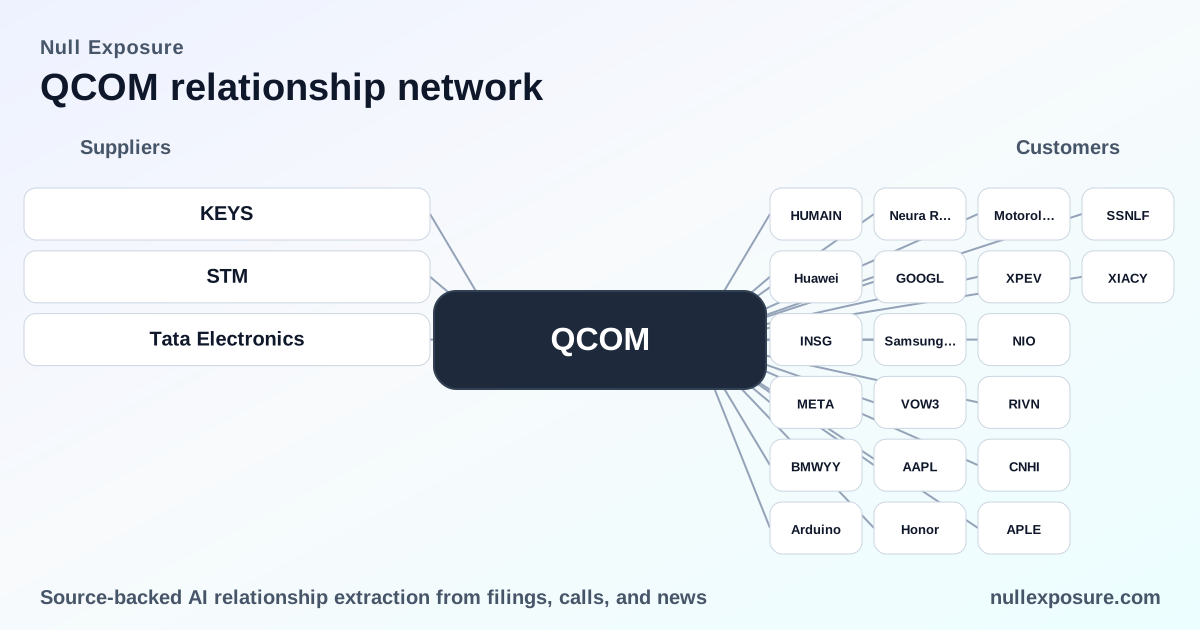
Qualcomm’s supplier posture: concentrated manufacturing, contractual scale, and targeted partnerships
Qualcomm monetizes through a hybrid model: chip and module sales, software and services, and licensing of critical wireless patents that anchor 4G/5G/6G ecosystems. For investors and operators, the company’s supplier relationships are governed by large, multi-year manufacturing commitments, a deep reliance on Asia-Pacific manufacturing and test partners, and targeted engineering collaborations that accelerate wireless platform development. These dynamics create both operational leverage and concentrated counterparty exposure that influence margin durability and capital allocation.
For a concise, supplier-focused briefing and continuous monitoring, visit https://nullexposure.com/ for tailored intelligence.
Quick snapshot: why suppliers shape Qualcomm’s P&L and risk profile
Qualcomm reported trailing revenue of $44.9 billion and market capitalization near $138 billion (latest quarter end), with robust operating margins (about 27.5% TTM) and a mix of product and licensing revenue that moderates cyclicality. The company discloses multi-year purchase commitments and significant near-term payment obligations — company filings show $15.1 billion of purchase obligations as of September 28, 2025, with $10.5 billion due within 12 months — which anchors supplier spend and gives suppliers predictable cash flow. That contractual scale is a double-edged sword: it secures capacity but concentrates counterparty importance and geopolitical exposure.
Supplier relationships currently in the news (what investors need to know)
Keysight Technologies — advancing RF digital twins for massive MIMO
Qualcomm is demonstrating a photorealistic RF digital twin of its massive MIMO prototype network using Keysight’s Channel Studio RaySim combined with Qualcomm’s algorithms, signaling a close engineering collaboration around RF modeling and next‑generation antenna systems. According to a Business Wire / FinancialContent release dated March 3, 2026, the demo was showcased at Keysight’s exhibit (https://markets.financialcontent.com/stocks/article/bizwire-2026-3-3-keysight-and-qualcomm-advance-rf-digital-twins-to-scale-massive-mimo-and-ai-native-6g-research).
Takeaway: This is an engineering partnership that accelerates RF systems validation and points to Qualcomm’s continued investment in foundational wireless research.
STMicroelectronics NV — sensor and NFC validation for Snapdragon Wear Elite
STMicroelectronics’ inertial sensor and NFC controller have been validated for integration with Qualcomm’s next-generation wearable platform, Snapdragon Wear Elite, indicating component-level supplier validation and design wins in wearables. TheLEC reported this validation in March 2026 (https://www.thelec.net/news/articleView.html?idxno=5733).
Takeaway: This is a typical component-level qualification that underpins product roadmaps and end-device OEM integrations in consumer wearables.
Tata Electronics — manufacturing partnership for automotive modules
Qualcomm Technologies and Tata Electronics announced a collaboration under which Tata Electronics will serve as a manufacturing partner for Qualcomm Automotive Modules, reflecting Qualcomm’s strategy of leveraging regional electronics manufacturers for automotive module production. Evertiq covered the announcement on March 9, 2026 (https://evertiq.com/design/2026-03-09-qualcomm-tata-electronics-to-manufacture-automotive-modules).
Takeaway: This is a contract manufacturing relationship that localizes module production and supports Qualcomm’s automotive go-to-market scale.
For ongoing coverage of supplier impact on semiconductor strategies, check https://nullexposure.com/.
Constraints and what they reveal about the operating model
The company-level constraints disclosed in filings and regulatory commentary paint a consistent picture:
- Long-term contracting posture: Qualcomm maintains multi-year capacity and purchase commitments with integrated circuit suppliers, which secures supply and pricing but locks in spend levels. Evidence shows multi-year inventory obligations disclosed in fiscal filings.
- Asia‑Pacific manufacturing concentration: The majority of foundry and assembly/test suppliers are in APAC, with primary facilities in Taiwan, Korea, China, and production-supporting warehouses in Singapore; a significant technical workforce is based in India. This creates geographic concentration risk tied to APAC supply chains.
- Manufacturing via third parties: Qualcomm relies on third parties for manufacturing, assembly, and most testing of its ICs, indicating high operational dependency on external foundries and OSATs rather than captive fabs.
- Service-provider reliance: Qualcomm engages a broad supplier community for IT and specialized services, including cybersecurity and engineering support, consistent with an outsourced services model.
- Active, material spend: Supplier relationships are active and large in scale — filings show purchase obligations of $15.1 billion (Sept 28, 2025) with $10.5 billion due within 12 months, placing Qualcomm in the $100M+ spend band for strategic suppliers.
- Indemnification exposures immaterial: Filings state that claims under indemnities have not been material to consolidated statements, reducing contingent liability concerns as disclosed.
These signals together show a company that manages supplier risk through long-term contracts and third-party manufacturing, trading supplier concentration for capital and operational flexibility.
Operational risk vs. strategic upside — what investors should weigh
- Concentration and geopolitical risk: The APAC concentration of foundry and assembly partners creates supply-chain vulnerability to regional disruptions and export controls. That risk is offset by Qualcomm’s contractual commitments and diversified warehouse footprint in Singapore, but geopolitical shifts would translate quickly into operational stress.
- Contractual leverage and predictability: Multi-year purchase commitments provide cost and capacity predictability and support OEM fulfillment, strengthening margin stability during cyclical demand swings.
- Third-party manufacturing trade-offs: Outsourcing manufacturing keeps capital intensity low and scales product roadmaps quickly, but increases exposure to suppliers’ yield, lead-time, and quality performance.
- Margin resilience and licensing moat: Qualcomm’s high operating margin and licensing franchise provide a margin buffer and pricing power that absorb some supplier shocks.
- Balance sheet and analyst positioning: With institutional ownership above 80% and a forward P/E around 11.6, market expectations reflect earnings visibility and multiple compression opportunities tied to execution.
Key risk factor: supplier concentration in APAC; key upside: contractual scale and licensing royalties that preserve profitability.
Practical next steps for investors and operators
- Monitor supplier diversification moves and regional manufacturing announcements — each signing like the Tata Electronics partnership signals localized production scaling that materially affects regional risk exposure.
- Track supplier payment obligations in quarterly filings to understand near-term cash flow and supplier bargaining power.
- For tailored supplier risk matrices and continuous monitoring, visit https://nullexposure.com/ to see how supplier relationships map to operational and financial exposure.
For further analysis and a live feed of supplier developments tied to portfolio exposure, go to https://nullexposure.com/.
Qualcomm’s supplier ecosystem combines large, long-term contracts with concentrated APAC manufacturing reliance and targeted engineering partnerships. That combination creates predictable capacity and engineering velocity, while concentrating execution risk in a handful of geographies and contract counterparties — a profile investors should surveil but can manage through contract monitoring and diversification tracking.