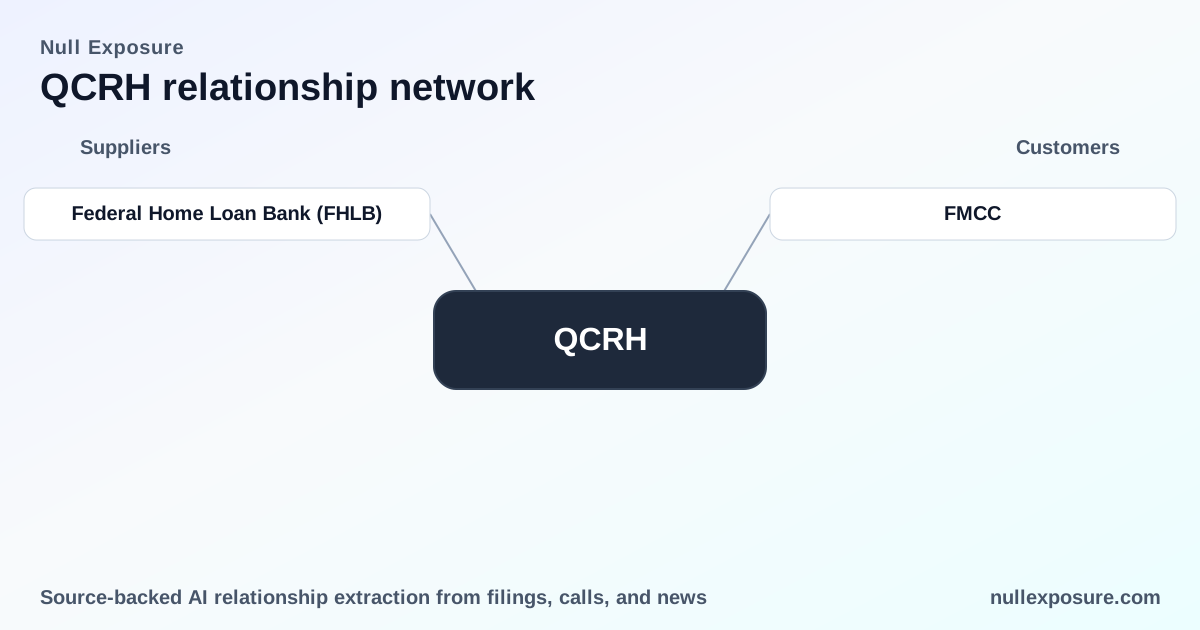
QCR Holdings (QCRH): Funding Optimization and the FHLB Relationship in a Capital-Intensive Year
QCR Holdings operates as a multi-bank holding company that earns through net interest margin on commercial and consumer loans, deposit spreads, and fee-based trust and asset management services. The company monetizes by originating and servicing loans, managing deposits across its subsidiary banks, and selectively selling or syndicating loan assets to free capital and lower funding costs—actions that directly influence return on equity and net interest income. With a market capitalization near $1.39 billion and a trailing P/E around 11x, QCRH is executing active balance-sheet management to protect margins and support profitable growth. Visit the NullExposure homepage for ongoing supplier-insight coverage: https://nullexposure.com/
Quick take: the Federal Home Loan Bank interaction changed the funding mix
During Q4 2025 QCRH reduced term borrowings from the Federal Home Loan Bank (FHLB) by $135 million, using proceeds from a $285.3 million low‑income housing tax credit (LIHTC) construction loan sale to retire high‑cost advances and lower overall funding expense. This transaction is a clear example of management using asset sales to optimize liabilities and preserve margin.
All reported supplier mentions — the FHLB in detail
- QCRH reduced term borrowings from the Federal Home Loan Bank by $135 million during Q4 2025, funded by proceeds from the LIHTC construction loan sale; the move was disclosed in coverage by AlphaStreet on March 10, 2026: https://news.alphastreet.com/qcr-holdings-reports-record-full-year-2025-net-income-of-127-2-million/amp/
- A narrative in AlphaStreet repeating the Q4 detail confirms the use of sale proceeds to lower FHLB exposure and funding cost, published March 10, 2026: https://news.alphastreet.com/qcr-holdings-reports-record-full-year-2025-net-income-of-127-2-million/
- Regional reporting in QuadCities Business also recorded the $135.0 million reduction of FHLB term advances tied to the LIHTC construction loan sale in Q4 2025, reinforcing the local coverage of the transaction: https://quadcitiesbusiness.com/qcr-delivers-record-2025-income-strong-q4-results/
- A Q4 2025 earnings call transcript cited on InsiderMonkey includes management commentary that the LIHTC sale proceeds were used to retire the company’s highest‑cost FHLB term advances, thereby lowering overall funding costs for the banking franchise: https://www.insidermonkey.com/blog/qcr-holdings-inc-nasdaqqcrh-q4-2025-earnings-call-transcript-1684160/
Key relationship takeaway: all observed reporting points to an intentional liability-management decision—sale of construction loans to pay down FHLB advances—delivering immediate funding-cost relief.
Constraints and what they reveal about QCRH’s operating model
The company filings and disclosures surface several operating characteristics that shape supplier and counterparty risk:
- Contracting posture (mix of short- and long-term obligations): QCRH runs both short‑term liquidity facilities and multi‑year construction commitments. The company disclosed a $50.0 million secured revolving credit note with a variable rate and a maturity of June 30, 2025, showing reliance on near-term credit facilities. At the same time, it maintains multi-year construction contracts for new branch facilities (notably a roughly $41.3 million Ankeny project with $32.6 million remaining and a Cedar Rapids project originally ~$17 million with a small remaining commitment). These are company-level signals from the 2024–2025 disclosures.
- Spend concentration and scale: QCRH reports significant balance-sheet commitments—$7.9 billion in deposits and other fixed obligations, subordinated notes around $233.5 million, and 27 lines of credit totaling $1.2 billion, of which substantial capacity is secured. This positions funding counterparties and capital markets providers as material to operations rather than incidental vendors.
- Maturity profile and near-term refinance risk: The presence of a near-term revolver maturity and sizable subordinated debt buckets creates points in time when funding needs and liability rollovers require active management.
- Materiality assessment of correspondent exposures: Management reports that cash held at upstream correspondent banks exceeded insured limits by tens of millions but concluded no material risk of loss—this is a company-level judgment about counterparty risk and liquidity placement.
- Buyer role in operating leases: The company’s operating leases for branch space produce relatively modest lease expenses (hundreds of thousands annually), indicating operational supplier relationships are immaterial relative to balance-sheet funding relationships.
Present these constraints as firm-level operating facts that shape how QCRH sources, prices, and prioritizes suppliers (funding providers, construction contractors, correspondent banks).
What investors should extract from the liability-management move
- Immediate margin benefit. Using the LIHTC construction loan sale to retire the highest‑cost FHLB advances reduces interest expense and improves net interest margin, directly supporting profitability metrics such as the 36% profit margin and 12.1% ROE reported in latest disclosures.
- Balance-sheet flexibility demonstrated. The transaction signals management’s willingness to sell loan assets to optimize capital and funding costs rather than preserve held loans at suboptimal spreads.
- Counterparty importance. The size of FHLB advances relative to QCRH’s overall funding mix makes FHLB access and pricing a strategic supplier relationship that materially affects earnings.
If you track counterparty risk or supplier concentration for banking franchises, add QCRH’s funding counterparties to your focused watchlist. For more signal-driven supplier intelligence and to track counterparties at scale, browse our coverage at https://nullexposure.com/
Actionable investor checklist
- Monitor QCRH’s remaining FHLB advance balances and advance pricing at quarterly updates; reductions directly translate to lower funding costs.
- Track completion and capitalization of the Ankeny and Cedar Rapids branch projects to understand remaining construction capital needs and any additional loan-sale catalysts.
- Watch subordinated notes and debenture refinancing windows for potential stress points or capital-elevating opportunities.
- Review deposits and available credit lines (the reported $1.2 billion capacity) to assess liquidity cushion versus short-term maturities.
Bottom line and next step
QCR Holdings is executing active balance-sheet management—selling loan assets to retire higher‑cost FHLB term advances and tighten funding expense. That liability discipline supports the bank’s margin profile and gives investors a clearer line of sight into how supplier relationships—particularly funding sources—move the P&L. For ongoing supplier-level intelligence and updates on counterparties that affect QCRH’s financials, visit https://nullexposure.com/ and subscribe to vendor-risk monitoring coverage.