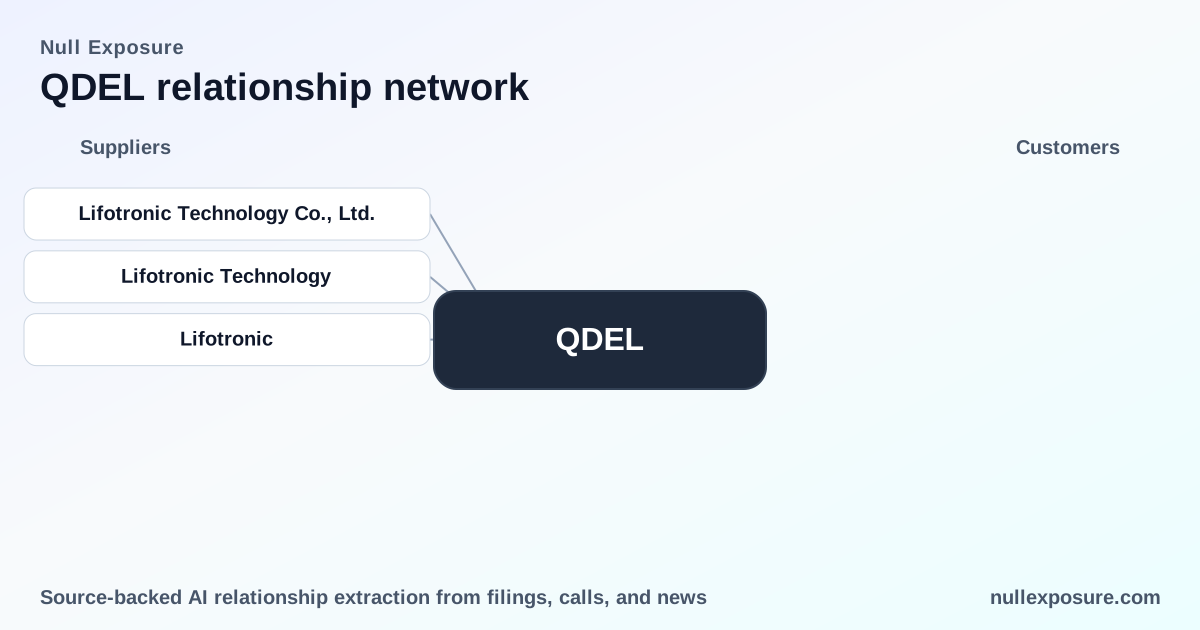
Quidel (QDEL) — supplier relationships: what the Lifotronic deal means for revenue and risk
Quidel (QDEL) operates and monetizes through diagnostic instruments, platform consumables (assays and reagents), and recurring service support for hospitals, reference labs, and point-of-care providers; its margins and cash generation depend on scale in consumables and the breadth of assay coverage globally. The company’s FY‑TTM revenue is roughly $2.73 billion with significant gross profit but mixed bottom‑line performance, so strategic supplier relationships that expand assay access and distribution channels directly support recurring consumable revenue and device placement economics. For investors evaluating supplier exposure and upside from partner-led expansion, this supplier-focused review isolates the public reporting around Quidel’s relationship with Lifotronic Technology and places it in the context of Quidel’s operating model and risk profile.
Discover more supplier intelligence at https://nullexposure.com/.
Why the Lifotronic supply pact is materially important
Quidel announced a long‑term supply agreement with Lifotronic Technology intended to broaden Quidel’s immunoassay footprint outside the U.S., adding analyzers and more than 70 assays — including assays not yet available on Quidel’s VITROS system. That expansion is commercially meaningful because diagnostic platforms monetize disproportionately through consumables and recurring test volume; unlocking new geographies and analyzers accelerates consumable throughput without the full capital and operational burden of direct market deployments. According to several news reports in March 2026, the pact targets select non‑U.S. markets and positions Quidel to capture incremental consumables revenue while leveraging Lifotronic’s installed base (Finviz and SimplyWallSt coverage, March 2026).
This agreement has strategic upside but also raises supplier and execution considerations: contracting posture is long‑term and commercial, concentration risk is moderate to emerging depending on how much Lifotronic contributes to incremental volumes, criticality is high for assay breadth expansion, and maturity is early since the market rollout and conversion of assays to scale remain to be demonstrated. These are company‑level operating signals derived from public reporting and regulatory context rather than transaction‑level promises.
Explore more on partner exposures and supplier maps at https://nullexposure.com/.
Constraints and operating model signals
- Regulatory and manufacturing posture: Quidel’s operations and those of its suppliers are subject to routine regulatory inspection and quality requirements, indicating a manufacturing‑centric contracting posture with compliance obligations across supply chains (company filings).
- Dependence on third‑party service providers: Quidel relies on a small number of third‑party service providers for cloud and delivery services, which is a company‑level signal reflecting service continuity and platform delivery risk.
- Commercial concentration potential: The Lifotronic relationship could be an important route to market outside the U.S., increasing commercial concentration on strategic supplier and distribution partners until Quidel’s direct channels scale.
The press roll: every reported supplier reference and what each item actually said
Below are plain‑English summaries of each reported relationship entry in the supplied results, with source references exactly as reported in the press.
- QuidelOrtho has entered a long‑term strategic supply agreement with Lifotronic Technology Co., Ltd., intended to expand QuidelOrtho’s global immunoassay portfolio and accelerate access to scalable, cost‑efficient solutions across select markets outside the United States; the story was carried by Finviz on March 10, 2026 (https://finviz.com/news/311421/quidelortho-enters-strategic-supply-agreement-to-expand-global-immunoassay-portfolio).
- Coverage on SimplyWallSt noted that the Lifotronic agreement gives QuidelOrtho access to additional immunoassay analyzers and more than 70 assays across select markets outside the U.S., highlighting the commercial breadth of the deal (https://simplywall.st/stocks/us/healthcare/nasdaq-qdel/quidelortho/news/a-look-at-quidelortho-qdel-valuation-after-new-lifotronic-su/amp).
- SimplyWallSt also published a near‑duplicate report reflecting investor attention after the long‑term supply agreement, emphasizing assay expansion outside the United States (https://simplywall.st/stocks/us/healthcare/nasdaq-qdel/quidelortho/news/a-look-at-quidelortho-qdel-valuation-after-new-lifotronic-su).
- Sahm Capital summarized the Lifotronic supply agreement in March 2026, noting investor interest driven by the added analyzer platforms and assay count (https://www.sahmcapital.com/news/content/a-look-at-quidelortho-qdel-valuation-after-new-lifotronic-supply-agreement-2026-03-02).
- Finviz reiterated that QDEL is expanding its immunoassay portfolio via the Lifotronic agreement as part of broader March 2026 coverage (https://finviz.com/news/328242/quidelortho-qdel-buy-sell-or-hold-post-q4-earnings).
- SimplyWallSt emphasized that the Lifotronic agreement adds over 25 assays not currently offered on Quidel’s VITROS platform, a concrete product expansion claim in the March 2026 write‑up (https://simplywall.st/stocks/us/healthcare/nasdaq-qdel/quidelortho/news/should-quidelorthos-qdel-lifotronic-immunoassay-expansion-re).
- Finviz used a headline format to note the same expansion of Quidel’s immunoassay portfolio through Lifotronic in its “earnings to watch” feed (https://finviz.com/news/306270/earnings-to-watch-quidelortho-qdel-reports-q4-results-tomorrow).
- Analyst‑question coverage on Finviz referenced the Lifotronic supply agreement as one of the top analyst topics following Q4 results, indicating investor and analyst focus on the new partner dynamic (https://finviz.com/news/313831/the-top-5-analyst-questions-from-quidelorthos-q4-earnings-call).
- Finviz’s earnings coverage stated QDEL expanded its immunoassay portfolio via the Lifotronic agreement in a March 2026 earnings summary piece (https://finviz.com/news/308177/quidelortho-nasdaq-qdel-exceeds-q4-cy2025-expectations).
- A Finviz health‑sector round covering blood supply and related topics also flagged the Lifotronic deal as portfolio expansion news (https://finviz.com/news/283571/strengthening-the-blood-supply-awareness-challenges-and-donor-impact).
- Finviz’s market feed reiterated the Lifotronic supply agreement headline as part of ongoing Q4/earnings coverage (https://finviz.com/news/306270/earnings-to-watch-quidelortho-qdel-reports-q4-results-tomorrow).
- SimplyWallSt noted that platform narratives are updated when news like the Lifotronic supply agreement arrives, underlining that the Lifotronic item materially adjusts QuidelOrtho’s public valuation narrative (https://simplywall.st/stocks/us/healthcare/nasdaq-qdel/quidelortho/news/has-quidelortho-qdel-become-a-potential-opportunity-after-it).
Investor takeaways and risk checklist
- Commercial upside: The Lifotronic agreement is a clear route to accelerate consumables revenue outside the U.S. by leveraging Lifotronic analyzers and expanding assay count; investors should treat this as incremental, recurring revenue potential rather than one‑time license income.
- Execution risk: Market rollout, assay validation, regulatory approvals in target jurisdictions, and commercial conversion will determine the pace of revenue realization; treat the deal as early‑stage commercial expansion.
- Supplier and regulatory exposure: Quidel’s manufacturing and supplier ecosystem is regulated and inspection‑sensitive; this adds operational and regulatory dependency to any supplier arrangement.
- Monitoring plan: Track quarterly disclosures for revenue attribution, assay rollouts by geography, and any regulatory clearances tied to Lifotronic‑supplied systems.
For a deeper supplier map and monitoring alerts on QDEL and its strategic partners visit https://nullexposure.com/.
Bottom line: the Lifotronic supply agreement is strategically positive for Quidel’s platform expansion and consumables runway, but material upside depends on validated assay conversions, regulatory clearances, and successful market penetration outside the U.S. Keep the contract’s execution milestones on your watchlist as the primary drivers of upside or disappointment.