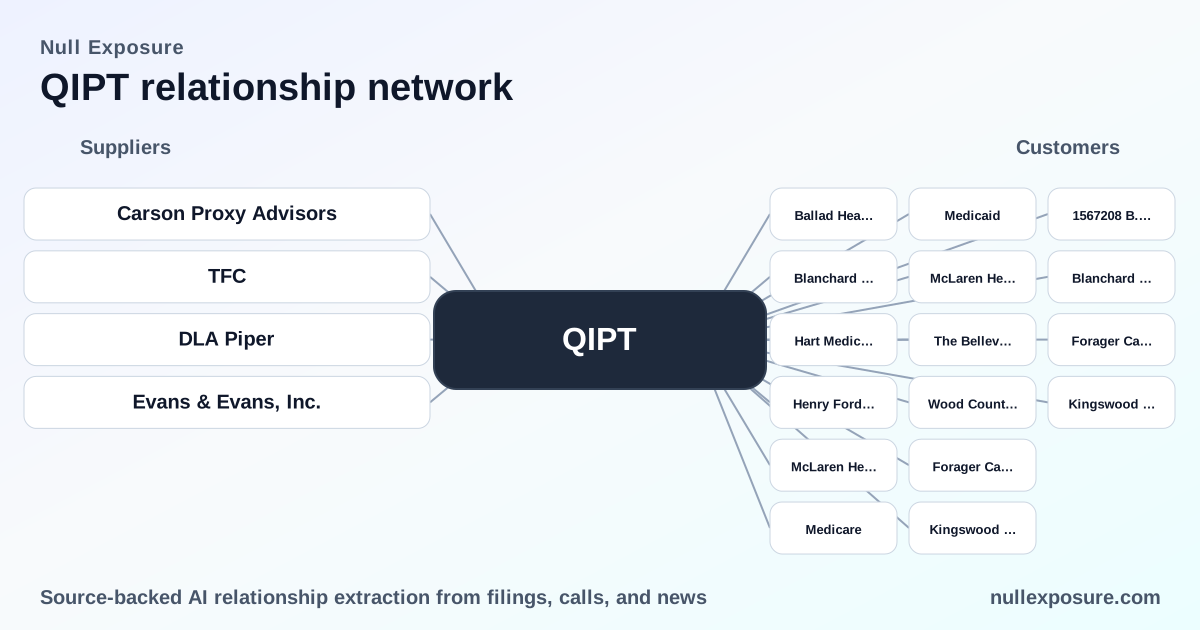
Quipt Home Medical (QIPT): supplier and advisor map investors should price into valuation
Quipt Home Medical operates as a national distributor and servicer of home medical equipment, monetizing through rental and sale of patient service equipment, consumable supplies, and related reimbursement flows tied to payors; the business depends on a concentrated supplier base for equipment and a web of advisors and service providers while it undergoes a strategic transaction process. Investors should treat vendor concentration, outsourced revenue-cycle dependencies, and active M&A advisory relationships as primary drivers of execution risk and upside negotiation mechanics. For a deeper view of supplier exposures and advisory ties, visit https://nullexposure.com/.
How Quipt makes money and why suppliers matter
Quipt’s top-line is driven by recurring equipment rentals and the sale of disposables and accessories; its TTM revenue is roughly $265 million with a gross profit of $192 million, yet profitability metrics are weak (negative EPS and thin operating margins). That economics profile creates two structural realities: (1) supplier concentration is high, because a small number of vendors supply the critical patient service equipment that underpins recurring revenue; and (2) third‑party service providers that touch billing and claims are functionally critical to cash collection and margin realization. Given a market capitalization near $162 million, vendor disruptions or renegotiation costs would have outsized effects on free cash flow and valuation. Learn more on the platform: https://nullexposure.com/.
Advisors and service vendors actually named in filings and press reports
Below I list every relationship captured in available reporting and give a plain-English take on what each partner does for Quipt.
Carson Proxy Advisors
Quipt retained Carson Proxy Advisors as strategic shareholder advisor and proxy solicitation agent in connection with its proposed Arrangement, indicating active shareholder engagement and a need to control the proxy process for a corporate transaction. According to a press release published on The Globe and Mail (March 2026), Carson is directly handling solicitation and strategy for the transaction vote.
Truist (financial advisor)
Truist is acting as financial advisor to Quipt and to the Strategic Transactions Committee, a role that places Truist at the center of valuation, bidder outreach, and deal structuring for the announced acquisition by affiliates of Kingswood Capital Management and Forager Capital Management. This engagement was disclosed in a press release on The Globe and Mail tied to the FY2025 transaction announcement.
Evans & Evans, Inc. (independent financial advisor)
Evans & Evans was engaged as the independent financial advisor to the company’s Strategic Transactions Committee, supplying a second, independent valuation and fairness analysis for the board as it evaluates the sale. The Globe and Mail press release (FY2025) lists Evans & Evans alongside Truist in the transaction advisory package.
DLA Piper (legal counsel)
DLA Piper serves as legal counsel to Quipt in both Canada and the United States, providing cross‑border transaction and regulatory advice for the Arrangement and related corporate governance matters. The role is documented in the same press release reporting the acquisition agreement (FY2025) and reflects counsel handling of deal documentation and interim orders.
What the constraints and contract excerpts tell us about operational risk
The public excerpts and company disclosures reveal three company‑level supplier constraints that directly affect operational resilience and bargaining dynamics:
- Concentration (material): Quipt “relies on a relatively small number of suppliers to provide it with the majority of its patient service equipment and supplies.” That concentration elevates supplier power and creates single‑point sensitivities where non‑renewal or delivery issues can hit revenue quickly.
- Service dependency (relationship_role): Quipt uses external providers for mission‑critical functions. The company explicitly uses Change Healthcare (a UnitedHealth Group subsidiary) to submit patient claims to certain non‑Medicare payors, and it outsources revenue‑cycle and administrative functions to third parties offshore while relying on third‑party managed file transfer for sensitive customer data. Those arrangements make claims adjudication and collections dependent on external systems and vendors.
- Contract maturity and attrition (relationship_stage — terminated): The company disclosed that a disposable supply contract was not renewed in November 2024, a concrete instance of contract attrition that illustrates how supplier turnover can affect product availability and margin. This is a company‑level signal that supplier relationships are not immutable and require active management.
Taken together, these constraints describe a contracting posture that is outsourcing‑heavy, concentrated, operationally critical, and showing signs of churn—factors that compress margins and increase execution risk unless managed through scale or diversification.
Why the advisor roster matters for buyers and existing suppliers
The combination of financial advisors (Truist and Evans & Evans), legal counsel (DLA Piper), and a proxy agent (Carson) is a classic triage for a sale process: advisors calibrate valuation, structure the deal to manage minority holders, and protect regulatory and transactional timelines. For suppliers and counterparties, that implies an imminent period of renegotiation risk and possible procurement retooling if new owners seek different commercial terms or vendors. The retention of a proxy specialist also signals potential shareholder pushback scenarios that could extend timelines and create transitional friction.
Risk-reward implications for investors
- Upside pathway: If the sale closes at a premium, advisors’ work likely preserves value for shareholders while giving the buyer immediate operational scale and creditor/supplier leverage. A disciplined buyer can renegotiate supplier contracts and centralize claims processes to improve margins.
- Downside pathway: Vendor concentration and outsourced claims processing create immediate operational fragility—a discontinued supply contract or a claims processing outage would compress cash flow quickly, particularly in a company with modest market cap and thin profitability.
- Governance angle: The board’s reliance on independent and transactional advisors is prudent and reduces execution drag, but it also signals that internal capabilities to negotiate supply and billing pain points have been insufficient to date.
Key takeaway: model a higher short‑term cost of vendor transition and potential working‑capital volatility, and treat any distributable value from an acquisition as contingent on the buyer’s ability to deconcentrate suppliers and internalize or tightly manage billing dependencies.
For a granular supplier‑risk view and to track material counterparties as the transaction progresses, visit https://nullexposure.com/.
Bottom line
Quipt’s supplier profile is a classic mid‑market medical‑equipment risk: revenue depends on a narrow set of equipment suppliers and on outsourced billing flows, while an active sale process has brought in heavyweight financial, legal, and proxy advisors that will determine whether value is preserved or unlocked. Investors should price in short‑term execution risk around supplier renewals and the integrity of external claims processors while monitoring the progress of the arrangement and any buyer‑driven supplier rationalization. Learn more and monitor updates at https://nullexposure.com/.