Qualys (QLYS): how cloud partnerships power delivery — and where investor risk lives
Qualys is a subscription-based SaaS provider of cloud-born IT security, vulnerability management and compliance tools that monetizes through recurring license and services fees to enterprises and channel partners. The company delivers software from a shared cloud platform hosted on large third‑party providers, and it scales distribution by integrating its vulnerability-management stack into major cloud security offerings and managed service partner channels. For investors evaluating supplier risk, the critical questions are how deep those integrations are, how reliant Qualys is on third‑party infrastructure globally, and how that dependence maps to contract and operational concentration. Visit https://nullexposure.com/ for a structured supplier-risk view that complements this analysis.
How Qualys runs the service and why partners matter
Qualys operates a multi-tenant security platform that runs on third‑party cloud infrastructure; the business model is inherently partner‑enabled. Qualys generates most revenue through recurring subscriptions (Revenue TTM $669.1M, Profit Margin 29.6%), which implies high operational leverage but also an elevated dependence on continuous platform availability and global data‑residency controls. The company’s financials—positive operating margin (33.6%) and steady revenue growth—reflect a mature, cash‑generative vendor that has commercialized integrations with cloud providers and managed service ecosystems as a distribution and technical integration strategy.
Contracting posture and operational constraints
In its disclosures Qualys states that “our shared cloud platform operations are provided by large third‑party vendors” and lists a global footprint spanning the United States, Canada, Switzerland, the Netherlands, United Arab Emirates, Australia, United Kingdom, Italy, the Kingdom of Saudi Arabia and India. That language signals a deliberate outsourcing posture: infrastructure is not internally built in every region but is provisioned through major cloud vendors, which reduces capex but increases supplier governance requirements and regulatory exposure (data residency, contractual SLAs, audit rights).
Company-level signals on concentration and maturity
Qualys’ public metrics and disclosures point to a company that is commercially mature and structurally dependent on third‑party cloud players: the combined signals of global infrastructure sourcing and recurring revenue economics produce concentrated operational dependencies that are significant but manageable with robust contract controls and monitoring. These are company-level characteristics rather than items tied to any single provider.
What the public record documents about each cloud relationship
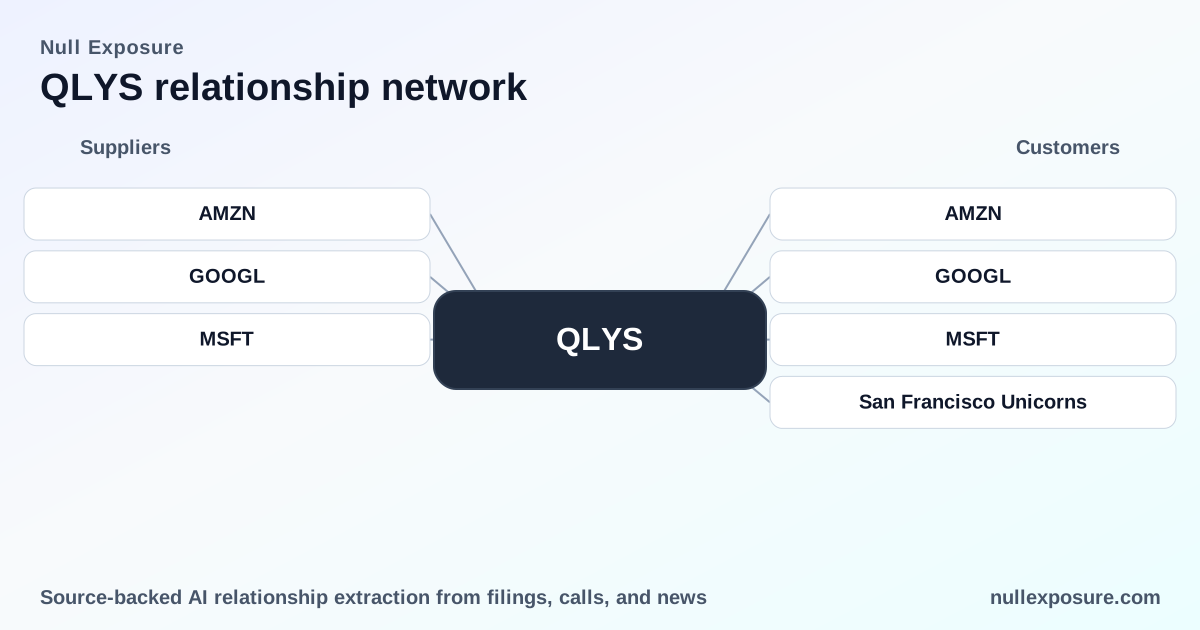
Qualys’ public mentions consistently describe integrations with the three major cloud providers. The following summarizes each relationship as documented in the disclosed results.
-
Amazon Web Services (AWS): Qualys integrates its vulnerability-management capabilities into AWS security offerings, enabling joint customer workflows and deeper telemetry exchange with the AWS platform. A news report from AIJourn on March 10, 2026 referenced these strategic partnerships and integrations for FY2026. (Source: AIJourn, 2026-03-10)
-
Google Cloud Platform (GCP): Qualys is integrated into Google Cloud’s security ecosystem so that its scanning and vulnerability intelligence can be accessed in GCP‑centric security deployments and partner solutions. A news report from AIJourn on March 10, 2026 referenced these strategic partnerships and integrations for FY2026. (Source: AIJourn, 2026-03-10)
-
Microsoft Azure: Qualys integrates its vulnerability-management capabilities into Microsoft Azure’s security offerings to provide customers hosted scanning and reporting within Azure environments. A news report from AIJourn on March 10, 2026 referenced these strategic partnerships and integrations for FY2026. (Source: AIJourn, 2026-03-10)
Each of these three relationships is presented in the public record as a strategic integration rather than an adversarial dependence; they are distribution and technical partners that enable Qualys to embed security tooling into cloud provider ecosystems.
For investors who want deeper mapping between Qualys’ contractual exposure and cloud vendor SLAs, explore our supplier intelligence hub at https://nullexposure.com/.
What this means for risk and upside
-
Operational risk vs. capital efficiency: Outsourcing global hosting to major providers reduces infrastructure capital needs and speeds regional expansion, which supports margin expansion. At the same time, it creates dependency on third‑party availability, pricing, and compliance posture—an operational concentration that requires active supplier governance.
-
Commercial leverage: Embedding Qualys into AWS, GCP and Azure security stacks improves go‑to‑market velocity and can increase wallet share inside large cloud accounts; that is a direct uplift to recurring revenue potential.
-
Control points for investors: The principal control levers are contract SLAs, data‑localization options, independence of telemetry flows, and the breadth of managed‑service and consultancy partnerships that resell or co‑deliver Qualys services.
-
Maturity signal: Profitability and positive operating margins indicate that Qualys has translated these partnerships into scaled, monetized capability rather than remaining an R&D or experimental offering.
Practical monitoring checklist for investor diligence
- Track partner‑level announcements and joint go‑to‑market arrangements from AWS, GCP and Azure for changes in co‑selling or embedding terms.
- Watch for cloud provider incidents and regional outages that could materially impact Qualys service availability or customer SLAs.
- Monitor Qualys’ disclosures around where its shared cloud platform is hosted and any shifts in geographic allocation or vendor concentration.
- Evaluate the degree to which revenue is attributable to channel partnerships vs. direct enterprise sales and whether that mix is shifting over time.
Final read for decision-makers
Qualys’ strategic integrations with AWS, Google Cloud Platform and Microsoft Azure are central to its delivery model and distribution strategy; those relationships accelerate adoption while introducing supplier concentration and operational dependencies that investors must actively monitor. The company-level disclosure that operations run on large third‑party vendors across many countries is an explicit signal of outsourced infrastructure and global exposure. For investors and operators who need a concise supplier-risk profile and ongoing monitoring, visit https://nullexposure.com/ to see how these relationships map to contract risk, concentration and criticality in a portfolio context.
Bold takeaway: Qualys is a mature, subscription-driven security vendor whose cloud provider integrations are a clear commercial advantage—provided governance, SLAs, and data‑residency controls remain tightly managed.