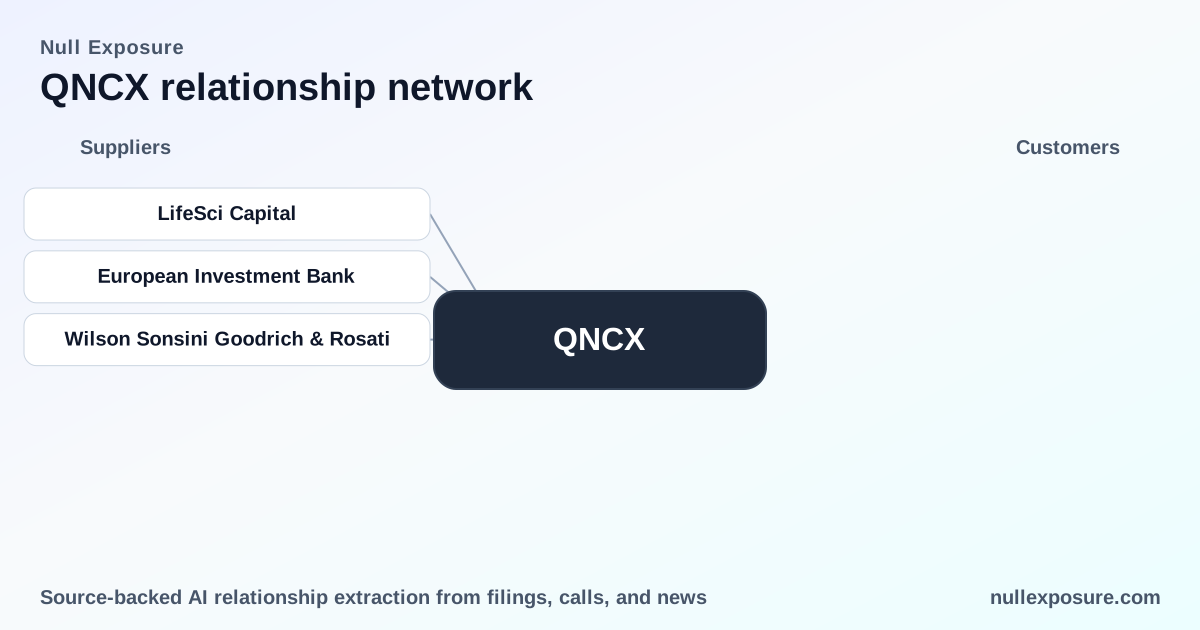
Quince Therapeutics (QNCX): Supplier and advisor relationships that determine the next chapter
Quince Therapeutics develops precision therapies for rare diseases and currently monetizes through a combination of staged financing, partnerships, and future licensing or product sales contingent on regulatory progress; at present the company is pre-revenue and funds operations via debt and equity while it pursues strategic alternatives. Recent disclosures show Quince under acute liquidity pressure and actively engaging advisers and creditors to reshape its balance sheet, making supplier and advisor relationships decisive for near-term outcomes. For a consolidated view of counterparties and risk exposure, visit https://nullexposure.com/.
The short-cycle thesis: cash, creditors, and advisors are the control points
Quince finished 2025 with a small cash base and material outstanding debt, and responded by engaging a financial adviser to evaluate restructuring and strategic options. That dynamic—limited cash, material EIB exposure, and an exclusive advisor mandate—creates a binary path for investors: a negotiated restructuring or deeper downside if financing access tightens. Public market moves in February 2026 directly tracked those developments, with trading volatility driven by press reports of the strategic review.
Key near-term facts: Quince reported roughly $5.8 million in cash, $11.9 million in short-term investments, and about $16.4 million outstanding on an unsecured loan from the European Investment Bank; the company hired LifeSci Capital as its exclusive financial adviser to pursue restructuring and strategic alternatives. For tracking counterparties and their potential influence on outcomes, see https://nullexposure.com/.
Supplier and advisor relationships — who matters to QNCX
LifeSci Capital
Quince engaged LifeSci Capital as its exclusive financial adviser to support a restructuring and to evaluate strategic alternatives including a potential reverse merger; markets reacted with large premarket and intraday moves after the announcement. According to a company release picked up by Yahoo Finance and multiple trading outlets in February 2026, LifeSci’s mandate is to review options aimed at maximizing shareholder value and to help navigate a potential debt restructuring. (Sources: Yahoo Finance, Benzinga, SahmCapital—February 2026.)
European Investment Bank (EIB)
Quince carries an unsecured line of credit with the European Investment Bank with roughly $16.4 million outstanding as of year-end 2025 and tranche structures that extend over multi-year maturities; the EIB is therefore a principal creditor whose terms materially affect Quince’s runway. Reporting in SahmCapital and Benzinga referenced the outstanding balance and tranche details disclosed in the company’s filing and preliminary unaudited estimates. (Sources: SahmCapital, Benzinga—FY2026 filings and reports.)
Wilson Sonsini Goodrich & Rosati
Legal counsel Wilson Sonsini advised Quince on patent matters tied to the acquisition of Erydel S.p.A., handling intellectual property issues relevant to Quince’s platform and future commercial positioning. The law firm’s advisory role was described in a firm announcement that post-dates the transaction and highlights ongoing patent work linked to the acquired assets. (Source: Wilson Sonsini Goodrich & Rosati insight—FY2023 filing commentary.)
Constraints that define Quince’s supplier posture and operating model
The public excerpts on Quince create a consistent company-level signal about how it contracts and operates with external partners:
- Long-term contracting posture: The EIB loan is structured across multiple tranches with repayment windows up to five years, signaling a preference for multi-year creditor relationships rather than short, transactional borrowing. This is a structural feature of the balance sheet rather than a single supplier idiosyncrasy.
- EMEA manufacturing footprint: Quince conducts partial manufacturing in Medolla, Italy, pointing to meaningful operations and supplier relationships in the EMEA region and potential geographic concentration for supply chain risk.
- Critical supplier dependence: The company discloses reliance on single-source suppliers for key components, making certain vendor relationships material and potentially fragile under stress.
- Mixed supplier roles: Public language identifies a mix of manufacturers, service providers, licensors, and sellers across Quince’s ecosystem—third-party CMOs for drug manufacturing, CROs for trials, and licensors for IP—indicating a classic small biotech outsourcing model with both technical and commercial dependencies.
- Active and material spend: Outstanding EIB principal places some supplier/creditor relationships in the $10–100 million spend band; this quantifies the economic scale of at least one creditor relationship and suggests other counterparties could be significant if commercial progress occurs.
Together these constraints say that Quince’s counterparty network is long-dated, geographically concentrated in part, and operationally critical—a profile that elevates creditor bargaining power and supplier delivery risk in any restructuring scenario.
What investors and partners should infer
- Liquidity and control are concentrated. The EIB loan and the exclusive advisor engagement transfer leverage to the creditor and adviser community; their decisions will shape capital structure outcomes and influence supplier payments and contractual renegotiations.
- Operational continuity is non-trivial. Single-source suppliers and third-party CMOs create execution risk—if Quince cannot stabilize financing, key manufacturing and clinical timelines will be at risk.
- Legal/IP posture matters. Ongoing patent work handled by established counsel such as Wilson Sonsini preserves optionality for licensing or sale transactions; successful IP defense or transfer materially increases asset value in a strategic alternative process.
Investors and counterparties should treat Quince as a pre-revenue biotech under active balance-sheet reconfiguration, where creditor covenants, EMEA manufacturing logistics, and IP estate quality determine recovery value.
For a deeper look at counterparties and exposure mapping, explore the supplier map at https://nullexposure.com/.
Tactical next steps for investors and operators
- For investors: monitor EIB covenant filings and LifeSci Capital communications closely; creditor consent and tranche covenants will be determinative of whether equity retains value or is supplanted by creditor remedies.
- For prospective partners or buyers: prioritize diligence on the Medolla manufacturing footprint, single-source supplier agreements, and patent assignments that Wilson Sonsini has handled.
- For suppliers: seek contractual protections (payment milestones, security interests, or escrow arrangements) given the company’s constrained liquidity and ongoing restructuring review.
If you want consolidated counterparty analytics and alerts on Quince and similar suppliers, visit https://nullexposure.com/ to subscribe and maintain real-time visibility.
Bottom line
Quince’s near-term trajectory is controlled by a small set of high-impact relationships: a creditor (EIB) with multi-tranche exposure, an exclusive financial adviser (LifeSci Capital) guiding strategic outcomes, and legal counsel (Wilson Sonsini) preserving IP value. These relationships turn supplier and advisor dynamics into the principal drivers of investor outcomes—stabilization or dilution will depend on creditor negotiations and the effectiveness of the strategic review. For a full supplier portfolio view and ongoing monitoring, see https://nullexposure.com/.