QuinStreet (QNST): Supplier relationships that shape revenue and risk
QuinStreet is an online performance-marketing firm that monetizes by generating high-intent customer acquisitions for clients and charging on variable outcomes — revenue-share, cost-per-lead (CPL) and cost-per-click (CPC) arrangements — while also operating platform assets that aggregate and sell leads. The company runs a capital-efficient model (Revenue TTM $1.105B, Market Cap $680M, EBITDA $34.3M) that converts publisher relationships and search-channel volume into predictable unit economics. For operators and investors evaluating supplier exposure, the key vectors are variable media cost structures, reliance on large search partners, and financing that supports M&A and working capital. Learn more or request bespoke analysis at https://nullexposure.com/.
How QuinStreet structures supplier exposure and why it matters
QuinStreet’s supplier posture is deliberately variable-cost oriented. Public filings and earnings commentary show the company pays third-party publishers and media owners predominantly on a revenue-share, CPL or CPC basis — a commercial design that converts fixed media risk into variable expense tied to revenue generation. That contracting posture reduces headline margin volatility from fixed buys but creates concentration and counterparty risk where a small number of large publishers or search platforms control volume and pricing.
The company also maintains longer-duration commitments on its real estate footprint: operating leases are in place through fiscal 2030 with some new leases commencing in FY2026 and multi-year renewal options. These lease obligations are a modest fixed-cost layer that investors should account for in stress scenarios. Finally, accrued media costs disclosed in filings (around $69.0M) imply material ongoing spend with publishers consistent with a $10M–$100M annual spend band on media partners, making supplier relationships commercially significant to cash flow and service delivery.
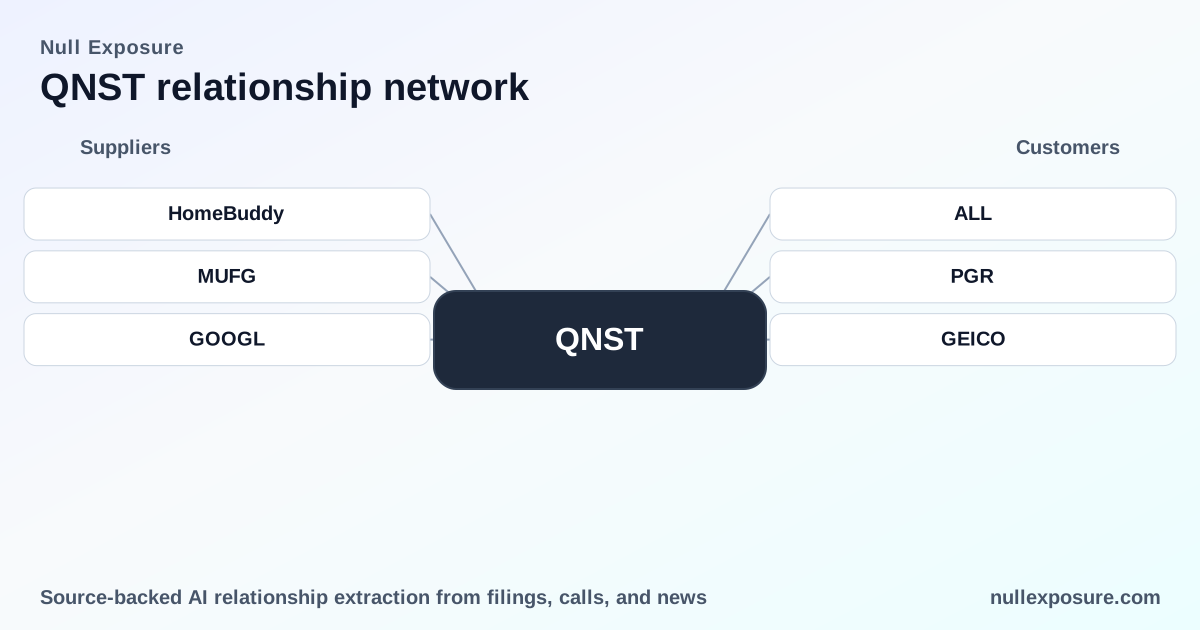
Material relationships: HomeBuddy, MUFG Bank and Google — the essentials
HomeBuddy
QuinStreet completed the acquisition of HomeBuddy to add exclusive, high-intent lead generation to its Modernize platform; HomeBuddy will supply auction-formatted leads designed to improve ROI for home services professionals. This is an accretive product-line enrichment aimed at increasing monetizable lead volume on QuinStreet’s owned platforms, according to a March 10, 2026 news report. (Intellectia.ai, March 10, 2026)
MUFG Bank (senior secured credit facility)
QuinStreet executed a new senior secured credit agreement with MUFG Bank establishing a $150 million revolving credit facility that matures January 2, 2031 and is secured by first-priority liens on substantially all assets of the company and certain subsidiaries; MUFG serves as Administrative Agent alongside other lenders. This facility materially increases liquidity and underwrites the company’s working capital and acquisition activity, per the corporate press release and market reports (Globe and Mail press release; TradingView coverage, January 2, 2026).
Management cited a record amount of volume sourced via Google on its platforms, underscoring the operational centrality of large search engines to QuinStreet’s lead generation engine. High-volume search exposure drives scale but concentrates delivery risk; management referenced this in the FY2026 earnings call transcript reported by InsiderMonkey (Q2 2026 earnings call transcript).
Operational constraints and what they signal for partners and investors
- Contracting posture: QuinStreet’s reliance on revenue-share, CPL and CPC contracts signals a partner-friendly, pay-for-performance posture. For suppliers, this means negotiations focus on margin splits and tracking/attribution integrity rather than upfront guarantees. For risk models, variable payment terms lower fixed-cost load but create sensitivity to platform volume and lead quality metrics.
- Concentration and criticality: The company reports record volumes from Google and significant accrued media liabilities; these facts indicate high criticality of a few large digital platforms. Loss of favorable placement or a pricing shift at a dominant search partner would materially affect throughput.
- Spend magnitude and maturity: Accrued media costs (~$69.0M) place QuinStreet’s supplier spend squarely in the $10M–$100M band — large enough to justify priority treatment from publishers and enterprise counterparty controls, and mature enough that counterparties should expect formal credit and operational onboarding.
- Balance-sheet and financing posture: The $150M revolving facility from MUFG provides liquidity and strategic optionality for M&A and working-capital smoothing, reducing immediate financing risk for suppliers and partners that require payment assurance.
These signals combine into a clear supplier profile: large, usage-based engagements with material monthly flow, governed by performance metrics and secured by a company that backs operations with institutional financing.
What investors and supplier managers should watch next
QuinStreet’s business model and recent actions drive three practical recommendations:
- Monitor search-channel volume and per-lead pricing: Google exposure is a primary operational risk; track keyword CPC trends and platform policy changes.
- Treat publisher relationships as commercial partnerships: negotiate performance-based guarantees tied to conversion quality and dispute resolution rather than pure volume commitments.
- Validate counterparty credit and cashflow cadence: the MUFG credit facility materially improves liquidity, but suppliers should confirm payment terms and covenant dynamics when agreeing to materially-sized draws or receivable financing.
If you need structured supplier risk scoring or peer benchmarking, start here: https://nullexposure.com/.
Quick checklist for supplier negotiations
- Require transparent conversion and post-sale validation windows.
- Price using tiered revenue-share or CPL bands tied to lead quality.
- Confirm receivables and payment timing against QuinStreet’s credit facility covenants and payout cadence.
Bottom line: positioning for volatility and growth
QuinStreet runs a scaled performance-marketing engine that reduces fixed cost risk through variable supplier contracts while depending critically on a small set of high-volume digital partners. The MUFG credit facility improves financial flexibility, and the HomeBuddy acquisition is a targeted product expansion intended to deepen lead inventory and monetization on the Modernize platform. For investors and supplier operators, the thesis is clear: the company’s economics hinge on volume stability and lead quality, so evaluate counterparty concentration, contractual mechanics, and short-term liquidity when assessing exposure.
For a consolidated supplier-risk report or to commission a tailored review of QuinStreet counterparties, visit https://nullexposure.com/.