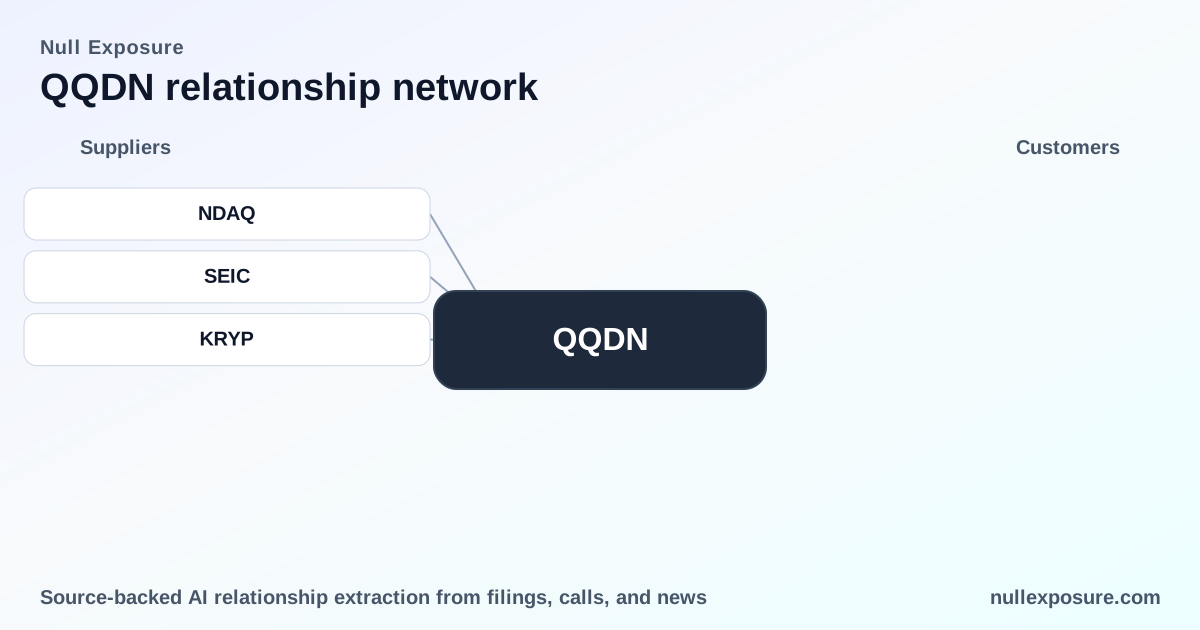
QQDN supplier map: how the new ProShares short-QQQ product is structured and what suppliers reveal
QQDN is a market-traded ETF product designed to deliver daily -2x exposure to an index focused on large-cap technology names. The product is monetized through fund management and operating fees collected by the issuer, plus ancillary service fees embedded in custody, distribution and licensing arrangements; economic value comes from assets under management and ongoing trading volume rather than a one-time sale. For investors assessing counterparty and supplier risk, the supplier footprint is compact and concentrated around three predictable service functions: index licensing, fund distribution and fund management/issuance. For a quick look at platform-level intelligence, visit https://nullexposure.com/.
The product economics in plain English
ProShares structures leveraged and inverse ETFs by entering into exposure-generating positions and offsetting swaps, then packaging that exposure into an exchange-traded vehicle sold to investors. Revenue is recurring and fee-based: the issuer collects management/operating fees and benefits from scale in assets under management and turnover. The business is operationally simple yet counterparty-sensitive: the performance promise is daily, so operational execution, distribution reach and legal licensing are critical to the product’s commercial success.
Visit https://nullexposure.com/ for supplier-level diligence tools and comparison frameworks.
What the suppliers tell investors about operational design
Below I list every supplier relationship surfaced in public reporting for QQDN and explain why each matters to an investor or operator evaluating counterparty exposure.
The Nasdaq OMX Group Inc.
Nasdaq holds registered trademarks for the underlying indices used in the product, and those trademarks have been licensed for use by the fund sponsor. Index licensing is a gatekeeper function: it defines what the product can call itself and enforces index usage terms. According to a Yahoo Finance report dated March 10, 2026, the fund uses Nasdaq trademarks including “QQQ®,” “Nasdaq-100 Index®” and “Nasdaq-100 Mega Index” under license. (Source: Yahoo Finance, Mar 10, 2026)
SEI Investments Distribution Co.
The fund’s distribution is handled by SEI Investments Distribution Co., an independent distributor that is not affiliated with the advisor or sponsor. Outsourced distribution centralizes go-to-market and compliance responsibilities with a third-party that controls placement and record-keeping. This arrangement is described in the same Yahoo Finance coverage referencing the new ProShares launches. (Source: Yahoo Finance, Mar 10, 2026)
ProShares (fund sponsor and issuer)
ProShares is the sponsor and issuer that launched QQDN and a leveraged long counterpart (QQUP), positioning these ETFs within its broader leveraged/inverse lineup. As issuer, ProShares is the primary commercial and operational counterparty—responsible for portfolio construction, exposure mechanics, and fee capture. Media coverage from March 2026 documents the launch of these two products targeting 2x and -2x daily returns of the Nasdaq-100 Mega Index, highlighting the sponsor’s strategy to expand leveraged offerings. (Sources: Yahoo Finance, Mar 10, 2026; Intellectia.ai summary, Mar 10, 2026)
Company-level constraints and operating signals investors should weigh
There are no explicit contract constraints filed in the materials reviewed, but the observable supplier footprint implies several company-level operating characteristics:
- Contracting posture: centralized issuance with outsourced distribution and licensed index intellectual property. The sponsor keeps portfolio and exposure control internal while delegating distribution and index licensing to external specialists, which is standard for ETF product launches.
- Concentration: limited supplier set with single providers for critical functions. A narrow set of suppliers reduces coordination overhead but increases single-vendor risk for distribution and intellectual property controls.
- Criticality: high operational criticality for each relationship. Index licensing, distribution and issuer operations are each high-impact to product availability, branding and legal compliance.
- Maturity: proven market template. The structure mirrors established leveraged/inverse ETF launches, suggesting operational playbooks and counterparty relationships that are mature, not experimental.
These signals indicate a low-complexity, high-dependence model: efficient from a cost perspective, but sensitive to service disruption in any of the core supplier roles.
Investment implications and counterparty risk checklist
For investors evaluating QQDN exposures, the supplier picture leads directly to practical diligence items:
- Confirm the issuer’s operational capacity—ProShares’ history in leveraged ETFs matters for execution and risk controls.
- Validate index licensing terms and whether any restrictions affect product marketing or reconstitution timing.
- Review distribution agreements to understand how the fund reaches retail and institutional channels, and whether distribution interruptions could impair liquidity.
Key risk factors to monitor:
- Potential concentration risk from single-vendor distribution.
- Reputational or contractual changes in index licensing that alter product naming or tracking mechanics.
- Execution risk inherent to daily-leveraged strategies, which is operational as much as market-driven.
What to do next (investor checklist)
- Run counterparty exposure analysis focused on the sponsor and distributor relationships.
- Monitor filings and press for amendments to licensing or distribution arrangements.
- For portfolio managers, size allocations with an eye to liquidity and rebalancing cost under stressed markets.
Explore supplier intelligence and ongoing monitoring frameworks at https://nullexposure.com/ to streamline this diligence.
Bottom line: compact supplier set, concentrated counterparty exposure
QQDN’s supplier map is intentionally compact: index provider, distributor, and sponsor compose the mission-critical network. That structure delivers efficiency and speed to market but concentrates operational risk. Investors should treat counterparty diligence as central to security selection for leveraged/inverse ETFs; the product economics are straightforward, but execution depends on these few relationships remaining stable and well-managed.
For an in-depth supplier comparison and monitoring toolbox, visit https://nullexposure.com/.