Quartzsea Acquisition (QSEA) — supplier map and operational implications for investors
Quartzsea Acquisition Corporation is a classic blank‑check vehicle: it is listed on Nasdaq as a SPAC/shell that generates no operating revenue and exists to effect a merger or similar business combination. Monetization for shareholders and sponsors is realized only through a successful business combination (or liquidation), while ongoing corporate activity — listing maintenance, unit separation, and shareholder servicing — is executed through a small set of critical service providers. For investors and operators evaluating counterparty exposure, the nucleus of risk is not commercial scale but operational dependency on a handful of market infrastructure suppliers. If you want a quick supplier-risk read, consult the company homepage research hub at https://nullexposure.com/.
Business snapshot and what that implies for supplier relationships Quartzsea’s public filings and market data show the characteristics of a shell vehicle: no revenue, no EBITDA, and a balance-sheet orientation toward a pending transaction (Market cap ~ $118M; latest quarter 2025-05-31). That profile produces a contracting posture with low procurement volume but very high supplier criticality — vendors are few, procurement is concentrated, and the services they provide (transfer agent, exchange listing) are essential to shareholder liquidity and corporate actions. For a capital markets operator or investor, the obvious implications are: prioritize operational continuity, document fallback arrangements for liquidity events, and model counterparty failure scenarios even though absolute spend on suppliers is immaterial. For more background research and supplier analytics, visit https://nullexposure.com/.
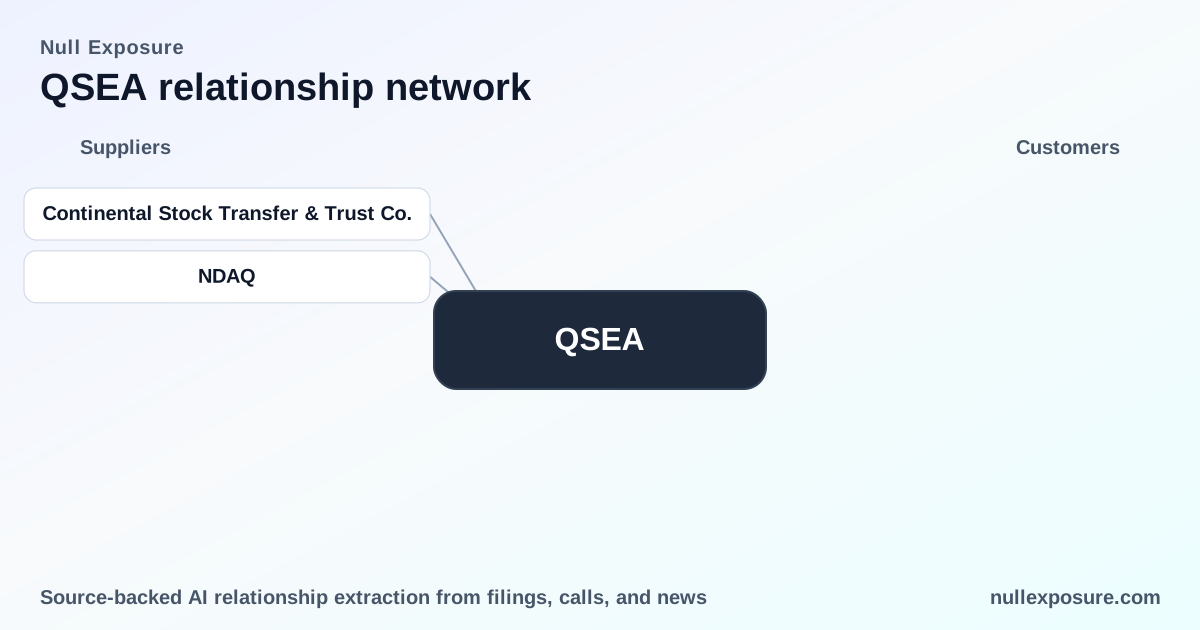
What the supplier list looks like — two relationships to know now Quartzsea’s disclosed supplier relationships in the public news coverage are concentrated and simple: a transfer agent and the listing venue. Both are indispensable to the company’s current phase.
Continental Stock Transfer & Trust Co. Continental Stock Transfer & Trust Co. is the transfer agent responsible for processing unit separations and servicing holders’ administrative requests; holders are instructed to contact Continental to separate units into ordinary shares and rights. According to a company announcement reported by Futunn on March 10, 2026, shareholders must coordinate with Continental to effect unit splits and related recordkeeping (https://news.futunn.com/en/post/56598723/quartzsea-acquisition-corp-announces-the-separate-trading-of-its-ordinary). This is a single point of operational contact for shareholder action.
Nasdaq Global Market Quartzsea is listed on the Nasdaq Global Market; the company’s announcement confirms that units not separated will continue trading under QSEAU, while separated ordinary shares and rights are expected to trade under QSEA and QSEAR respectively. The same Futunn news post (March 10, 2026) details the tickers and trading arrangement and explains how market liquidity will be effected by the separation procedure (https://news.futunn.com/en/post/56598723/quartzsea-acquisition-corp-announces-the-separate-trading-of-its-ordinary). Exchange status dictates market access and compliance obligations — a critical supplier relationship for any listed SPAC.
Constraints and company‑level signals you should model The supplier disclosure list itself contains no formal contractual constraints. That absence is an informative signal: Quartzsea is operating with a compact supplier footprint and no published non‑standard supplier constraints. From a company-level perspective, investors should treat the following as actionable operating characteristics rather than isolated stats:
- Contracting posture — transactional and low-volume. The company hires specialist market-service providers on standard industry terms rather than maintaining broad vendor networks. Expect limited negotiating leverage but also limited spend exposure.
- Concentration — high. With critical functions concentrated in a few counterparties (transfer agent, exchange, counsel, sponsor), single-failure scenarios have outsized impact on liquidity and corporate timelines.
- Criticality — very high for the disclosed suppliers. Transfer-agent and exchange relationships are gatekeepers for investor rights, share movement, and public trading; operational disruptions there directly impact the company’s ability to complete a combination or process redemptions.
- Maturity — early-stage corporate maturity. As a SPAC with no operating earnings, the operational playbook is dominated by capital-markets mechanics rather than vendor-driven supply chains.
Operational and investment risk considerations For investors and acquirers evaluating exposure to QSEA, the supplier map points to operational risks that are discrete and manageable but non‑negligible:
- Single vendor failure risk: service interruption at the transfer agent would complicate unit separations and could delay or obstruct shareholder voting or redemption processing.
- Exchange compliance dependency: Nasdaq’s delisting rules and administrative decisions materially affect the timing and feasibility of a transaction; maintain readiness for accelerated disclosure or re-listing contingencies.
- Low diversification of supplier counterparty credit risk: vendor defaults are unlikely to impose direct financial losses on the balance sheet, but they translate into operational delays that can destroy deal economics.
Practical actions for investors and operators For investors and operators evaluating QSEA exposure, adopt these practical steps:
- Verify transfer-agent confirmations for any position you hold and document the process for unit separation and share delivery; the company’s March 10, 2026 announcement directs holders to Continental Stock Transfer & Trust Co. (https://news.futunn.com/en/post/56598723/quartzsea-acquisition-corp-announces-the-separate-trading-of-its-ordinary).
- Monitor Nasdaq notices and regulatory filings closely; any exchange action alters market access and the timing of a combination (see the March 2026 trading notices referenced above).
- Maintain counterparty contingency plans: although vendor spend is small, operational continuity procedures (alternate transfer agents, escrow mechanics, legal readiness) materially reduce event risk.
If you want an in-depth supplier risk profile or scenario modeling for QSEA, start with the central research page at https://nullexposure.com/ and request a targeted analysis.
Final takeaways and next steps Quartzsea’s supplier landscape is intentionally narrow and centered on capital-market infrastructure. That concentration simplifies monitoring but increases the impact of any single operational failure. For investors, the right focus is not vendor price but continuity, documents, and compliance signals — especially around unit separation mechanics and Nasdaq listings, both described in the company notice reported March 10, 2026 (https://news.futunn.com/en/post/56598723/quartzsea-acquisition-corp-announces-the-separate-trading-of-its-ordinary). For a tailored supplier-risk assessment and watchlist that tracks these critical counterparties in real time, visit https://nullexposure.com/ and request a briefing.
This assessment covers all supplier relationships disclosed in the available coverage and highlights the operational constraints that define counterparty exposure for a shell vehicle like Quartzsea.