Quantum Computing Inc. (QUBT): How the Luminar purchases rewire supply and capability
Quantum Computing Inc. operates as a developer and integrator of room‑temperature quantum and AI acceleration platforms, selling software, systems integration, and foundry-style services tied to integrated photonics. The company monetizes through a mix of systems sales, foundry and manufacturing contracts, and software licensing for photonics-enabled quantum and AI workloads; recent strategic acquisitions of Luminar assets materially shift its supplier posture toward vertical integration. For a briefing on supplier intelligence and relationship mapping, visit https://nullexposure.com/.
Why the Luminar moves change the game
QUBT has moved decisively from being a photonics systems customer to an owner/operator of significant photonics manufacturing and components. That transition converts a supplier relationship risk into an operational capability — if executed — and positions QUBT to sell foundry services and integrated subsystems to third parties as well as itself. The market reaction reflects a re‑rating of the company’s strategic scope rather than a simple bolt‑on purchase.
Key takeaway: QUBT is now both a buyer and a builder of the photonics stack, which increases revenue upside but also raises execution and capital allocation scrutiny.
The explicit supplier relationships you need to know
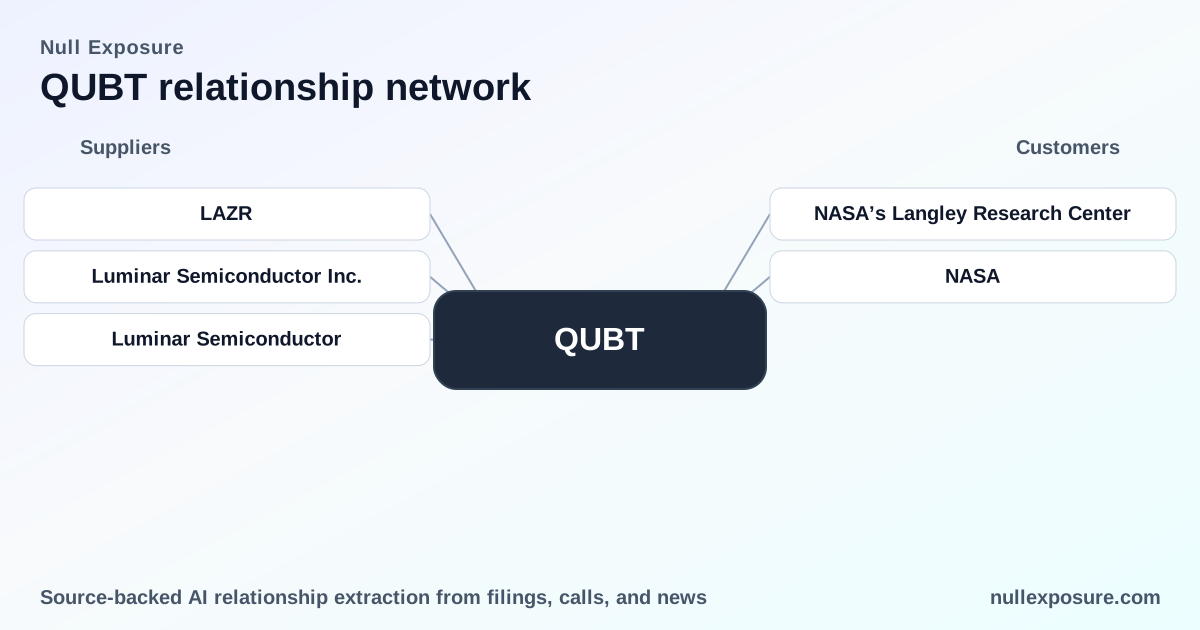
Luminar (public parent, LAZR)
Quantum Computing Inc. agreed to acquire Luminar’s lidar business for $22 million subject to higher offers, as part of Luminar’s Chapter 11 process. The deal was reported in January 2026 and positions QUBT to capture lidar-related lasers, detectors and packaging if completed. (TechCrunch, Jan 12, 2026 — https://techcrunch.com/2026/01/12/luminar-lines-up-22-million-bidder-for-its-lidar-business/)
Luminar Semiconductor / Luminar Semiconductor Inc.
QUBT finalized a $110 million purchase of Luminar Semiconductor, bringing lasers, detectors, advanced packaging and manufacturing into its control and integrating those assets with its thin‑film lithium niobate (TFLN) photonics platform. Purchases were reported across multiple outlets in early 2026 and are described as strengthening QUBT’s foundry and systems capabilities. (MLQ.ai, Jan 2026 — https://mlq.ai/news/quantum-computing-inc-finalizes-110m-purchase-of-luminar-semiconductor-unit/; StocksToTrade, Jan 5, 2026 — https://stockstotrade.com/news/quantum-computing-inc-qubt-news-2026_01_05/)
What those relationships mean for QUBT’s operating model
Bringing Luminar Semiconductor’s assets in‑house transforms supplier exposure into an operational line item. Expect the following business model characteristics to emerge as dominant themes:
- Contracting posture: QUBT shifts from being primarily a buyer of photonics components to a dual role as both manufacturer and service provider; this produces longer‑term contracts with vertical customers but also longer capital payback horizons.
- Concentration risk: Control over TFLN components centralizes a previously outsourced supply chain, decreasing external vendor dependence but increasing in‑house concentration and single‑point operational risk.
- Criticality: Photonics components are critical to QUBT’s product performance and scale — the company explicitly links product capabilities to TFLN optical chips, making these parts strategic for both performance and cost structure.
- Maturity and integration: Acquiring manufacturing capacity accelerates capability but requires mature operations and capital discipline; integration risk and cash deployment are now core operational priorities rather than peripheral supplier management issues.
These are company‑level signals drawn from QUBT’s public reporting and transaction coverage; they are not assigned to any single supplier absent explicit naming in source excerpts.
Supply‑chain constraints and geopolitical exposure
The company’s own disclosures and news coverage flag material supply constraints: TFLN optical chip production and distribution is concentrated in East Asia (notably China), exposing QUBT to geopolitical, trade and environmental risk that will persist even after onshoreing acquisitions. In practice, that means QUBT must balance its new manufacturing footprint with supply and logistics strategies that account for regional disruption probabilities. The company also reports reliance on cloud infrastructure (predominantly Amazon Web Services) for portions of its classical compute, which is an operational service‑provider dependency to track through vendor SLAs and outage histories.
Source signals: constraint excerpts reflecting APAC concentration, manufacturer role and service‑provider dependencies are present in corporate disclosures and third‑party analysis (company filings and related news coverage, FY2026).
Financial context investors should hold front of mind
QUBT’s public financials show very low trailing revenue ($682k TTM) versus a market capitalization of roughly $1.65 billion, indicating a valuation built on growth and capability optionality rather than current scale. Operating losses and negative operating margin underscore the imperative that the Luminar transactions produce revenue uplift or cost synergies. The acquisition strategy converts a supplier exposure into a capital allocation decision that must generate tangible top‑line and margin improvements to justify current multiples. (Public filings and market data, LatestQuarter 2025‑12‑31.)
For vendor mapping and counterparty intelligence on QUBT, review our platform at https://nullexposure.com/.
Risk/reward implications for supplier relationships and operators
- Upside: Vertical integration can unlock foundry revenue and margin expansion if QUBT leverages Luminar’s lasers, detectors and packaging to win external foundry contracts and internal product wins.
- Downside: Operational execution and regionally concentrated manufacturing risks can offset that upside; a single major disruption in APAC manufacturing or an integration misstep would materially impair product delivery and revenues.
- Monitoring focus: watch production yield improvements, signed foundry contracts, customer concentration in new revenue, and any regulatory or trade developments affecting East Asia manufacturing.
Major relationship takeaway: the Luminar transactions are simultaneously an offensive growth move and a defensive supply‑chain play; investors and partners must evaluate both execution capability and geopolitical exposure.
What operators and procurement teams should do now
Operators negotiating with QUBT should treat the company as a manufacturer and service provider with in‑house photonics capabilities, not just a system integrator. Procurement teams should seek contractual protections around capacity commitments, yield guarantees, lead times, and contingency sourcing given regional concentration. For a deeper supplier risk profile and actionable recommendations, visit https://nullexposure.com/.
Bottom line
Quantum Computing Inc.’s purchases of Luminar Semiconductor and the Luminar lidar business reconfigure its supplier relationships into owned capabilities, creating clear upside for foundry and systems revenue while simultaneously introducing integration, capital and geopolitical risks. Investors and partner operators should evaluate QUBT through the dual lens of execution — turning supplier control into margin — and resilience — managing APAC concentration and service dependencies. For ongoing tracking of supplier relationships and operational risk signals, see our analysis hub at https://nullexposure.com/.