uniQure (QURE) — supplier relationships, operational contours, and what investors should watch
uniQure is a clinical-stage gene therapy company that monetizes through a mix of licensing deals, milestone and royalty streams, and commercial supply arrangements with strategic partners. Its revenue profile is concentrated and milestone-driven while manufacturing and commercial execution are outsourced to third parties under long-term agreements; cash generation therefore depends on partner-driven product launches and on-time supply. For investors assessing counterparty and operational risk, the Genezen supply relationship and uniQure’s licensing posture are the primary levers affecting near-term commercial execution and spend commitments. Learn more about how we collate contract-level exposure at https://nullexposure.com/.
How uniQure makes money and why suppliers matter
uniQure’s business model is classic biotech leverage: develop gene therapies and convert those assets into recurring revenue via out-licenses, sublicenses, and commercial supply obligations. The company funds development through upfront payments and equity while structuring future upside as milestone payments and tiered royalties tied to regulatory and sales success. Commercial execution is largely outsourced: uniQure relies on contract manufacturers and supply partners to produce clinical and commercial lots, shifting capital-intensive manufacturing risk off the balance sheet but concentrating operational risk in a small set of counterparties.
Financials underline the operating profile: Revenue TTM $16.1M and EBITDA -$164.3M highlight that cash flows are still development-driven rather than product-driven (company filings, latest annual disclosure). Monitoring counterparties is therefore critical to the path to profitable commercialization.
Visit https://nullexposure.com/ for deeper supplier risk analytics.
Genezen: the manufacturing backbone for HEMGENIX
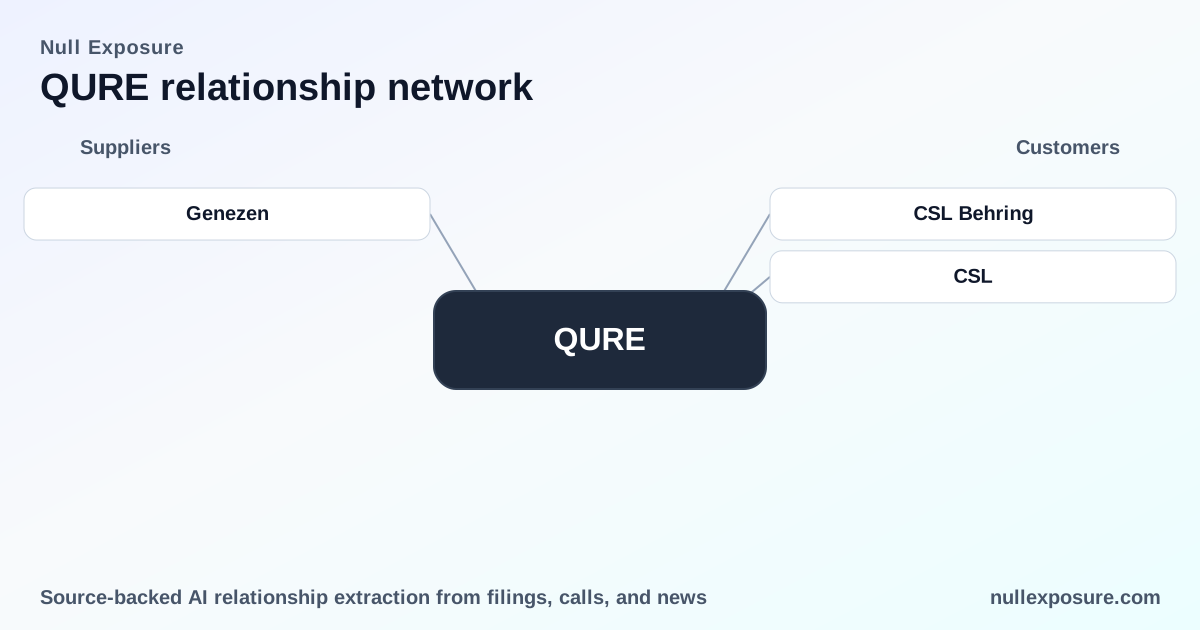
Genezen is uniQure’s primary commercial and development manufacturer for HEMGENIX and related programs. According to uniQure’s FY2024 10‑K, Genezen manufactures and supplies commercial HEMGENIX demand on uniQure’s behalf and provides development and manufacturing services under a separate DMSA; title to HEMGENIX supply passes directly from Genezen to CSL Behring following the Lexington transaction (uniQure FY2024 10‑K, qure-2024-12-31).
This relationship has measurable contract features:
- Long-term commitment: the commercial supply agreement (CSA) and the development and manufacturing services agreement (DMSA) each carry minimum three‑year terms, establishing a multiyear contracting posture for manufacturing capacity and services (FY2024 10‑K).
- Material minimum spend: the CSA contains minimum purchase commitments of $43.3M over the first three years, while the DMSA requires minimum payments of $14.0M for services over a three-year period; remaining commitments were disclosed as $12.5M with $4.0M payable within 12 months (FY2024 filing).
- Operational criticality and preferential access: uniQure has preferred access to the Lexington Facility for production related to AMT-130 and AMT-191 and relies on Genezen for production of HEMGENIX (FY2024 10‑K).
Key takeaway: Genezen is a single, central manufacturer whose contracts are active, long-dated, and financially meaningful—this reduces immediate capex but concentrates supply risk in one counterparty.
Licensing with Apic Bio: a revenue-side lever
uniQure disclosed a global licensing agreement with Apic Bio for a one-time intrathecal gene therapy targeting SOD1 ALS, signed in January 2023. Under the agreement uniQure made an initial $10.0M cash payment, with up to $43.0M payable in regulatory and sales milestones plus a tiered royalty on net sales ranging from mid-single digits to low double digits (company disclosures, announced January 2023 and reflected in filings).
Key takeaway: Licensing deals like Apic Bio convert R&D assets into contingent cash flows—upfront receipts are modest, while the bulk of economic value hinges on regulatory progress and future sales.
What the contractual constraints reveal about the operating model
The contract evidence surfaces a coherent operating posture:
- Contracting posture — defensive and committed. uniQure has structured multi-year, take‑or‑pay style arrangements that secure manufacturing capacity and align supplier incentives with product commerciality (FY2024 disclosures).
- Concentration risk — high. The Genezen relationship consolidates manufacturing for key programs, exposing uniQure to operational interruption or capacity constraints at a single supplier.
- Criticality — essential. For HEMGENIX, Genezen supplies product that flows directly to CSL Behring; any manufacturing shortfall affects contractual downstream obligations and partner revenues (FY2024 10‑K).
- Maturity — active and near‑term. Contracts are currently active, with minimum terms and remaining payment schedules extending into the medium term (commitments noted through July 2027 and minimum three‑year terms in the CDMSA language).
- Spend profile — mid‑sized but material. Minimum purchase commitments and service minimums place the relationship in the $10M–$100M spend band, large enough to be balance-sheet relevant but small relative to peak commercial sales of approved gene therapies.
Investors should integrate these contract-level signals with cash runway and milestone timelines. uniQure’s market cap (approximately $997M) and negative EBITDA (-$164.3M) mean supplier obligations are meaningful to capital planning (company financials, latest filings).
Relationship summaries (direct from disclosures)
Genezen — Genezen is contracted under a commercial supply agreement and a development and manufacturing services agreement to manufacture and supply HEMGENIX and provide development services; title to HEMGENIX supply passes from Genezen to CSL Behring after the Lexington transaction (uniQure FY2024 10‑K).
Apic Bio — uniQure entered a global licensing agreement with Apic Bio (announced January 2023) for an investigational SOD1 ALS gene therapy, including a $10M upfront payment, up to $43M of milestones, and tiered royalties on net sales (company disclosures).
Investor takeaway and recommended signals to monitor
- Monitor manufacturing KPIs and any quality or capacity notices from Genezen; single‑source manufacturing is the largest operational risk to commercialization timelines.
- Track regulatory milestones that trigger the material milestone payments from licensing deals (Apic Bio) and the timing of royalties, which will materially alter cash flow profiles.
- Watch contractual triggers and purchase commitments (the $43.3M CSA and $14M DMSA minimums) for potential cash outflows and timing pressures as uniQure moves toward commercialization.
- Reconcile supplier exposure against capital resources and upcoming milestones; with negative EBITDA and modest revenues, missed milestones or manufacturing interruptions amplify financing risk.
For a concise supplier-risk dashboard and contract-level exposure analysis, visit https://nullexposure.com/ — actionable intelligence for underwriting counterparty and operational risk.
uniQure’s model converts scientific upside into concentrated counterparty and milestone exposure. The company’s strategic choice to outsource manufacturing reduces capex but intensifies dependence on a small set of suppliers; the investment case therefore hinges on successful regulatory progress and uninterrupted supply execution. Learn more about how supplier relationships map to valuation and operational risk at https://nullexposure.com/.