QVC Group Inc. (QVCGP) — supplier relationships and operational constraints investors should price in
QVC Group is a video- and e‑commerce retailer that monetizes its audience through merchandise sales across televised programming and direct online channels, sourcing products from designers, manufacturers and brand partners while capturing gross margin on product sales and ancillary fees such as vendor promotions and lease-backed broadcast arrangements. The company reported trailing revenue of roughly $9.5 billion and EBITDA of $937 million in recent filings, reflecting a business that is cash-generative at the operating level but structurally exposed to merchandising, logistics and content distribution costs. For a deeper read on supplier dynamics and counterparties, visit https://nullexposure.com/.
Why supplier relationships matter for QVCGP investors
QVC’s operating model is built around curated inventory and live programming; suppliers and vendors are both revenue drivers (brand and product supply) and infrastructure enablers (logistics, transmission, and studio services). The company’s disclosures signal a mixed contracting posture: long-term leases and transmission agreements coexist with shorter-term leases and flexible shipping arrangements. That structure creates a combination of predictability for fixed costs and operational sensitivity to vendor performance and content partner economics.
Key company-level signals from disclosures:
- Long-term contractual commitments: QVC has executed multi‑year property leasebacks and transmission leases with terms that can extend into decades, supporting stable broadcast capacity and real estate planning.
- Short-term flexibility: Certain base-rent arrangements under 12 months are not recorded on the balance sheet, which preserves nimbleness for smaller locations or event-driven space needs.
- Global logistics footprint: QVC negotiates shipping agreements in each market, giving it leverage on rates but exposing it to cross-border execution risk.
- Mixed materiality: The company states it does not rely on any single supplier for a large share of inventory (an immateriality signal) while simultaneously warning that adverse changes in partner arrangements could have a significant adverse effect on operations (a materiality caveat investors must price).
- Multi-role relationships: QVC operates as a buyer of finished goods, a partner to manufacturers and brands, and a service buyer for carriers and transmission providers; distribution is handled both through internal facilities and third‑party logistics providers.
- Active relationships: Disclosures and recent activity indicate an active vendor network supporting ongoing programming and fulfillment.
These characteristics produce a predictable fixed-cost base for broadcast and studio operations while leaving revenue and margin exposed to merchandising cycles and partner execution.
What the named relationships show — a concise catalog
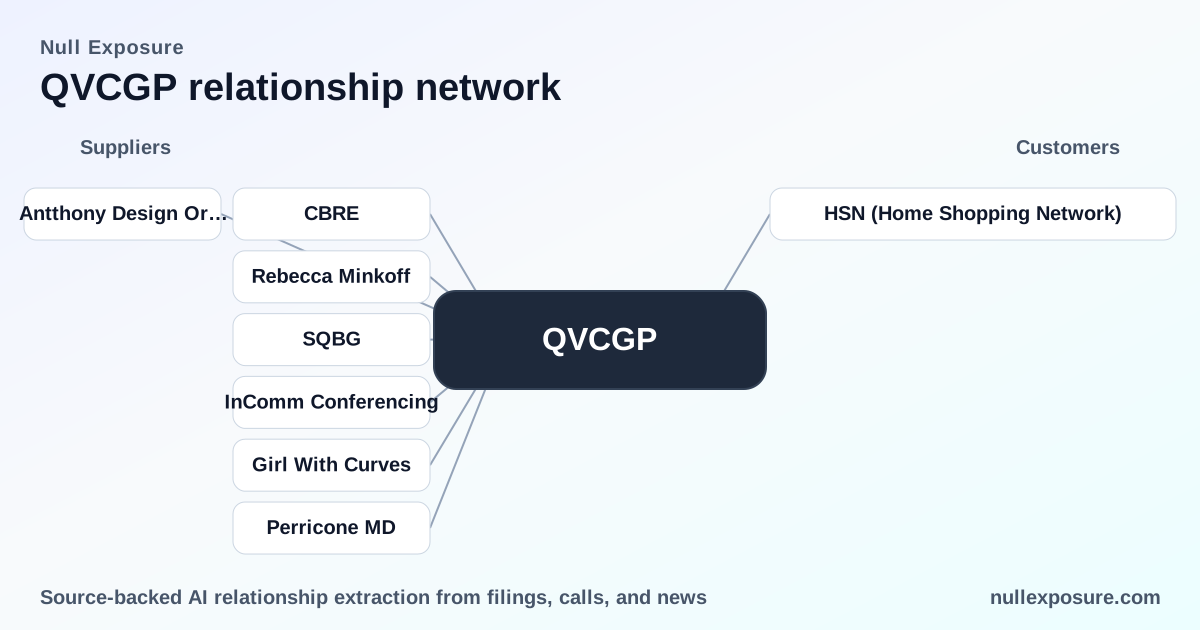
Below I list every cited relationship in the source results and summarize their relevance.
-
CBRE Group — CBRE is marketing QVC/HSN’s 65‑acre St. Petersburg campus as a redevelopment opportunity after QVC announced consolidation to West Chester and planned layoffs; the transaction is a real estate marketing assignment rather than an operational supplier contract (Vista.Today, citing Philadelphia Business Journal, March 2026).
Source: Vista.Today / Philadelphia Business Journal reporting on the listing (March 2026). -
Rebecca Minkoff — Rebecca Minkoff expanded her partnership with QVC to debut a footwear line and exclusive RM Studio collections on QVC channels, underlining QVC’s role as a distributor and brand-growth platform for lifestyle designers (Finviz news release, March 2026).
Source: Finviz (news release, March 2026). -
Sequential Brands Group (Martha Stewart) — Sequential Brands announced additions to Martha Stewart’s signature QVC line, illustrating QVC’s long-standing designer partnerships that drive category depth across home and lifestyle products (GlobeNewswire press release, February 2018).
Source: GlobeNewswire press release (February 2018). -
InComm Conferencing — InComm was listed as the provider of conference call access for QVC’s earnings release, indicating a vendor relationship for investor communications and teleconferencing services rather than merchandising or distribution (earnings release notice, AIJourn syndication, FY2026).
Source: AIJourn earnings-release notice (FY2026). -
Girl With Curves — Tanesha Awasthi’s Girl With Curves collection aired live on QVC and was made available across QVC digital channels, demonstrating QVC’s curated brand showcases that serve targeted audience segments (PR Newswire announcement, September 2021).
Source: PR Newswire (September 2021). -
Perricone MD — Perricone MD engaged QVC for on-air representation with a brand ambassador, reflecting QVC’s role in beauty and wellness brand marketing and the company’s reliance on influencer‑style partnerships to drive conversion (FashionUnited report, August 2024).
Source: FashionUnited (August 2024). -
Antthony Design Originals — A legal filing reported that HSN executives reduced the designer’s airtime and promotion to prioritize a TikTok‑centered model, highlighting execution risk in QVC/HSN programming allocation and the commercial impacts on smaller partner brands (The Inquirer reporting on lawsuit, February 2026).
Source: The Inquirer (February 18, 2026).
Operational constraints that matter for valuation
Company disclosures and the relationship map produce several valuation-relevant constraints that are company-level signals rather than specific to any single partner:
- Contract tenure concentration: Long-term real estate and transmission leases lock in fixed costs and reduce short-term capital exposure, but they increase leverage on future revenue growth to cover those obligations.
- Logistics dependency and geographic reach: Global shipping agreements enable scale and favorable rates, yet cross-border logistics complexity increases sensitivity to fuel, tariffs and carrier capacity.
- Supplier dispersion vs. switching risk: The company states no single supplier dominates inventory purchases, which reduces counterparty concentration risk; nonetheless, QVC acknowledges that losing favorable terms or key partnerships could produce material revenue impacts.
- Role breadth: Acting simultaneously as buyer, retailer and promoter increases negotiation leverage with suppliers but also raises operational coordination complexity across buying, marketing and fulfillment.
Actionable risk points: long-term lease obligations, channel allocation decisions (airtime vs. social), and fulfillment continuity deserve heightened monitoring in quarterly filings and operational disclosures.
For a complete view of supplier exposure and to align trading strategy with contract maturity profiles, see more at https://nullexposure.com/.
Tactical takeaways for investors and operators
- Monitor lease maturity schedules and transmission commitments in SEC filings to quantify fixed-cost duration and refinancing risk. Long lease tails are a stability asset when revenue is stable and a leverage hazard when revenue is contracting.
- Track promotional and airtime allocation for high‑margin designer partners; reduced support for boutique brands (as alleged in the Antthony case) signals strategic reallocation toward social channels that can affect gross merchandise mix and margins.
- Evaluate logistics partners and 3PL arrangements ahead of peak seasons; favorable shipping agreements provide margin protection but require operational discipline to realize benefits.
For further supplier intelligence and to model contractual obsolescence across QVC’s partner base, consult https://nullexposure.com/.
Conclusion — how to price supplier risk into QVCGP
QVC Group operates a hybrid retail-and-broadcast model with stable infrastructure commitments and variable merchandising exposure. The named relationships demonstrate that QVC remains a key distribution channel for established lifestyle brands while also facing execution and allocation risks that can impact smaller partners’ economics. Investors should value QVC with a two‑layer approach: price fixed-cost persistence from long-term leases into enterprise value, and apply scenario analysis to merchandising revenue and partner promotion allocation when forecasting gross margin. For deeper counterparty mapping and constraint-driven analysis, visit https://nullexposure.com/ — the clearest path to incorporate supplier structure into QVCGP risk-adjusted models.