Ryder System Inc: acquisitions tighten the maintenance and leasing funnel
Ryder System, Inc. operates an integrated transportation and logistics platform that monetizes through vehicle rental and leasing, fleet maintenance services, and freight brokerage—collecting recurring revenue from contracted leases, maintenance fees and transaction-based logistics margins. Recent bolt-on acquisitions expand Ryder’s field service footprint and regional leasing inventory, reinforcing a model that converts scale into service density and customer lock-in. For a deeper supplier-relationship view and transaction tracking, visit https://nullexposure.com/.
Why these deals matter to investors: growth through service density
Ryder’s strategy is shifting heavier toward owning higher-margin service capabilities around vehicles rather than treating maintenance as a distributed cost center. The two FY2026 supplier/transaction items in public coverage show targeted acquisitions that increase on-the-ground maintenance capacity and regional leasing scale, which directly supports uptime and utilization for Ryder’s fleet customers. That raises the effective lifetime value of leased vehicles and reduces third-party maintenance leakage.
Ryder’s public filings and reporting signal two company-level characteristics that shape supplier relationships and procurement posture. First, Ryder acknowledges concentrated OEM sourcing: “We buy vehicles and related equipment from a relatively small number of OEMs in our FMS business,” which indicates supplier concentration and strategic dependence on a narrow set of manufacturers. Second, Ryder’s logistics volume demonstrates scale: during 2025 the company “purchased or executed $9.8 billion in freight moves on our customers’ behalf, including $334 million in brokerage services,” which is a large spend footprint that translates into negotiating leverage with service and parts suppliers. These are company-level signals that influence contracting posture, counterparty selection and the economics of any acquired assets.
For more transaction intelligence and supplier analysis primed for investors, explore https://nullexposure.com/.
Deal-by-deal: what Ryder acquired and why it matters
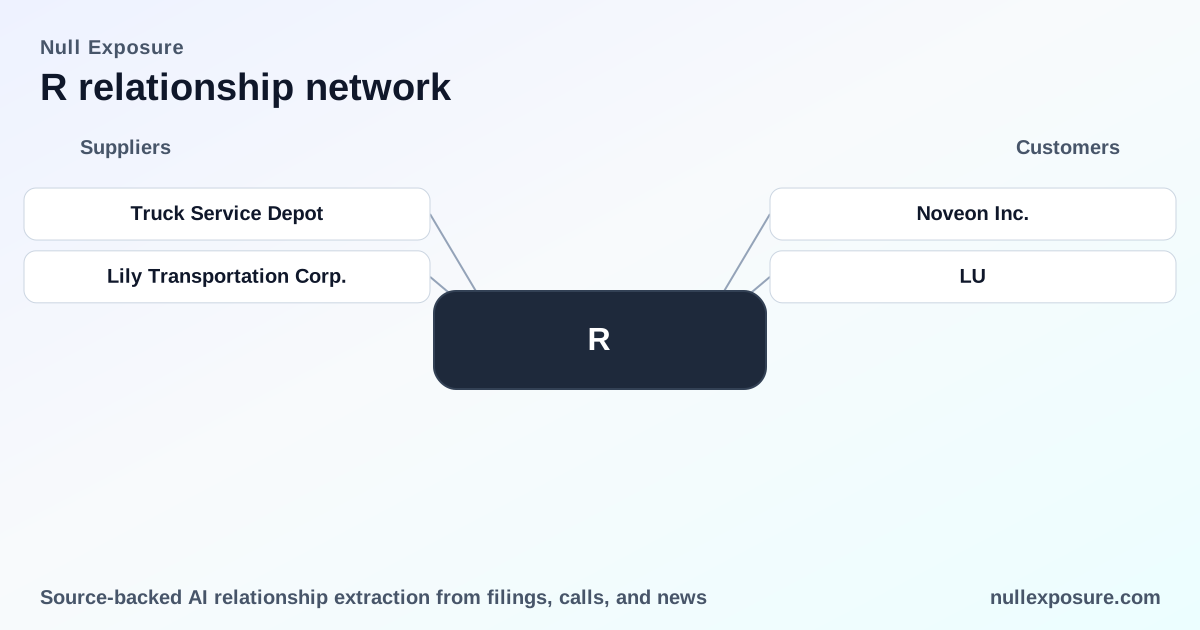
Truck Service Depot — Atlanta mobile maintenance
Ryder completed the acquisition of Truck Service Depot, an Atlanta-based mobile maintenance business that services commercial trucks and trailers across Georgia; the buy strengthens Ryder’s field-service capacity and local response times for uptime-critical customers. The company announcement on Ryder’s newsroom (March 10, 2026) and coverage in CityBiz confirm the transaction and the strategic intent to scale mobile maintenance in a key regional market.
Source: Ryder newsroom release (March 10, 2026) and CityBiz report (March 10, 2026).
Lily Transportation Corp. — regional full-service leasing and maintenance
Ryder agreed to acquire substantially all assets of the Full Service Truck Leasing, Commercial Truck Rental and Contract Truck Maintenance businesses of Lily Transportation Corp., a regional services provider based in Needham, Massachusetts, expanding Ryder’s leasing footprint and contract maintenance book in the New England market. TruckingInfo reported the asset acquisition and emphasized that Ryder is absorbing regional leasing inventory and maintenance contracts that immediately feed recurring revenue streams.
Source: TruckingInfo coverage (reported March 2026).
How these relationships reshape the supplier map
Ryder’s acquisitions are not simply roll-ups; they are tactical investments that change supplier dynamics in three ways:
- Consolidation of maintenance suppliers into Ryder’s owned network. Acquiring mobile and contract maintenance businesses converts third-party service relationships into internal capabilities, reducing reliance on independent shops and enabling tighter parts procurement control.
- Greater leverage with vehicle OEMs and parts providers. The company-level signal that Ryder sources vehicles from a “relatively small number of OEMs,” combined with very large freight and lease volumes, gives Ryder bargaining power when negotiating lead times, pricing, and service levels for parts and new units.
- Higher criticality of integration and operational execution. As Ryder internalizes maintenance providers, supplier performance risk shifts toward integration execution—IT, operations, technician standards and parts logistics become critical to realize the expected uplift in utilization.
These characteristics imply a contracting posture that is focused, centralized and high-volume, with supplier concentration on the OEM side and increasing internal capture of maintenance services.
Procurement and operational constraints investors should watch
Ryder’s public constraints and disclosures translate into actionable risk signals:
- Concentration risk in equipment sourcing. The admission of a small number of OEM suppliers signals vulnerability to supply-chain disruption or OEM-specific shortages; investors should track OEM order backlogs and any supplier performance notices.
- Large transactional spend and brokerage scale. The $9.8 billion freight footprint and $334 million in brokerage in 2025 underline Ryder’s exposure to freight-market cycles and counterparty credit of contracted shippers and brokers.
- Integration and service quality risk. Converting outside maintenance providers into Ryder-operated units requires harmonizing standards and parts supply. Execution shortfalls would affect fleet uptime and leasing economics.
These constraints are company-level signals shaping Ryder’s supplier strategy and operational priorities; they are not tied to any single relationship unless explicitly stated.
Risk-adjusted view for operators and investors
Operationally, the acquisitions strengthen Ryder’s competitive moat through improved uptime and denser service coverage, which supports better utilization economics on existing leased fleets. From a procurement perspective, expect Ryder to centralize parts sourcing, standardize technician training, and renegotiate OEM terms where scale permits. The primary downside is integration risk and the external dependency on a limited OEM set for vehicles and critical components.
- Integration success will determine whether the maintenance acquisitions generate net margin expansion or temporary cost pressure.
- OEM concentration and macro supply constraints remain a lever for both upside (volume discounts) and downside (supply disruption).
What investors and supplier managers should do next
- Track Ryder’s integration progress on the Truck Service Depot and Lily Transportation assets via quarterly filings and management commentary; these disclosures will reveal the speed at which third-party maintenance spend is internalized.
- Monitor OEM order backlogs and parts lead times as early indicators of constraint risk that will affect fleet deployment and capital expenditure.
- Evaluate counterparty exposure in the brokerage and freight contracting book given the $334 million brokerage footprint.
For a consolidated view of supplier exposures and transaction coverage that supports due diligence and procurement strategy, visit https://nullexposure.com/.
Bottom line
Ryder’s FY2026 activity reflects a deliberate push to own more of the maintenance and regional leasing value chain, converting external spend into internal service density that supports utilization and customer retention. The strategic acquisitions increase operational control and bargaining power, while concentrating execution risk on integration and OEM dependency. Investors should treat the move as accretive if Ryder translates field capability into improved uptime and margin capture; supplier managers should recalibrate sourcing strategies to align with Ryder’s tighter supplier network and purchasing scale.
For continuous monitoring of Ryder’s supplier relationships and transaction signals, see https://nullexposure.com/.