Real Asset Acquisition Corp. (RAAQ): A supplier-profile for capital allocators
Real Asset Acquisition Corp. operates as a special-purpose acquisition vehicle that monetizes by selling units to public investors and then executing a business combination or liquidating unused capital; its economics are driven by the proceeds of the IPO, sponsor economics on a deal, and any follow-on financing (PIPEs) or post-combination equity price performance. RAAQ is effectively a listed shell that leverages capital markets intermediaries and the Nasdaq listing to convert sponsor theses into deployable capital, and investors should evaluate the company through the prism of deal-execution capability and market access. For expanded supplier profiling and counterparty intelligence, visit NullExposure.
How RAAQ uses market relationships to deliver value
RAAQ’s revenue model is not operational in the traditional sense: it raises cash through a unit offering and then either identifies a target company for the business combination or returns capital to public holders upon expiration. The value to investors stems from the sponsor’s ability to source attractive targets and execute financing packages, with primary monetization events occurring at the time of combination or through sponsor-driven follow-on transactions. With a market capitalization of roughly $248.4 million and a high institutional ownership rate (94.87%), RAAQ is positioned as a capital-raising vehicle whose success is tightly coupled to capital markets partners and execution timing.
Operating posture and business-model constraints
Investors evaluating supplier relationships should treat these characteristics as company-level operating signals rather than relationship-level facts:
- Contracting posture — transactional and event-driven. RAAQ’s engagements are contract-focused around the IPO, book-running, and underwriting and follow-on financings. Counterparties are engaged for discrete mandates (e.g., book-runner responsibilities).
- Concentration — concentrated counterparty set. The company’s public disclosure shows a small set of financial intermediaries handling the primary offering, implying counterparty concentration risk if any partner fails to perform.
- Criticality — listing and distribution relationships are mission-critical. The Nasdaq listing and book-running partners are essential to capital formation and secondary market liquidity.
- Maturity — early-stage corporate life cycle. RAAQ is in the pre-combination phase with no operating revenue; the entity is best viewed as a capital vehicle whose risk profile is dominated by deal execution and mark-to-market volatility post-listing.
These characteristics imply that supplier diligence should emphasize counterparty execution history, distribution reach, and the sponsor’s track record in closing business combinations.
Who handled the offering — a relationship-by-relationship view
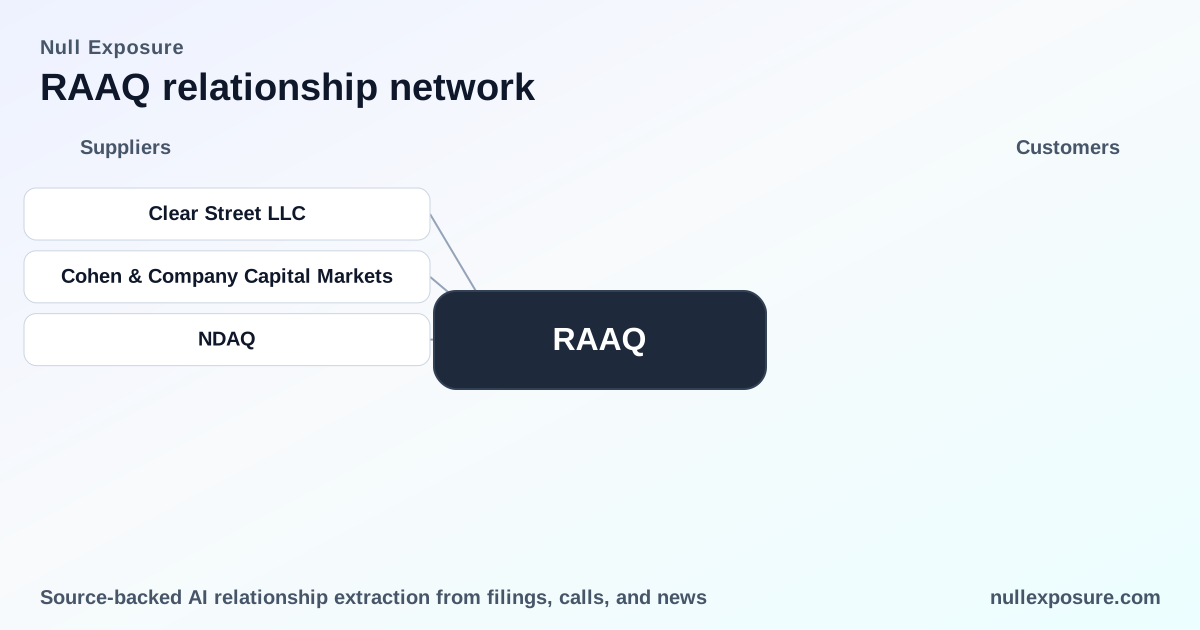
Below are the counterparties disclosed in public reporting tied to RAAQ’s offering and listing. Each relationship is summarized in plain English with the original press release cited.
Clear Street LLC
Clear Street LLC acted as the joint book-runner on RAAQ’s offering, sharing distribution responsibilities for the units sold to public investors. According to the company press release distributed through Yahoo Finance (March 10, 2026), Clear Street took a lead execution role in syndication: https://finance.yahoo.com/news/real-asset-acquisition-corp-announces-172000213.html.
Cohen & Company Capital Markets (a division of J.V.B. Financial Group, LLC)
Cohen & Company Capital Markets served as the lead book-running manager for the offering, indicating primary responsibility for pricing and allocating the units to investors. The same Yahoo Finance announcement (March 10, 2026) identifies Cohen & Company as the lead underwriter: https://finance.yahoo.com/news/real-asset-acquisition-corp-announces-172000213.html.
The Nasdaq Global Market (Nasdaq)
RAAQ’s units commenced trading on The Nasdaq Global Market under the ticker symbol “RAAQU” on April 29, 2025, establishing the public trading venue and post-transaction liquidity framework for unit holders. This listing detail is included in the company’s offering announcement carried on Yahoo Finance (March 10, 2026): https://finance.yahoo.com/news/real-asset-acquisition-corp-announces-172000213.html.
What these relationships imply for investors and operators
- Execution capability: The presence of a lead book-runner and a joint book-runner signals a conventional underwriting syndicate for an SPAC-style offering; investors should treat the underwriting group as a primary supplier of distribution and price discovery. The syndicate composition affects retail and institutional reach and thus redemption rates and aftermarket liquidity.
- Listing dependency: The Nasdaq listing is a gating item for liquidity and future financing. Any delisting or failure to comply with exchange rules would be immediately material.
- Concentration risk: With a narrow set of named intermediaries, operational or reputational issues at one counterparty could disrupt distribution or financing options.
- Sponsor-driven outcomes: Absent operating revenue, value conversion depends on the sponsor and the ability to attract PIPE investors or complete a combination that commands market confidence.
If you want a deeper supplier map or counterparty risk scoring for RAAQ’s syndicate and exchange relationships, explore additional research at NullExposure.
Tactical due diligence checklist for counterparties
Evaluate these items when sizing RAAQ exposure or negotiating supplier terms:
- Underwriter syndicate depth and prior SPAC execution track record.
- Distribution mix between institutional and retail placements (institutional fraction here is high; expect retail stickiness to be the differentiator at pricing).
- Nasdaq compliance history and ongoing reporting cadence.
- Sponsor-level pipeline and any disclosed letter-of-intent (LOI) targets or exclusivity arrangements.
Near-term catalysts and risk triggers
- Redemption levels at combination: High redemptions will shrink deal economics and increase reliance on PIPE financings.
- PIPE availability: The willingness of institutional investors and the named book-runners to underwrite a PIPE is a decisive liquidity event.
- Market reception of any announced target: The post-combination valuation will reprice sponsor economics and public market liquidity.
- Regulatory and listing compliance: Nasdaq rules and SEC reporting are critical — any material non-compliance creates acute risk.
Bottom line and next steps
RAAQ is a market-access vehicle whose value depends on execution partners (book-runners) and the Nasdaq listing; these suppliers are central to its ability to turn sponsor intent into capital deployment. For investors and operators evaluating RAAQ, focus diligence on the underwriting team's SPAC experience, the exchange listing status, and the sponsor's pipeline and financing strategy. For a curated supplier-risk profile and ongoing monitoring of RAAQ counterparties, visit NullExposure.
For further assistance building a counterparty risk model around SPAC sponsors, underwriters, and exchange relationships, the team at NullExposure provides detailed supplier intelligence and ongoing monitoring.