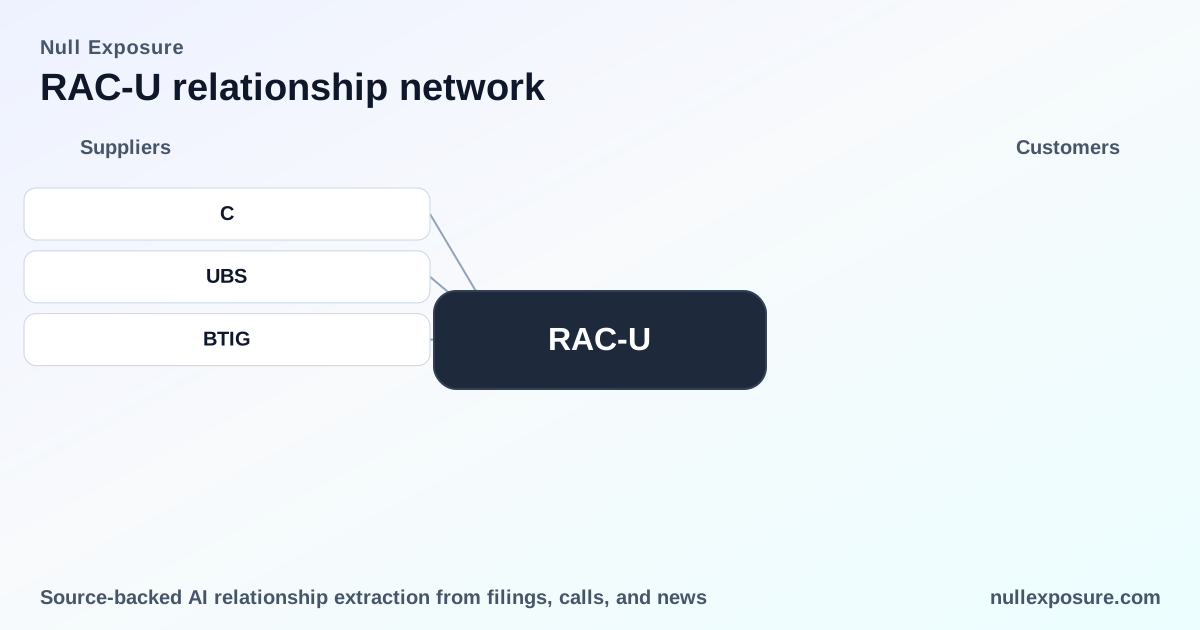
RAC-U: Underwriter relationships that shape capital access for a real-estate-focused vehicle
RAC-U operates as an investment vehicle that acquires and manages income-producing real estate, monetizing through rental cash flows, disciplined asset management and periodic capital-market transactions to fund portfolio expansion and distributions. The firm's access to top-tier capital markets partners is a core enabler of liquidity and growth, so understanding its supplier relationships — particularly underwriting partners used for equity issuance — is central for investors and operators evaluating financing flexibility and execution risk. For a concise vendor-risk view and tracking of counterparties, visit https://nullexposure.com/.
The capital markets plumbing that matters for RAC-U
RAC-U’s public profile emphasizes recurring cash distributions and strategic portfolio growth as primary monetization levers. Absent detailed operating metrics in the available profile, capital markets activity (equity issuance, unit offerings) stands out as the primary external vector that influences near-term liquidity and scaling. The relationships identified in available reporting are classic capital-markets suppliers: global and boutique underwriters who execute public offerings and provide distribution capacity to institutional and retail channels.
A narrow group of underwriters handling a transaction implies a concentrated contracting posture: the company looks to established banks for execution muscle rather than a dispersed syndicate. That concentration speeds execution but raises counterparty and execution risk if market appetite changes. For more supplier-level visibility and historical relationship mapping, see https://nullexposure.com/.
Who RAC-U is working with today (what the record shows)
The available relationship records derive from news coverage of a units offering connected to a Rithm Acquisition transaction; the named underwriters are relevant as supplier relationships in the capital markets ecosystem supporting RAC-U-type vehicles.
Citigroup Global Markets
Citigroup Global Markets acted as one of the lead underwriters on a 20 million unit offering, with the bank joining a syndicate that has a 45-day overallotment option for an additional 3 million units. According to National Mortgage News coverage dated March 10, 2026, Citigroup was listed alongside UBS and BTIG on the transaction announcement.
UBS Investment Bank
UBS Investment Bank is named as a syndicate underwriter on the same offering, providing distribution and placement capabilities for the 20 million units and participating in the 45-day option to cover overallotments, per National Mortgage News (March 10, 2026).
BTIG
BTIG participated as an underwriter in the offering as part of the syndicate that included Citigroup and UBS, supporting the initial distribution of 20 million units and the potential 3 million additional allocation under the syndicate’s option (National Mortgage News, March 10, 2026).
These three entries represent every relationship surfaced in the source results; each is a capital-markets supplier supplying underwriting and distribution services for unit/equity placements.
What these supplier ties imply about RAC-U’s operating and business model
- Contracting posture: RAC-U relies on a compact set of established underwriters for primary-market transactions, signaling a preference for high-quality execution partners rather than a broad roster of boutique dealers. This contracting posture favors speed and credibility in capital raises.
- Concentration risk: The small number of named underwriters concentrates execution risk; a failure or reputational issue with one counterparty would have outsized operational impact during issuance windows.
- Criticality of the relationships: Underwriting partners are mission-critical for liquidity events. For an income-focused real-estate vehicle that monetizes via distributions and portfolio expansion, timely capital access directly affects growth and distribution cadence.
- Maturity signal: Using major global banks for underwriting indicates a professionalized capital-raising approach consistent with vehicles that pursue institutional investor channels rather than wholly private placements.
- Disclosure gap risk: Company-level public profile fields (financials, filings, and operating metrics) are largely blank in the available profile, which increases the importance of counterparty intelligence: when issuer-level transparency is limited, counterparties and transaction history become primary inputs for credit and operational assessments.
Risk posture — what investors and operators should watch next
- Execution risk on future raises: Syndicate composition and overallotment options matter; the existence of a 45-day overallotment option provides short-term flexibility but also indicates reliance on secondary demand to fully finance a raise.
- Counterparty concentration: Dependence on a small set of underwriters concentrates operational risk and negotiation leverage; monitor for changes in lead-man roles or additions/removals from the syndicate.
- Information asymmetry: With limited issuer-level financial disclosures in the profile, supplier relationships and market activity are the best available signals for capital access strength — investors should demand more granular periodic reporting or validated third-party confirmations.
- Market reception sensitivity: Pricing and distribution success on initial offerings will set the tone for follow-on capital needs; underwriter quality can mitigate, but not eliminate, market risk.
Practical takeaways for portfolio managers and operators
- Prioritize active counterparty monitoring. Track syndicate membership and execution outcomes for each issuance — underwriter strengths materially affect pricing and placement velocity.
- Stress-test concentration. Model scenarios where one underwriter reduces participation and quantify the funding and timing impact on planned acquisitions and distributions.
- Demand higher issuer transparency. When issuer financials are sparse, require supplemental diligence or covenant protections in financing agreements to reduce information asymmetry.
For an in-depth supplier-risk scorecard and continuous monitoring tools, explore the resources at https://nullexposure.com/.
Closing verdict and recommended next steps
RAC-U’s identified supplier relationships — Citigroup Global Markets, UBS Investment Bank, and BTIG — are high-quality capital markets partners that provide immediate execution capacity for equity/unit offerings. That underwriter mix supports efficient access to capital but also concentrates execution risk in a small syndicate. Given the sparse issuer-level metrics in the public profile, counterparty intelligence and transaction monitoring become the primary means to assess RAC-U’s ability to fund growth and sustain distributions.
Actionable next steps:
- Obtain transaction-level documentation and placement results from recent offerings to quantify market reception.
- Reassess counterparty concentration limits in capital plans and consider alternate distribution channels.
- Insist on periodic disclosure of operating performance metrics to reduce reliance on supplier signals alone.
For a vendor-focused diligence package and alerts on changes to RAC-U’s supplier roster, visit https://nullexposure.com/ and subscribe to regular updates.