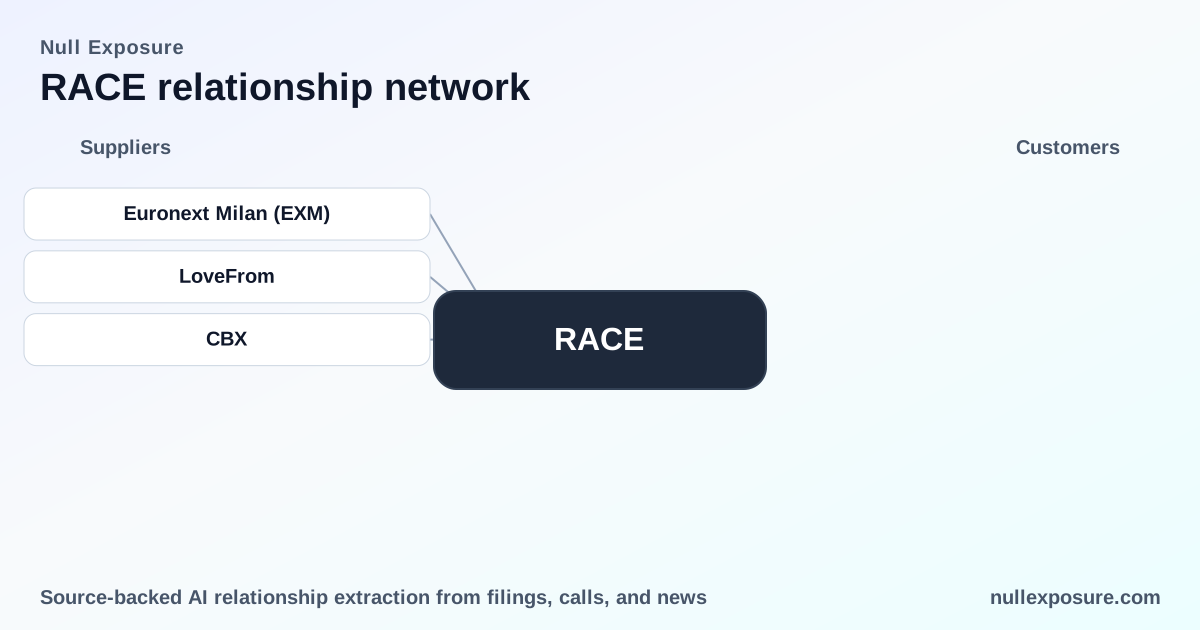
Ferrari NV (RACE) — Supplier relationship profile and investor implications
Ferrari NV designs, engineers, manufactures and sells high-performance sports cars and related luxury products, monetizing through premium vehicle sales, customization and brand licensing while returning capital to shareholders via dividends and an explicitly staged multi-year share buyback. Investors should view Ferrari as a high-margin, brand-driven manufacturer with disciplined capital allocation; supplier and partner relationships — from trading venues that execute capital moves to design collaborators that shape future models — directly influence both cash deployment and product differentiation. For more curated supplier intelligence and related signals, visit https://nullexposure.com/.
How Ferrari’s business model ties to supplier and partner risk
Ferrari’s revenue mix is concentrated on high-value vehicle sales, personalization, parts and licensing, delivering industry-leading operating margins (roughly 28% TTM) and strong return on equity. The company balances growth and shareholder returns: management committed to a Euro 3.5 billion multi-year buyback program (first tranche Euro 250 million) announced at the 2025 Capital Markets Day and executed through market purchases on listed exchanges. That capital-allocation posture makes market access and execution partners — the listed exchanges used for buybacks and the boutique design firms used for product development — materially relevant to investor outcomes.
Ferrari’s financial profile supports a risk-on, premium strategy: Revenue TTM ~$7.08 billion, gross profit ~$3.63 billion, diluted EPS ~$10.62, and a market capitalization near $60 billion. The company’s low beta and high insider ownership further indicate a stable, tightly held capitalization structure that protects long-term product and brand decisions from market volatility.
Trading venues: Euronext Milan (EXM)
Ferrari is actively using Euronext Milan as a primary execution venue for its share repurchase activity. According to a company periodic report published on GlobeNewswire (Jan 26, 2026), the firm purchased shares under the Euro 250 million first tranche of the multi-year Euro 3.5 billion buyback on Euronext Milan and disclosed daily aggregate volumes. (GlobeNewswire, Jan 26, 2026 — https://www.globenewswire.com/news-release/2026/01/26/3225730/0/en/FERRARI-N-V-PERIODIC-REPORT-ON-THE-BUYBACK-PROGRAM.html)
This use of EXM confirms a deliberate, exchange-level execution strategy that preserves market access and transparency while enabling staged capital returns.
Trading venues: NYSE
Ferrari has executed buyback transactions on the New York Stock Exchange alongside EXM, with reported cumulative purchases since the program start. A Manila Times summary of the company report (Feb 24, 2026) notes that from January 5, 2026 through February 20, 2026 Ferrari bought 307,643 common shares on EXM and NYSE for ~€91.7 million, inclusive of sell-to-cover transactions. (Manila Times / GlobeNewswire summary, Feb 24, 2026 — https://www.manilatimes.net/2026/02/24/tmt-newswire/globenewswire/ferrari-nv-periodic-report-on-the-buyback-program/2283261)
Active execution on both European and U.S. exchanges underlines cross-list liquidity and the company’s preference for visible, market-based repurchases rather than off-market transactions.
Strategic design partner: LoveFrom
Ferrari has engaged LoveFrom, the design firm founded by former Apple design chief Jony Ive and Marc Newson, on its Luce electric vehicle over a five-year collaboration that shaped the model’s design language. News coverage of the Luce reveal highlights this long-term creative partnership as a feature of the vehicle program. (MLQ.ai coverage of the Luce announcement, 2026 — https://mlq.ai/news/ferrari-officially-announces-luce-ev-with-teaser-images/)
This collaboration is a strategic product-level partnership: it contributes to Ferrari’s design differentiation in the critical transition to electric models and therefore has direct implications for manufacturing specifications, supplier selection and brand desirability.
Company-level operating signals and constraints investors should read together
Even though there are no formal constraint excerpts tied to individual suppliers in the underlying record, the combined disclosures and financial metrics produce clear company-level operating signals:
- Contracting posture — share-holder centric and market-executed: The staged Euro 3.5 billion buyback and initial tranche executed on public exchanges shows a preference for transparent, market-based capital returns rather than negotiated, private repurchases.
- Concentration and governance: Insider ownership is high (~30.5%) with institutional holders at ~45.5%, indicating a concentrated shareholder base that supports long-term brand and product strategies over short-term opportunism.
- Criticality of partners: Ferrari’s reliance on premier design partners for flagship products and on major exchanges for capital deployment makes selected third parties operationally consequential — disruptions or execution issues would have outsized effects on product timing and shareholder returns.
- Maturity and financial health: Stable profitability (operating margin ~28%) and resilient revenue growth (quarterly revenue growth YoY ~7.4%) position Ferrari as a mature luxury manufacturer with flexibility to fund innovation and returns.
For access to deeper supplier mappings that connect these signals to counterparty profiles, visit https://nullexposure.com/.
What this means for investor due diligence
- Capital-allocation monitoring is central. Track periodic buyback reports on EXM and NYSE to confirm pace and scale of execution versus announced tranches; those trades materially affect equity float and EPS trajectories.
- Product partnerships are strategic risk vectors. Creative collaborators such as LoveFrom affect design IP, manufacturing specs, and consumer demand elasticity — monitor disclosure around scope, exclusivity and delivery milestones.
- Liquidity and governance matter. With concentrated insider holdings and substantial institutional stakes, incremental buybacks and insider transactions will disproportionately influence free float and trading dynamics.
Key takeaway: Ferrari’s supplier and partner relationships are not peripheral procurement issues — they are levers of brand value, execution capacity and shareholder returns.
Bottom line and recommended actions
Ferrari operates as a cash-generative, brand-led luxury manufacturer that uses public exchanges for staged buybacks and engages elite design partners to secure product differentiation. Investors should prioritize monitoring exchange-level buyback execution and partnership disclosures, as these channels directly affect capital allocation, float dynamics and the success of Ferrari’s transition to electric models.
For continued tracking of Ferrari’s supplier exposures and execution signals, explore tailored reports and relationship overlays at https://nullexposure.com/.