FreightCar America (RAIL): Supplier Footprint and Operational Constraints that Matter to Investors
FreightCar America designs and manufactures freight railcars and components, monetizing through vehicle sales and after-market components primarily across North America and Mexico. The company’s economics derive from large, cyclical contract wins for railcar builds, margin capture on manufacturing throughput, and localized supply relationships that affect unit cost and delivery cadence. For investors, the key questions are supplier concentration, vertical integration around steel and components, and how recent asset purchases and supplier links shape capacity and margin durability.
Explore supplier intelligence and implications at https://nullexposure.com/.
Why supplier relationships drive the investment thesis
FreightCar America’s manufacturing model is capital- and input-intensive: steel inputs, fabrication partners, and plant capacity directly determine throughput, lead times, and gross margins. The company’s ability to win and execute large fleet orders depends on stable access to both materials and operating assets. That makes discrete supplier events — plant acquisitions and material partnerships — central to forecasting revenue cadence and capital allocation.
Recent transactional moves: plant acquisitions that increase capacity
FreightCar America executed an asset purchase of Navistar’s railcar operating assets at the Shoals facility in Cherokee, Alabama, which transfers localized manufacturing capability and shortens the ramp to higher build rates. According to Progressive Railroading’s coverage, the company agreed to buy Navistar’s railcar operations assets at Shoals as part of an expansion of its manufacturing footprint (reporting on the 2018 asset transaction). RailwayPro also documented the asset purchase agreement that transferred substantially all railcar operating assets at the Shoals facility to FreightCar America (reporting on the same 2018 transaction).
Key takeaway: the acquisition is a capacity-expanding, near-term de-risk to production ramp, and it illustrates FreightCar’s preference for bolt-on growth via asset purchases.
Input partnerships: material sourcing and OEM linkages
FreightCar America builds cars that incorporate high-grade inputs from major steel producers. A Progressive Railroading report on CN’s FY2024 order noted that FreightCar America manufactured iron-ore cars at its Castanos, Mexico plant using high-quality materials supplied by U.S. Steel to enhance performance and durability. Key takeaway: relationships with major steel suppliers are revenue-enablers for higher-spec builds and can be a competitive differentiator on multi-car orders.
Relationship digest: who FreightCar America works with
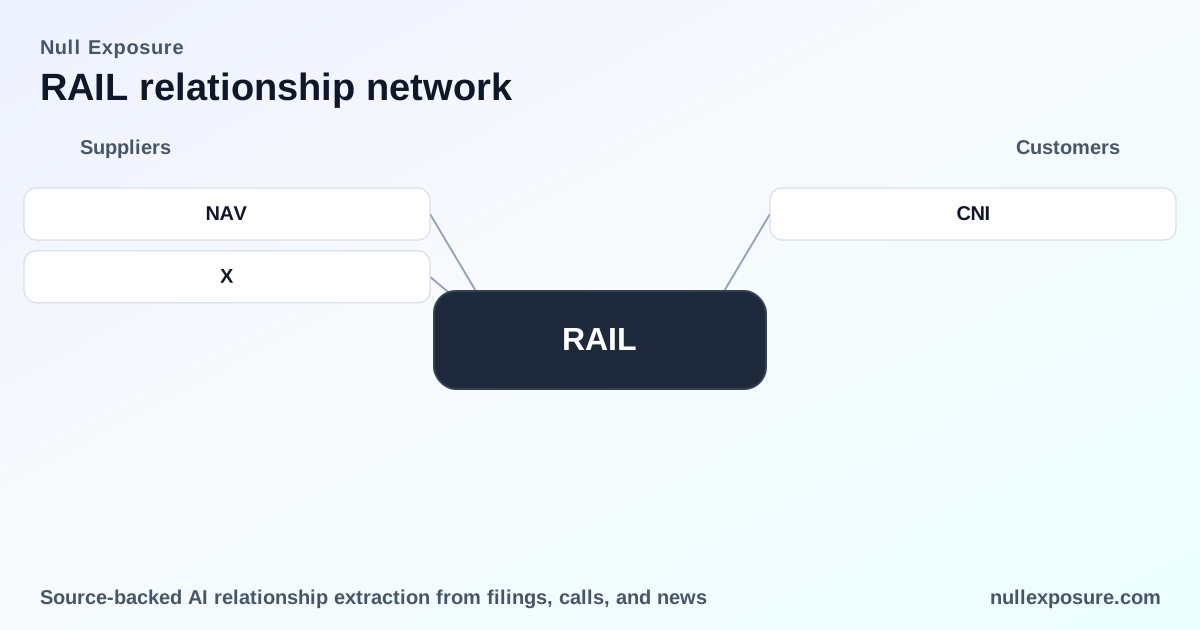
Navistar, Inc. — FreightCar America acquired Navistar’s railcar operating assets at the Shoals facility in Cherokee, Alabama, under an asset purchase agreement that transferred substantially all operating assets associated with that operation, strengthening RAIL’s U.S. manufacturing base (Progressive Railroading and RailwayPro coverage of the 2018 transaction).
U.S. Steel — CN ordered iron-ore cars from FreightCar America built at Castanos, Mexico that incorporate materials sourced from U.S. Steel to improve performance and durability, illustrating a strategic materials relationship used in FY2024 builds (Progressive Railroading reporting, FY2024).
Operational constraints and what they signal about risk and governance
FreightCar America’s filings and disclosures surface clear operational constraints that are material to supply-side risk and contracting posture:
- Sole-source risk on critical components. The company uses a sole supplier for roll-formed center sills, which accounted for 51% of new railcars in 2024 and 27% in 2023, creating a concentration that is functionally critical to production continuity. This is an active, high-impact supplier relationship and a structural constraint on procurement flexibility.
- Related-party and small-value vendor relationships. The company discloses payments to the Gil Family and affiliated entities (for steel fabrication, rent, trucking, material and safety supplies) of $27,214 in 2024 and $17,379 in 2023, signaling low-dollar but recurring transactions and governance that investors should monitor for procurement controls.
- Service providers with shareholder links. Fasemex provides steel fabrication services and held approximately 10.2% of common stock as of December 31, 2024, indicating an ownership-service provider overlap that affects supplier governance and negotiating posture. Maquinaria y equipo de transporte Jova (METJ) provides trucking services and is owned by a family member of company insiders, further underscoring related-party service relationships.
- Spend profile and stage. Most disclosed payments to related parties are under $100k annually, positioning these relationships as low-spend but potentially high-control due to proximity and ownership ties. The roll-formed center sill supplier is active and functionally critical, increasing the company’s exposure to single-source disruption.
Together, these signals indicate a contracting posture that blends strategic asset ownership with localized, sometimes related-party service provision. Concentration is focal where it matters (structural components); overall spend is modest for related-party services, but ownership overlaps require continual governance scrutiny.
What investors should watch next
- Delivery cadence on large orders: factory capacity expanded by the Shoals acquisition increases upside if FreightCar converts backlog into throughput without material supply interruptions.
- Supplier diversification for center sills: any move to qualify alternate providers reduces single-point-of-failure risk and meaningfully improves operational resilience.
- Governance around related-party suppliers: continued transparency on pricing and competitive procurement will affect investor confidence and potential valuation multiples.
If you track supplier risk as a leading indicator of execution and margin stability, this is a company where supply-side events directly reprice forecasts. Learn more about supplier-driven signals at https://nullexposure.com/.
Bottom line and investor action
FreightCar America’s tangible strategy blends asset-based capacity expansion with tight material partnerships. The company shows clear capacity leverage from acquisitions and material quality gains from steel suppliers, but it also carries concentrated component risk and related-party supplier exposures that require monitoring. For investors, upside is execution-dependent: successful integration of acquired assets and diversification of key component suppliers will unlock durable margin improvement.
For a deeper review of how supplier relationships affect corporate performance, visit https://nullexposure.com/ and explore supplier intelligence and relationship analytics tailored for investors.