Rand Capital Corp (RAND) — supplier relationships and what they mean for investors
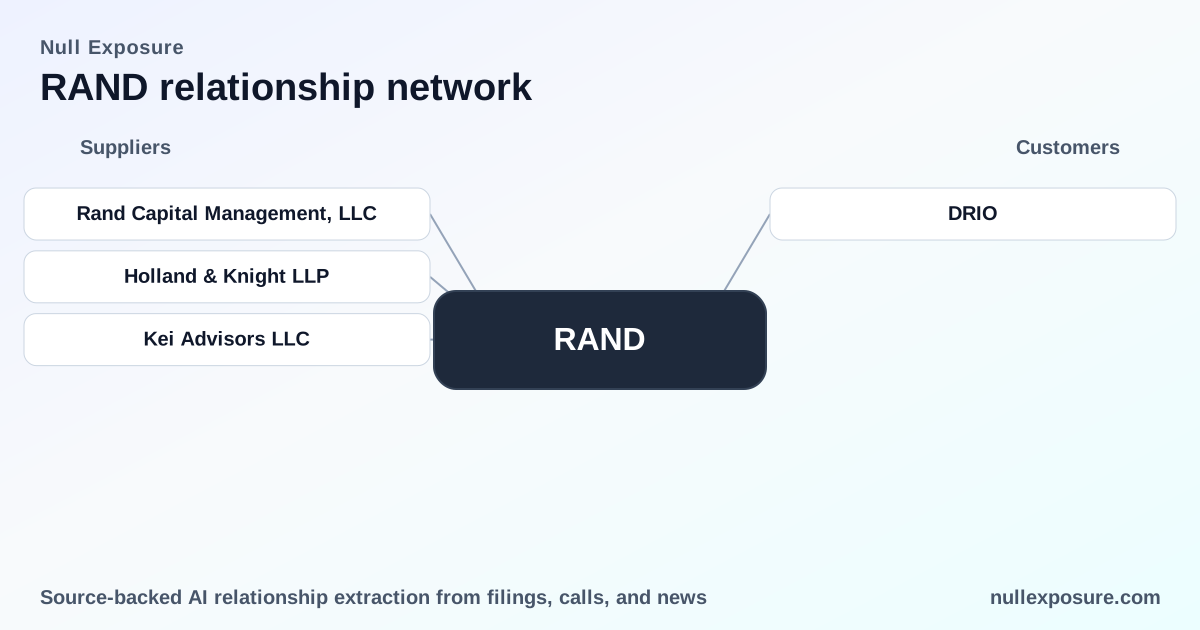
Rand Capital is an externally managed, lower-middle‑market investment company that monetizes through investment income (interest and dividends), realized capital gains, and fee arrangements with its external adviser. The operating model is simple in structure but concentrated in execution: an external Registered Investment Adviser runs the portfolio under a management and administration agreement that generates base management fees and potential incentive fees, while the public vehicle retains financing facilities and portfolio exposures that drive total returns. For investors evaluating supplier risk and operational leverage, the most material relationships are the external adviser, occasional legal counsel in financing deals, and IR/pr firms that handle market communications. Learn more at https://nullexposure.com/.
Executive summary: the essential dynamics for investors
Rand Capital is externally managed, which creates a dual revenue dependency: the firm’s investment performance produces traditional portfolio returns, while the adviser’s compensation structure determines ongoing operating cost and alignment. Key operating signals in public disclosures: a management and administration agreement with Rand Capital Management, LLC (RCM) that defines fees and services; an extended advisory term through an agreement that requires monitoring for renewal; and a credit facility with a defined maturity in mid‑2027 that frames financing flexibility.
- Concentration and criticality: reliance on a single external adviser for portfolio construction and day‑to‑day operations makes RCM a critical supplier.
- Contracting posture: the adviser relationship is long‑running and governed by explicit fee schedules—this is a managed outsourcing posture rather than in‑house management.
- Maturity pressure: the company-level credit facility matures June 27, 2027, which sets a near‑term financing milestone for management and counterparties.
These features justify active diligence on adviser economics, contract renewal cadence, and balance‑sheet flexibility. For more supplier intelligence and signal analysis visit https://nullexposure.com/.
Supplier-by-supplier breakdown (what the record shows)
Rand Capital Management, LLC
Rand’s investment activities and administration are run by Rand Capital Management, LLC, which serves as the company’s external investment adviser under an Investment Management Agreement that includes a base management fee and potential incentive fees; the agreement was extended and is scheduled to expire on December 31, 2025. According to a Business Wire release covering first‑quarter results, RCM is the adviser that manages Rand’s investment activities and administrative functions (Business Wire, May 13, 2024 — https://markets.financialcontent.com/worldnow/article/bizwire-2024-5-13-rand-capital-reports-12-increase-in-total-investment-income-for-first-quarter-2024).
Source: Business Wire / FinancialContent (FY2024).
Holland & Knight LLP
Holland & Knight acted as legal counsel for Rand Capital and Callodine Group in a refinancing transaction connected to DarioHealth, where a new debt facility of up to $50 million was arranged to provide operational flexibility (PR Newswire, FY2025). This indicates Rand uses established external law firms for transactional and financing work rather than relying solely on in‑house counsel.
Source: PR Newswire (FY2025) — https://www.prnewswire.com/il/news-releases/dariohealth-closes-strategic-refinancing-of-existing-debt-facility-of-up-to-50-million-to-provide-additional-operational-flexibility-and-support-growth-initiatives-302443987.html.
Kei Advisors LLC
Kei Advisors LLC is identified in investor‑relations contact information distributed with Rand’s quarterly release; the firm’s personnel were listed as investor contacts for the report cited above. This signals the use of an external IR/communications resource for market and investor engagement. (Business Wire, May 13, 2024 — https://markets.financialcontent.com/worldnow/article/bizwire-2024-5-13-rand-capital-reports-12-increase-in-total-investment-income-for-first-quarter-2024).
Source: Business Wire / FinancialContent (FY2024).
What constraints and contract signals reveal about the operating model
Public evidence provides concrete constraints that shape the business model:
- Long‑term financing schedule: the company has a credit facility maturing June 27, 2027, which sets a definable timeline for refinancing or repayment and therefore influences capital allocation and liquidity management. This is a company‑level signal that affects portfolio deployment and counterparty planning.
- Service provider posture: Rand’s operation is structured around an external adviser relationship (RCM) that handles core investment decisions and administrative tasks, and compensation is fee‑based with incentive components—this elevates the adviser to a mission‑critical supplier with direct impact on performance and cost.
- Active agreement lifecycle: the adviser agreement was renewed and its term extended, with the current term scheduled to expire December 31, 2025; treat contract renewal as a governance and continuity risk trigger.
- Segment orientation: disclosures classify the adviser/service relationship under services, confirming that the relationship is primarily operational and managerial rather than transactional or peripheral.
Together these constraints produce a business profile where counterparty continuity (adviser retention), fee alignment, and near‑term financing are the principal operational risks.
Investment and operational implications for investors and operators
- Operational dependency: because RCM is the principal manager, any change in that relationship materially affects execution and governance; investors should watch board minutes and proxy disclosures around the management agreement renewal cycle.
- Liquidity and refinancing cadence: the June 2027 credit facility maturity is a hard date that will drive financing decisions; management’s ability to refinance on comparable terms will influence cash returns and portfolio behavior.
- Communications and legal support: routine use of external IR (Kei Advisors) and law firms (Holland & Knight) signals a modestly outsourced corporate services model; this reduces fixed overhead but increases reliance on third‑party counsel and advisors for discrete transactions.
- Concentration in ownership: high insider ownership (roughly 76% per latest filings) and low institutional ownership (~2%) shape voting outcomes and strategic continuity, increasing stability but reducing external governance pressure.
For a deeper read on how supplier posture affects smaller, externally managed investment firms, consult current supplier analyses at https://nullexposure.com/.
Actionable next steps for investors
- Confirm timeline and terms for renewal of the Investment Management Agreement ahead of the December 31, 2025 expiry. Contract renewal is the single most material supplier event in the near term.
- Monitor financing activity related to the June 27, 2027 credit‑facility maturity; prioritize scenarios for refinancing stress and its impact on dividend policy and liquidity.
- Evaluate adviser fee structure and incentive alignment relative to performance benchmarks to understand cost drag vs. alpha generation.
For practical monitoring tools and supplier signals on RAND and peer managers, visit https://nullexposure.com/.
Conclusion
Rand Capital’s operating model is defined by an externally managed structure with a single adviser that is central to execution, a near‑term financing milestone in 2027, and routine use of external legal and communications support for transactions and disclosures. The primary investor considerations are adviser continuity, fee alignment, and the company’s approach to refinancing the credit facility. These are the levers that will determine whether Rand’s investment income and fee framework translate into sustainable returns for shareholders.