Rani Therapeutics: Supplier Relationships and Operational Constraints Investors Should Price In
Rani Therapeutics operates a platform business built around the RaniPill™ oral delivery capsule and monetizes through partnership-driven development, licensing arrangements for biologic payloads, and eventual product sales or royalties from partnered commercialization. The company outsources critical payload manufacturing and clinical execution to third parties while funding operations through equity placements and placement-agent relationships. For investors, the core thesis is straightforward: Rani is a development-stage biologics delivery company whose value hinges on supplier performance, licensing economics, and continued access to capital.
For more supplier and counterparty intelligence, visit https://nullexposure.com/.
Why supplier relationships are central to Rani’s value creation
Rani’s commercial proposition requires two distinct capabilities: the RaniPill capsule itself and reliable access to biologic drug substances that are incorporated into that capsule. The company’s financial profile — TTM revenue of $1.2M, negative EBITDA, and a high price-to-sales multiple — confirms a pre-revenue / early commercialization posture where operational execution depends heavily on partners rather than internal scale.
- Contracting posture: Rani uses licensing and supply agreements to obtain established biologics for integration with its delivery platform; these contracts transfer manufacturing responsibility to suppliers while granting Rani commercialization rights in some cases.
- Concentration and criticality: Several programs depend on single named suppliers for drug substance supply and licensed IP, making supplier continuity a critical operational variable.
- Maturity and runway: The firm’s small current revenues and negative operating margins mean it will continue to rely on capital markets and placement agents to fund development until commercial revenues scale.
These company-level signals are reflected in Rani’s filings: the 2024 Form 10‑K documents explicit license and supply agreements and ongoing reliance on contract research organizations and third‑party manufacturers to run trials and produce payloads.
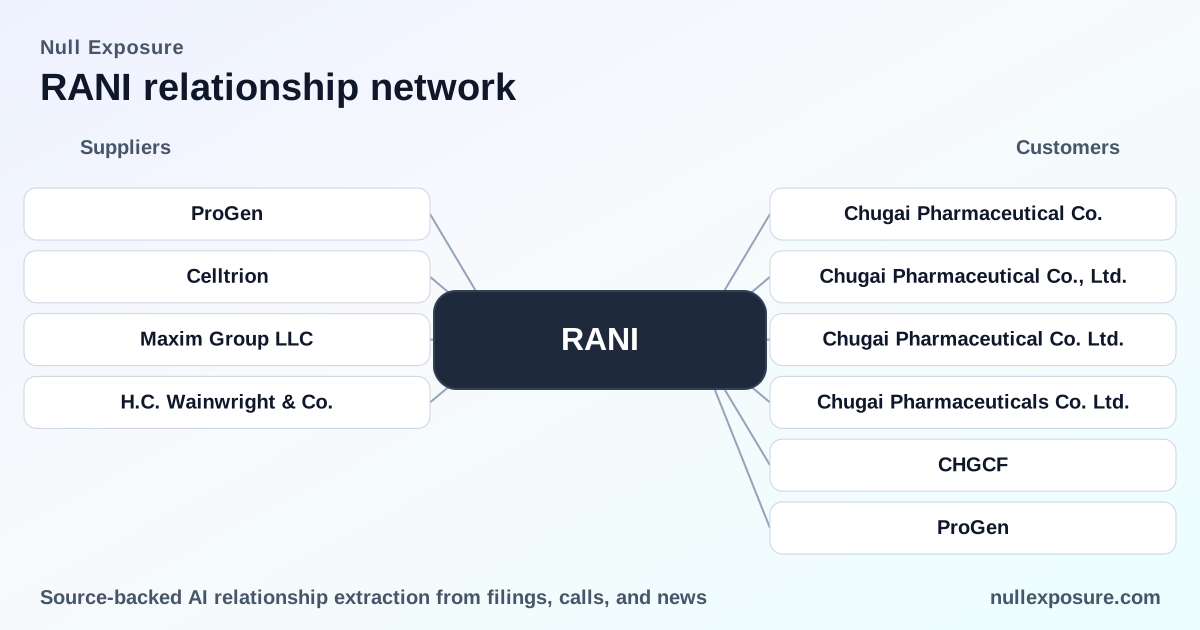
Supplier map: what every partner does today
ProGen — drug substance supplier for PG‑102 (RT‑114)
Rani obtains the drug substance for PG‑102 used in RT‑114 under a ProGen Collaboration Agreement, making ProGen a direct supplier to that program. This relationship is documented in Rani’s FY2024 Form 10‑K. (Source: Rani 2024 10‑K)
Celltrion — licensed biosimilars supplier and licensor for RT‑111 / RT‑105
Celltrion provides ustekinumab and adalimumab biosimilars to Rani and has granted Rani an exclusive, worldwide, royalty‑free license to certain IP to make, develop, and commercialize RT‑111 and RT‑105; supply prices and exclusivity terms are set in the Celltrion agreements, with a contractual right to source alternatives if Celltrion experiences supply disruption. The licensing and supply structure and exclusivity provisions are described in Rani’s FY2024 10‑K (filed for period ending Dec 31, 2024). (Source: Rani 2024 10‑K)
Maxim Group LLC — placement agent for registered direct offering (2025)
Maxim Group LLC served as the placement agent in Rani’s $3.0M registered direct offering announced July 15, 2025, demonstrating Maxim’s role in executing small equity raises supporting near‑term financing needs. (Source: Globenewswire press release, July 15, 2025)
H.C. Wainwright & Co. — lead placement agent for private placement (2025)
H.C. Wainwright & Co. acted as lead placement agent for Rani’s oversubscribed $60.3M private placement announced October 23, 2025, with Maxim Group participating as a co‑placement agent; this syndicate activity indicates market access and investor interest sufficient to back a sizeable financing round. (Sources: Globenewswire press release, Oct 23, 2025; Finance Yahoo coverage, Oct 23, 2025)
Constraints and operating signals investors should internalize
Rani’s disclosures generate several actionable constraints and signals about its business model and supplier posture.
- Licensing is a deliberate strategy. Rani uses licensing agreements to secure rights to biologic payload IP and supply — a structural choice that reduces Rani’s need to develop biologics in‑house but transfers dependency to licensors. Evidence: Rani’s 2023 License and Supply Agreement with Celltrion described in its 10‑K.
- Celltrion functions as both licensor and manufacturer for key programs. The filings state Celltrion grants an exclusive license and will supply specific biosimilars for RT‑111 and RT‑105 — a combined commercial and manufacturing role that concentrates program risk with a single partner. (Company filing: 2024 10‑K)
- Third‑party manufacturing and CRO reliance is business‑wide. Rani routinely contracts CROs and other vendors to run preclinical and clinical programs and to manufacture payloads for the RaniPill; this creates operational dependencies and externalizes execution risk across multiple suppliers. (Company filing: 2024 10‑K)
- Relationship stage is active for recently executed Celltrion agreements. The Celltrion license and supply agreements signed in 2023 are active components of Rani’s development plan. (Company filing: 2024 10‑K)
These constraints translate into investment reality: supplier performance and contractual protections drive program timelines and dilution outcomes. For monitoring and benchmarking providers, investors should track supply‑chain notices, API traceability disclosures, and alternate‑sourcing clauses in future filings.
If you want consolidated counterparty profiles and contract signals, explore detailed supplier intelligence at https://nullexposure.com/.
Investment implications: risk factors and upside levers
- Operational risk is high but concentrated. The Celltrion arrangement centralizes supply for flagship programs; a failure of that supply chain would materially delay development and force expensive re‑sourcing.
- Capital markets access reduces near‑term financing risk. The oversubscribed $60.3M private placement led by H.C. Wainwright and subsequent registered direct offering executed with Maxim Group demonstrate the company’s ability to monetize equity — a necessary lever given negative EBITDA and limited current revenue.
- Value depends on execution, not valuation multiples. With analysts setting a target price near $8 and a compact revenue base, upside depends on clinical progress, commercialization economics of licensed payloads, and the ability to scale supply without prohibitive cost escalation.
Near‑term watchlist and actionable signals
- Monitor operational updates on Celltrion supply performance and any invoked alternative‑source clauses in future 10‑Q/8‑K filings. The Celltrion agreements are central to RT‑111 and RT‑105 program timelines. (Source: Rani 2024 10‑K)
- Watch announcements from ProGen on PG‑102 manufacturing milestones for RT‑114 to assess whether third‑party execution keeps pace with planned trials. (Source: Rani 2024 10‑K)
- Track placement activity and syndicate composition for signs of dilution risk or improving access to deeper capital pools; the H.C. Wainwright/Maxim placements in 2025 are relevant comparators. (Sources: Globenewswire Jul/Oct 2025; Finance Yahoo Oct 2025)
For a deeper read on counterparties and contractual constraints that affect valuation and execution risk, visit https://nullexposure.com/.
Bottom line
Rani's commercial path is partner‑dependent: the RaniPill platform de‑risks patient adherence but transfers biologic payload risk to suppliers and licensors. Celltrion and ProGen are material operational counterparts, while placement agents H.C. Wainwright and Maxim have underwritten the company’s recent capital raises. Investors should price in single‑source supplier risk, CRO/manufacturer reliance, and ongoing capital needs when modeling upside for RANI.