Rapport Therapeutics: Supplier relationships that shape a pre-commercial neuroscience bet
Rapport Therapeutics develops therapies for neurodegenerative disease and advances RAP-219 through early clinical testing by outsourcing critical functions and monetizing primarily through licensing, milestone payments and eventual product commercialization. The company operates a capital‑intensive R&D model: it contracts device and clinical services partners to execute trials, maintains licensing arrangements with larger pharma for development and commercialization, and expects revenue to emerge from milestone and sales-based arrangements rather than product sales today. For investors, supplier relationships are the operative mechanism that converts science into clinical readouts and, ultimately, value. Learn more about supplier intelligence at https://nullexposure.com/.
Why supplier relationships determine timing and dilution
Rapport is pre‑revenue with heavy R&D outflows and a market capitalization dominated by potential future approvals. Supplier counterparties — device manufacturers, CROs/CMOs, and strategic advisors — therefore carry oversized operational and valuation risk: delays or failures in executing trials directly translate into cash burn and financing needs. The company’s public filings and press releases provide a compact picture of how those partnerships are structured and how material they are to near‑term development milestones.
NeuroPace, Inc. — clinical device partner and distributor/manufacturer
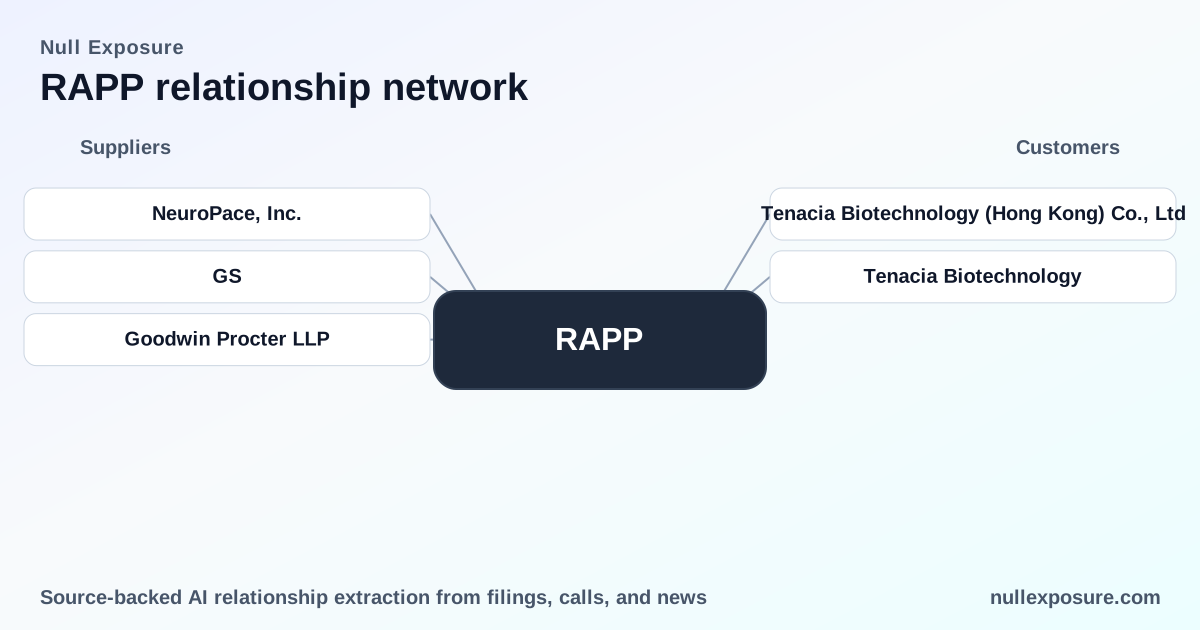
Rapport’s Phase 2a proof‑of‑concept trial for RAP‑219 targets participants already implanted with an intracranial RNS system marketed by NeuroPace, and the companies have a master services agreement plus statements of work to provide trial readiness, data analysis and reporting services. According to Rapport’s 2024 Form 10‑K, NeuroPace supplies device access and clinical services for RAP‑219 enrollment and data management (FY2024 10‑K). The company recorded payments to NeuroPace and recognized R&D expense associated with these services — filings show $0.6 million paid and $1.8 million recognized in R&D expense for services during the year ended December 31, 2024 (Rapport 2024 Form 10‑K).
Goldman Sachs & Co. LLC — financial advisor on the China collaboration
Goldman Sachs served as Rapport’s financial advisor in connection with the March 2026 strategic collaboration to develop and commercialize RAP‑219 in Greater China with Tenacia Biotechnology, signaling a transaction structured for regional licensing and partnership economics. That role is documented in a March 9, 2026 GlobeNewswire press release announcing the collaboration with Tenacia (GlobeNewswire, 2026‑03‑09).
Goodwin Procter LLP — legal advisor to Rapport on the same transaction
Goodwin Procter acted as legal advisor to Rapport in the Tenacia Greater China collaboration, indicating law‑firm support for complex cross‑border licensing and regulatory terms. This engagement is noted alongside the Goldman advisory role in the March 9, 2026 GlobeNewswire press release (GlobeNewswire, 2026‑03‑09).
What the constraints tell investors about how Rapport contracts and operates
The public excerpts in Rapport’s filings reveal a consistent operating model: heavy outsourcing, a mix of short‑term flexible agreements and longer‑duration strategic contracts, and targeted geographic manufacturing exposure.
- Contracting posture — Rapport maintains longer‑term master agreements where continuity matters (for example, the NeuroPace Agreement extends to the later of three years or the completion of SOW services) while most CRO/CMO engagements are short‑term and cancelable. This hybrid posture preserves operational continuity for critical services while keeping runway flexibility for non‑core work.
- Concentration and criticality — The company outsources all manufacturing, including to jurisdictions outside the U.S. such as China, which creates concentration risk in contract manufacturing and supply chain exposure to APAC regulatory regimes. The company also relies on third parties to store and distribute clinical supplies, making those partners operationally critical.
- Spend profile and financial maturity — Current transactional evidence shows modest committed near‑term cash obligations to service providers (SOW payments to NeuroPace total up to $3.7 million over roughly two years, with ~$0.6 million paid in 2024) alongside large contingent obligations embedded in licensing (the Janssen license contemplates up to tens of millions of dollars in future development and sales milestones). The balance of modest near‑term cash commitments and significant contingent milestone upside is consistent with a pre‑commercial biotech financing profile.
- Relationship roles and stage — Filings categorize partners as manufacturers, distributors and service providers, and identify these relationships as active. NeuroPace is explicitly called out as both manufacturer/distributor of the RNS system and as a services vendor for the RAP‑219 study; other CRO/CMO relationships are cancellable and non‑committal by design.
- Legal and indemnity posture — Rapport reports no material indemnification liabilities to date, which is positive for near‑term balance‑sheet risk, but legal arrangements tied to licensing and regional commercialization will demand close monitoring as collaborations progress.
These structural constraints explain Rapport’s capital allocation choices: keep fixed commitments moderate, preserve optionality through cancelable CRO/CMO contracts, and pursue licensing to transfer commercial execution risk while capturing milestone economics.
Learn how supplier footprints convert to valuation drivers at https://nullexposure.com/.
Investment implications — drivers and risks to watch
- Clinical dependency risk: RAP‑219’s Phase 2a execution depends on access to patients with NeuroPace RNS implants and on NeuroPace’s data services; monitor enrollment cadence and SOW deliverables closely.
- Commercial optionality via licensing: The Janssen license (disclosed in company filings) creates potential milestone and sales upside measured in the tens of millions, converting clinical success into cash inflows without building full commercial capacity.
- Manufacturing and geographic exposure: Outsourcing manufacturing to third parties, including facilities in China, accelerates timelines but concentrates regulatory and supply risk outside the U.S.
- Advisory signal: Engagement of Goldman Sachs and Goodwin Procter on the Tenacia transaction signals intentional partnership structuring for Asia commercialization and is consistent with a strategy of licensing regional rights to limit capital intensity.
- Capital sensitivity: Pre‑revenue financials and negative EBITDA require attention to cash runway; supplier contracts that shift fixed costs to partners or convert costs to milestone payments materially improve the company’s financing profile.
Actionable next steps for investors and operators
- For investors: track NeuroPace SOW milestones and enrollment updates, and monitor any milestone payments or option exercises from licensing partners, as those are the nearest inflection points for de‑risking the story.
- For operators and procurement: prioritize redundancy for critical manufacturing and distribution partners, and codify escalation clauses for non‑U.S. manufacturing to reduce geopolitical and regulatory execution risk.
- For deal teams: use the current advisory engagement model as a blueprint — regional licensing with reputable advisors accelerates speed to market while conserving capital.
If you are modeling Rapport’s path to commercialization or evaluating counterparty risk, start with supplier-level intelligence and structured monitoring at https://nullexposure.com/.
Strong supplier governance and disciplined licensing determine whether early clinical promise translates into shareholder value; Rapport’s public record identifies clear partners, modest near‑term service spend and large contingent milestone upside — the combination investors should track as clinical readouts and regional deals move forward.