RAPT Therapeutics: Supplier map, contractual posture, and where risk concentrates
RAPT Therapeutics is a clinical-stage immunology biopharma that builds value by acquiring and advancing oral small-molecule candidates toward commercialization; the company monetizes through future product sales and structured licensing economics (upfront fees, milestones and royalties) while relying on third-party supply and collaboration to run clinical programs. RAPT currently has no product revenue, a market capitalization around $1.68 billion, and is operating as a development-led company whose near-term value is driven by partner relationships and licensed assets. For sourcing and counterparty due diligence, the supplier picture — who supplies clinical drug, who owns IP, and who supplies comparator or combination therapies — is decisive for operational continuity and valuation. Learn more and track counterparties at https://nullexposure.com/.
Two supplier relationships you must evaluate before underwriting exposure
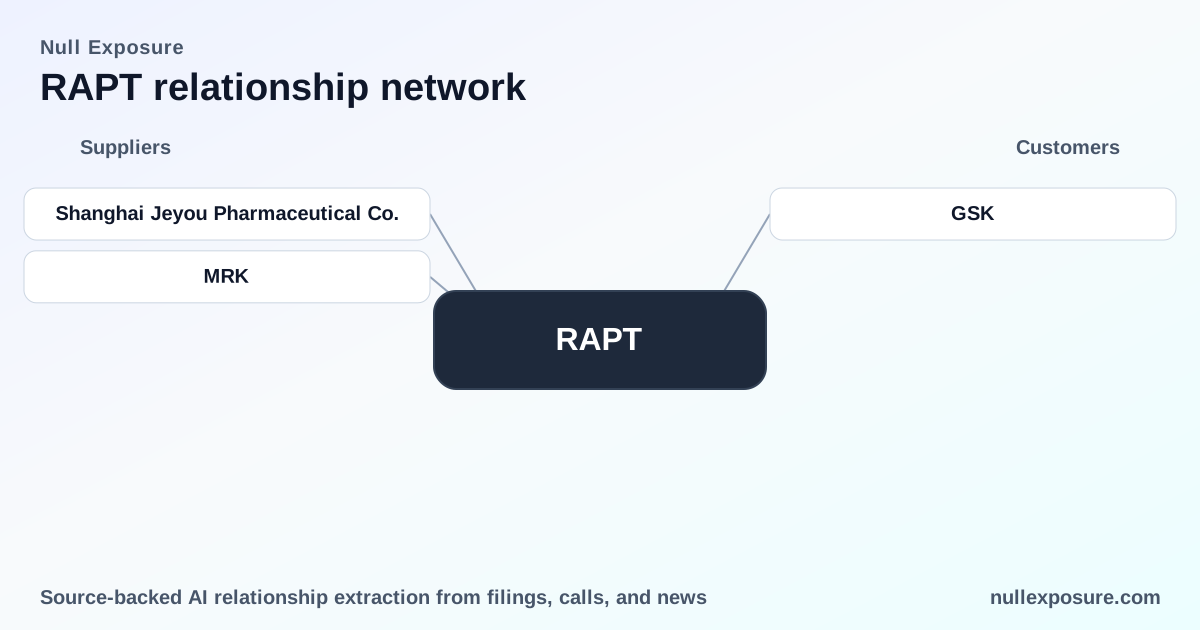
RAPT’s disclosed supplier and collaboration footprint is compact but consequential: a China-origin licensor/clinical supplier referenced in press coverage, and a legacy clinical collaboration with Merck for combination studies. Both relationships have discrete operational implications — one concentrates clinical supply and IP offshore, the other governs access to a global commercial-grade immune-oncology agent.
Shanghai Jeyou Pharmaceutical Co. — license origin for ozureprubart (topic: China-origin asset)
RAPT acquired rights to a compound identified as ozureprubart from a China-based biotech now described as Shanghai Jeyou Pharmaceutical Co., which supplies the IP origin for that program. According to a MedCity News report in March 2026, RAPT licensed ozureprubart from that China-based developer as part of its inflammation / IgE-targeted strategy (news report, March 2026).
Merck — clinical trial collaborator and supplier for combination therapy
RAPT executed a clinical trial collaboration and supply agreement (entered November 2018) with an affiliate of Merck (MSD outside North America) under which RAPT sponsored a trial evaluating tivumecirnon combined with Merck’s pembrolizumab (KEYTRUDA®); Merck supplied pembrolizumab for the study. This relationship is described in RAPT’s 2024 Form 10‑K (filed December 31, 2024).
What the supplier map implies about RAPT’s operating model and risk posture
RAPT’s supplier relationships and the constraints disclosed in filings produce a clear set of operational signals for investors and operators evaluating counterparty exposure.
-
Concentration of critical IP/supply in APAC: RAPT’s disclosures reference a China-based licensor that controls IP and is relied upon for clinical drug supply; this is a corporate-level signal that critical development inputs are sourced offshore, which raises logistics, regulatory coordination, and geopolitical supply-chain attention points. RAPT’s 2024 disclosures describe a license with a China party that is the owner of IP and clinical supply for RPT904 (Form 10‑K, FY2024).
-
License-driven cash commitments and upside sharing: RAPT paid a material upfront license fee ($35.0 million) and agreed to up to $672.5 million of additional milestone payments plus tiered royalties on future net sales for the licensed program, demonstrating a capital deployment model that trades near-term cash for exclusive development and commercialization rights (Form 10‑K, December 31, 2024). This structure reduces outright discovery cost but creates long-term royalty obligations that shape future margins.
-
Criticality of single-source suppliers: The company-level disclosure explicitly states dependency on a named China licensor for clinical supply, which signals that any disruption at that source is material to development timelines and cost. This is a critical, not ancillary, supplier relationship (Form 10‑K, FY2024).
-
Manufacturer role confirmed for Merck in combination studies: RAPT’s historical collaboration with Merck included Merck supplying pembrolizumab for clinical work, establishing a supplier role for Merck in those trials and ensuring access to a globally manufactured comparator/partner product (Form 10‑K, FY2024). This supply relationship reduces execution risk for combination trials while introducing the dependency of scheduling and supply terms controlled by a large pharmaceutical counterparty.
Collectively these points define RAPT’s contracting posture as license-heavy, development-focused, and externally supplied, with limited vertical manufacturing capability in-house and meaningful dependence on a small set of external counterparties for both IP and critical drug supply.
Relationship-level takeaways for investors and operators
-
Shanghai Jeyou / China-origin licensor: RAPT acquired rights to ozureprubart from a China-based biotech now identified as Shanghai Jeyou, positioning the company as licensee of a foreign-origin asset. The acquisition of these rights is central to the RPT904 program and creates dependency on the original licensor for clinical supply and IP continuity (MedCity News, March 2026). This introduces APAC supply and IP governance as key operational risk factors.
-
Merck (MRK): The clinical trial collaboration and supply agreement with an affiliate of Merck (entered November 2018) established RAPT as sponsor for combination studies of tivumecirnon with pembrolizumab, with Merck providing pembrolizumab for the trial. This arrangement secures access to a standard-of-care PD‑1 agent during development and demonstrates RAPT’s use of established partner supply to execute combination trials (RAPT Form 10‑K, filed December 31, 2024).
(Each relationship summary above links back to source material: MedCity News coverage for the Shanghai Jeyou note and RAPT’s 2024 Form 10‑K for the Merck collaboration.)
For project-level risk monitoring and counterparty scoring for these partnerships, see how we normalize vendor criticality and geography on the platform: https://nullexposure.com/.
Practical implications for valuation and diligence
-
Value drivers: RAPT’s enterprise value is driven by clinical milestones and the optionality embedded in licensed assets; the license economics (upfront + milestones + royalties) are a direct mechanism for shifting risk and reward. RAPT’s investment in licensed IP accelerates the timeline to clinic but creates future royalty liabilities that will compress realized margins if commercialization succeeds.
-
Operational risks to size into assumptions: The APAC dependency for clinical supply requires scenario modeling for shipping delays, regulatory holdouts, and quality audits; investors should incorporate supply disruption scenarios into probability-adjusted cash flows. The Merck relationship reduces execution risk for combination trials but does not eliminate dependency risk where timing and supply cadence are controlled by a global partner.
-
Contracting posture and maturity: RAPT’s posture is that of an active licensee and trial sponsor that outsources manufacturing and leverages large-pharma collaborations for combination agents. This is typical for clinical-stage biotech, but the combination of a single offshore licensor holding both IP and supply and reliance on a major pharma for combination supply elevates concentration risk.
If you’re building a counterparty diligence plan or stress-testing trial timelines, start with the license agreement milestones and supply sourcing clauses in the 10‑K, and follow press coverage for any re-branding or consolidation among Chinese licensors: https://nullexposure.com/.
Final assessment and next steps
RAPT’s supplier footprint is compact but strategically significant: one offshore licensor controls a clinical-stage asset and supply, and one global pharma supplies combination therapy for trials. For investors, that means upside is concentrated in successful clinical progression and in the enforceability of license and supply terms; downside is concentrated in supply disruption, IP disputes, or milestone overruns.
For ongoing monitoring of RAPT counterparties, licensing economics, and supplier concentration metrics, visit https://nullexposure.com/ for structured supplier intelligence and alerts.