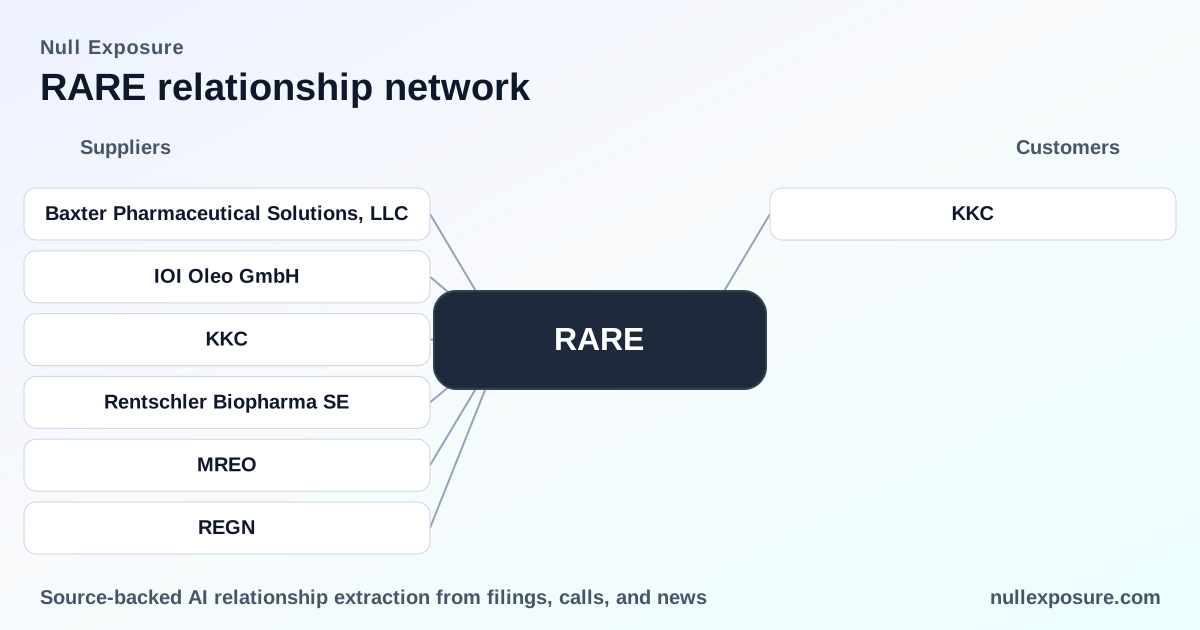
Ultragenyx’s supplier map: where production lives and what it means for investors
Ultragenyx (RARE) is a commercial-stage rare disease company that monetizes through specialty drug sales and territorial licensing, outsourcing nearly all manufacturing and many development tasks to third parties. Revenue derives from product sales (including Crysvita, Dojolvi, Mepsevii and Evkeeza) and regional licensing arrangements; the firm preserves capital by contracting manufacturing and supply with external partners and recognizing defined transfer pricing on some collaboration products. For investors, the core thesis is straightforward: Ultragenyx’s growth is driven by orphan-drug commercialization, but the company’s operating leverage and execution are tightly coupled to a small set of external manufacturers and collaboration partners.
Explore the supplier intelligence behind that thesis at https://nullexposure.com/.
Why supplier relationships matter for valuation and downside protection
Ultragenyx deliberately outsources manufacturing and clinical services as a strategic choice to scale rare-disease programs without building full in‑house capacity. That model delivers capital efficiency and speed to market, but it also creates concentration and operational risk: the company’s filings state that loss of suppliers or failure to supply necessary drug substance or drug product could materially and adversely affect the business. This is not theoretical—manufacturing obligations and contract durations drive near-term inventory and cost-of-sales dynamics that appear in the company’s 10‑K disclosures for FY2024.
Key operating-model signals investors should internalize:
- Contracting posture: a mix of exclusive and non‑exclusive supply agreements, and collaboration contracts that include explicit transfer pricing rules. These contracts lock Ultragenyx into supplier economics and sourcing paths that are difficult to substitute quickly.
- Concentration: Ultragenyx relies on a relatively small group of manufacturers for active ingredients and finished product, increasing single‑point-of-failure exposure.
- Criticality: suppliers are operationally critical—manufacturing interruptions would directly affect product availability and revenue recognition.
- Maturity and stage: relationships are active and tied to commercial supply and near‑term manufacturing obligations, not just early-stage CMC work.
How Ultragenyx structures supplier economics and collaboration pricing
Ultragenyx recognizes cost of goods and transfer pricing embedded in collaboration agreements rather than simple tolling rates; for example, collaboration partners charge transfer prices as a percent of net sales for particular territories. The 10‑K discloses transfer-price ranges and explicit percentages for certain collaborations, which directly affect gross margins on those products and the volatility of cost of sales. These contractual mechanics are essential when modeling gross-margin trajectories and downside scenarios in stress cases.
If you want granular position-level supplier analytics and contract signals, visit https://nullexposure.com/ for more context.
Supplier-by-supplier briefing (direct excerpts and investor takeaways)
Below are the suppliers disclosed in Ultragenyx’s FY2024 reporting and related public coverage, with a concise investor-oriented description and source reference.
Baxter Pharmaceutical Solutions, LLC
Baxter manufactures the Evkeeza drug product at its Bloomington, Indiana facility, providing finished‑dose production capacity for that product. This is a commercial manufacturing arrangement documented in Ultragenyx’s FY2024 10‑K.
Source: Ultragenyx 2024 Form 10‑K (FY2024).
IOI Oleo GmbH
IOI Oleo supplies the pharmaceutical‑grade drug substance for Dojolvi under an exclusive worldwide supply agreement, making IOI a single-source provider for that active ingredient. This exclusivity elevates substitution risk for Dojolvi supply.
Source: Ultragenyx 2024 Form 10‑K (FY2024).
KKC
KKC manufactures both the drug substance and drug product for burosumab under a collaboration and supply structure; the collaboration includes a transfer‑price mechanism tied to net sales. KKC is therefore a high‑impact manufacturing partner for Crysvita/burosumab.
Source: Ultragenyx 2024 Form 10‑K (FY2024).
Rentschler Biopharma SE
Rentschler produces the Mepsevii drug substance under non‑exclusive commercial supply and services agreements, supplying active ingredient capacity for that therapy and allowing Ultragenyx some, but not unlimited, sourcing flexibility.
Source: Ultragenyx 2024 Form 10‑K (FY2024).
Mereo BioPharma (MREO)
Ultragenyx paid Mereo $50 million in 2020 for ex‑Europe rights to a development-stage bone therapy, reflecting a licensing-style supplier/partner relationship focused on territorial rights and program economics rather than pure manufacturing. This deal underscores Ultragenyx’s use of acquisitions and rights purchases to secure pipeline optionality.
Source: FierceBiotech report, March 2026.
Regeneron
Regeneron manufactures the Evkeeza drug substance at its Rensselaer, New York facility and supplies product under an intercompany-style collaboration that features transfer pricing recognized as cost of sales; the contract structure allocates a defined percentage of net sales to the supplier. Regeneron is therefore a material upstream partner for Evkeeza supply.
Source: Ultragenyx 2024 Form 10‑K (FY2024).
Risk synthesis and portfolio implications
The supplier map creates a clear risk/reward concentration dynamic for investors:
- Concentration risk is elevated because a small number of contract manufacturers produce critical active ingredients and finished products. The 10‑K explicitly states reliance on a small number of manufacturers for active pharmaceutical ingredients and formulated drugs.
- Contractual economics are explicit and impactful: partner transfer prices and collaboration terms flow directly into gross margins (the 10‑K gives ranges and specific transfer‑price examples for collaborators).
- Operational fragility is real: Ultragenyx disclosed that third‑party manufacturing and service obligations for approved products are due in the next 12 months, and that a prior drug‑product manufacturer (Aenova Haupt Pharma Wolfratshausen GmbH) notified the company of facility closure in March 2023, which required remediation. These facts require investors to underwrite near‑term supply continuity when modeling revenue paths.
- Upside is product‑driven: if manufacturing holds and demand for existing therapies grows, Ultragenyx benefits from leverage without the fixed‑cost burden of in‑house plants.
Consider these triggers for active monitoring: supplier audit results, inventory days and build plans disclosed in quarterly reports, any amendments to exclusive supply agreements (notably for IOI Oleo), and transfer‑price changes in collaboration filings.
If you want ongoing tracking of supplier disclosures and contract shifts, get started at https://nullexposure.com/.
Bottom line and what to watch next
Ultragenyx’s model sells premium orphan therapies while outsourcing manufacturing to a small, strategically contracted supplier base. That configuration supports capital efficiency and rapid scale but creates concentrated operational risk and predictable margin mechanics via transfer pricing. For valuation and risk-control, investors must underwrite supplier continuity, track exclusivity clauses, and stress-test margins against supplier transfer‑price scenarios.
For a deeper read and supplier signal feeds tailored to investor due diligence, visit https://nullexposure.com/.