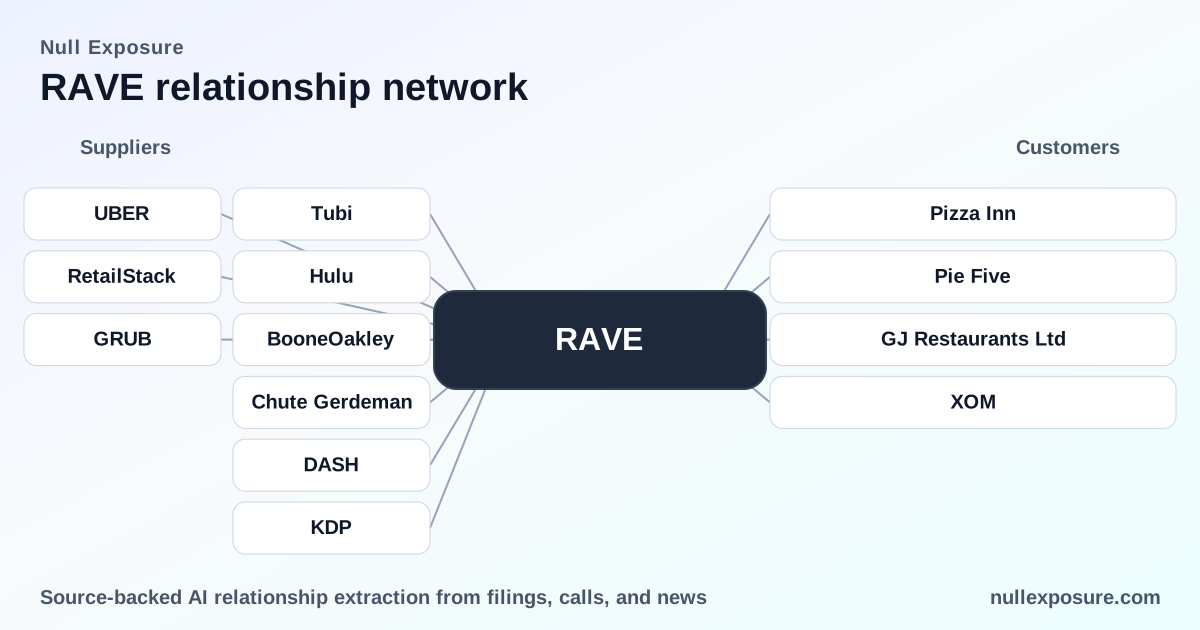
RAVE: Supplier relationships that shape a small-cap pizza franchise’s operational leverage
Rave Restaurant Group (NASDAQ: RAVE) operates and franchises Pizza Inn restaurants, generating revenue through company-owned locations, franchise royalties, and sales to franchisees, while expanding carryout and delivery channels via third-party platforms and modernizing retail operations through design and POS partnerships. The firm monetizes a branded legacy footprint with modest scale — revenue TTM roughly $12.4 million and a positive operating margin — and deliberately outsources critical functions (distribution, processing, digital delivery and marketing) to external vendors to preserve capital and accelerate system modernization.
Discover more supplier intelligence and relationship mapping at https://nullexposure.com/.
Why supplier relationships matter here RAVE’s operating model is franchise-centric: franchisees purchase supplies through authorized distributors and RAVE contracts with food processors for proprietary items. That structure creates a procurement network that is externally managed and subject to third‑party operational risk, while giving the franchisor low capex but ongoing reliance on vendors for customer experience and growth initiatives. According to company disclosures, the organization also uses third‑party vendors for cybersecurity and cloud hosting, and pursued a systemwide POS rollout via RetailStack in FY2020. These are company-level signals of how RAVE contracts, scales, and allocates operational risk.
Key company-level constraints and what they imply:
- Contracting posture: Franchise model with centralized specification-setting and decentralized purchasing suggests RAVE leans on contracts and standards rather than owning distribution assets. Evidence: company statements on franchisee purchasing and contracts with food processors.
- Concentration and criticality: Multiple delivery and marketing partners reduce single‑vendor concentration but create critical dependency on platform economics and ad channels for growth.
- Maturity and governance: Engagement with established agencies and a Franchise Leadership Council–led POS rollout indicate governance across franchise stakeholders and a measured approach to system upgrades.
- Third‑party risk management: Use of external security vendors and cloud hosting means cyber and service continuity risks are operational exposures that investors should stress‑test.
Supplier relationships and what they deliver for RAVE
Tubi — streaming channels for renewed national marketing (FY2025)
Pizza Inn restarted national streaming commercials and purchased streaming placements on services like Tubi as part of a refreshed marketing push, indicating RAVE is buying reach through free ad-supported streaming. Source: PizzaMarketplace coverage of marketing activity in FY2025.
Hulu — mainstream streaming inventory for brand advertising (FY2025)
Hulu ran Pizza Inn commercials when RAVE increased marketing spend, reflecting a strategy to rebuild brand awareness via premium streaming inventory. Source: PizzaMarketplace article on Pizza Inn marketing in FY2025.
BooneOakley — creative partner for brand refresh (FY2022)
RAVE engaged advertising agency BooneOakley to modernize Pizza Inn’s creative direction during its rebranding effort, underscoring reliance on external creative firms for customer-facing repositioning. Source: PizzaMarketplace and GlobeNewswire reports on the FY2022 brand refresh.
Chute Gerdeman — retail design firm for store reimagination (FY2022)
Chute Gerdeman supported the design and retail experience transformation for Pizza Inn, a capital‑light route to change in-store presentation without direct internal design capability. Source: GlobeNewswire announcement and PizzaMarketplace coverage in FY2022.
DoorDash (DASH) — delivery partner extending carryout reach (FY2022)
DoorDash is one of RAVE’s delivery partners, enabling Pizza Inn to expand carryout and delivery reach without building proprietary logistics, while exposing unit economics to marketplace fee structures. Source: PizzaMarketplace article on FY2022 technology and delivery partnerships.
Uber Eats (UBER) — complementary delivery channel for convenience demand (FY2022)
Uber Eats functions alongside other platforms to deliver Pizza Inn orders, diversifying channel access and customer touchpoints for delivery sales. Source: PizzaMarketplace coverage describing FY2022 expansion into delivery platforms.
GrubHub (GRUB) — additional delivery aggregator partner (FY2022)
GrubHub is named among RAVE’s delivery partners, representing another distribution channel that contributes to off-premise growth and order aggregation. Source: PizzaMarketplace report on carryout and delivery partnerships in FY2022.
Dr Pepper (KDP) — co‑marketing and in-store promotions (FY2025)
RAVE partnered with Dr Pepper to create themed in-store fan zones and sweepstakes tied to college football, using beverage co-promotions to drive traffic and experiential marketing. Source: RestaurantNews report on the Pizza Inn and Dr Pepper partnership in FY2025.
RetailStack — POS vendor selected by franchise leadership (FY2020)
RAVE selected RetailStack for a systemwide point‑of‑sale rollout, a franchisor-endorsed decision that reflects coordinated technology adoption across the system and a controllable lever for payments, reporting, and menu management. Source: PR Newswire release announcing the POS partnership in FY2020.
Middleline supplier insight and strategic implications RAVE’s supplier mix spreads operational responsibilities across marketing, design, distribution, and delivery partners. That distribution of responsibilities reduces capex but increases dependency on contract performance and third‑party economics. The FY2020 RetailStack rollout indicates franchise governance can drive technology convergence across stores, while FY2022 brand and design investments show management prioritizes experience upgrades to lift sales per unit. Delivery partners (DoorDash, Uber Eats, GrubHub) give scale to off‑premise revenues but compress margins due to platform fees and promotional dynamics. For deeper intel and mapping of supplier exposures, visit https://nullexposure.com/.
Investment implications and risk checklist
- Revenue leverage vs. vendor cost pressure: Off‑premise growth from delivery platforms contributes to top-line without incremental stores, yet platform fees are a recurring cost pressure that directly affect margins.
- Franchise governance reduces capex but shifts execution risk outward: Company-level controls (product specs, POS standards) limit capital deployment but transfer execution and continuity risk to vendors and franchisees.
- Brand revitalization requires sustained marketing investment: National streaming buys and agency engagements are necessary to modernize awareness; sustained spend increases fixed marketing consumption and affects near‑term free cash flow.
- Operational continuity and cyber risk are externalized: Use of third‑party security vendors and cloud hosting focuses expertise but makes RAVE sensitive to vendor security posture and SLAs.
Bottom line and next steps RAVE leverages a franchise model to scale Pizza Inn with a network of external partners that deliver marketing, design, distribution, technology, and delivery services. That strategy preserves capital and accelerates modernization while exposing the business to vendor economics and continuity risks that directly influence profitability. For investors and operators evaluating supplier relationships, the tradeoff is clear: operational agility and low capital intensity against third‑party dependency and margin pressure.
Explore detailed supplier profiles and supplier-risk scoring at https://nullexposure.com/ to inform investment and operational decisions.
Final action: if you are modeling RAVE’s earnings or negotiating franchise terms, prioritize scenario analysis around delivery fee sensitivity, POS uptime and data security, and the marketing spend required to sustain the brand refresh. For ongoing supplier monitoring and curated intelligence, visit https://nullexposure.com/.