RBB Bancorp: funding-first regional bank with targeted community origination and wholesale liquidity management
RBB Bancorp operates as the holding company for Royal Business Bank, a Los Angeles–headquartered regional bank that originates commercial and residential loans to Asian-American small businesses and depositors and monetizes through net interest margin and fee income from lending, deposits and correspondent wholesale funding. The bank’s balance-sheet strategy combines community-focused origination with active use of secured wholesale finance (notably Federal Home Loan Bank advances) and brokered deposits to manage liquidity and funding cost. For relationship diligence and supplier evaluation, focus on funding counterparties, secured-borrowing capacity, and the maturity profile of term advances. Learn more at https://nullexposure.com/.
Funding posture: a hybrid of retail originations and deliberate wholesale substitution
RBB’s operating model centers on profitable lending into niche local markets while actively managing funding cost via secured advances and brokered wholesale deposits. The company’s reported financials show a modest valuation multiple and capital metrics consistent with a regional bank: Price-to-Book of 0.68, Return on Equity around 6.2%, and a trailing P/E ~11.5. Those figures reflect a bank generating steady profit margins (operating margin ~42.6%) while balancing liquidity and interest-rate sensitivity.
The practical consequence for suppliers and counterparties is that RBB is often both a borrower and a buyer of services—it sources liquidity from formal government-sponsored banks and from brokered deposit channels while engaging third-party vendors for operations—so vendor and funding relationships occupy different strategic roles for the company. If you evaluate exposure to RBB, prioritize counterparty risk on funding lines and operational dependency on critical vendors. For a deeper supplier view visit https://nullexposure.com/.
What the relationships are and why they matter
Below I document every supplier- and funding-related relationship surfaced in our search, with a concise, plain-English description and the original source.
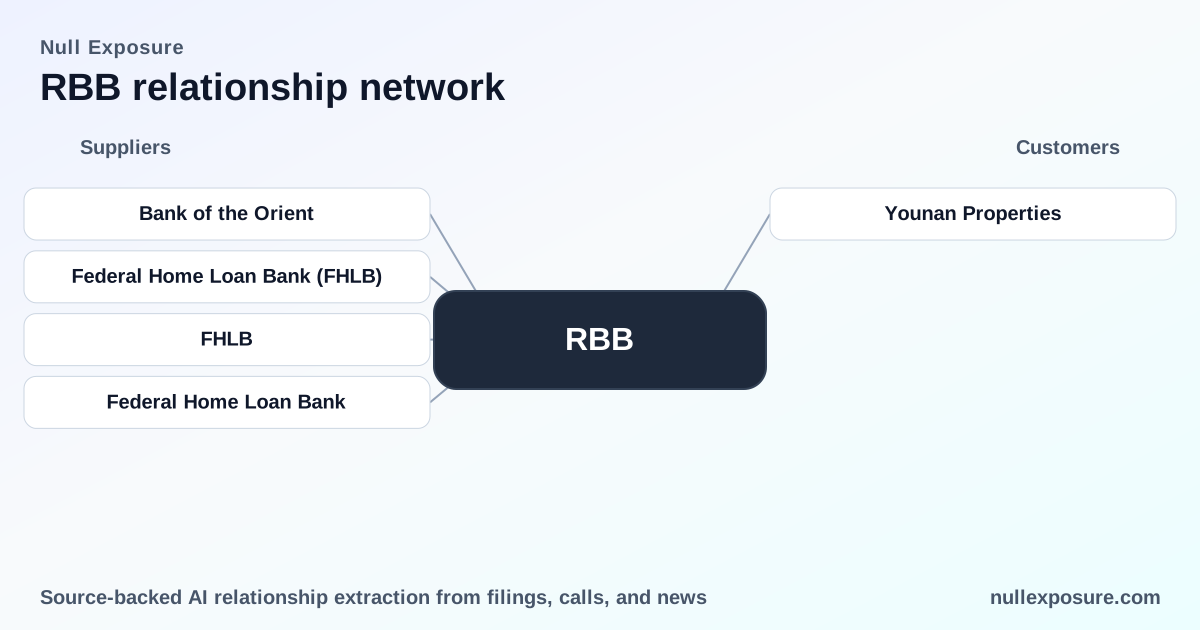
Bank of the Orient — branch/asset transaction (FY2021)
RBB engaged in a transaction with San Francisco-based Bank of the Orient that required regulatory approval and was expected to close by the end of 2021, reflecting RBB’s customary strategy of growth by acquisition of branch assets in targeted markets. (Los Angeles Business Journal report, FY2021: https://labusinessjournal.com/finance/rbank-buys-honooyal-business-lulu-branch-3-millio/)
Federal Home Loan Bank (FHLB) — secured borrowing partner (FY2024–FY2026 disclosures)
RBB maintains a large secured borrowing capacity with the Federal Home Loan Bank, with disclosed advances totaling $200 million at December 31, 2024—including $150 million in five‑year advances—and it has actively refinanced or repaid advances (for example, $50 million was repaid and replaced with brokered time deposits in the FY2026 period). These FHLB facilities function as core term funding for the bank and influence its cost-of-funds and maturity ladder. (RBB earnings call transcripts and press coverage, Q2–Q3 2025 and Q3 2024: https://www.theglobeandmail.com/investing/markets/stocks/RBB-Q/pressreleases/37231395/rbb-bancorp-rbb-q3-2025-earnings-call-transcript/; https://www.theglobeandmail.com/investing/markets/markets-news/Motley%20Fool/37231395/rbb-bancorp-rbb-q3-2025-earnings-call-transcript/; https://www.theglobeandmail.com/investing/markets/markets-news/Motley%20Fool/37231408/rbb-bancorp-rbb-q2-2025-earnings-call-transcript/; https://www.theglobeandmail.com/investing/markets/stocks/RBB-Q/pressreleases/37231349/rbb-bancorp-rbb-q3-2024-earnings-call-transcript/)
Constraints that change supplier risk calculus
RBB’s public filings and transcript excerpts reveal constraints that matter for supplier diligence—some are relationship-specific (FHLB) and others are company-level signals.
-
Long-term secured borrowing is an explicit structural element of the balance sheet: RBB reported a secured borrowing capacity with the FHLB of $1.1 billion, collateralized by loans with carrying value of $1.4 billion, and it disclosed $200 million of FHLB advances at year-end 2024, including long-dated five-year advances. This establishes a contractual, long-term funding posture for the bank and makes the FHLB a critical funding counterparty. (Company filings as of December 31, 2024.)
-
Counterparty type and concentration: the FHLB is a government-sponsored liquidity counterparty for RBB; that relationship is government-backed and formally collateralized, reducing unsecured counterparty exposure but increasing sensitivity to the bank’s collateral pool and advance terms.
-
Role signals: RBB acts as a buyer of funds from the FHLB and other institutions and also as a service consumer through regular third-party vendor use—suppliers should expect standard vendor contracting with the bank, and funding counterparties should expect formal collateral and covenant structures.
-
Maturity and repricing risk is evident: several term advances matured or were scheduled to mature in early 2025, and management has refinanced or substituted these advances with brokered deposits at higher rates, which directly increases funding costs and pressure on net interest margin.
Taken together, these constraints indicate RBB is a mature credit actor that relies on secured, multi-year funding relationships while retaining flexibility to substitute with brokered deposits—a profile that affects vendor payment terms, collateral requirements, and the criticality of timely repo/advance settlements.
What this means for suppliers and investors
-
Funding counterparties should treat the FHLB relationship as strategic and long-term: the size of pledged collateral and the five‑year advance components make FHLB exposure critical to RBB’s funding profile.
-
Operational vendors face a stable but relationship-driven customer: RBB uses third-party vendors regularly and will prioritize continuity and service-level compliance; vendors should expect negotiation on SLAs and standard banking compliance terms.
-
Liquidity-sensitive suppliers should monitor the maturity ladder: RBB’s active refinancing of term advances and substitution with brokered funds at higher rates is an immediate influence on its cost structure and working capital behavior.
For deeper supplier analysis and ongoing monitoring of RBB counterparties, see our platform at https://nullexposure.com/.
Final investment-grade takeaways
RBB combines community lending strength with an active wholesale funding playbook: it monetizes localized origination while leaning on secured FHLB advances and brokered deposits to manage liquidity. That model yields predictable revenue but creates supplier-relevant exposures around collateral composition, funding maturity, and repricing cycles. For investors and vendors evaluating engagements, prioritize counterparty documentation around pledged collateral, advance maturity dates, and the bank’s substitution strategy for wholesale funds.
If you want a consolidated supplier-risk view and continuous monitoring of RBB relationships, start here: https://nullexposure.com/. For a tailored diligence brief or to track counterparties across the regional banking sector, visit https://nullexposure.com/ and request a briefing.