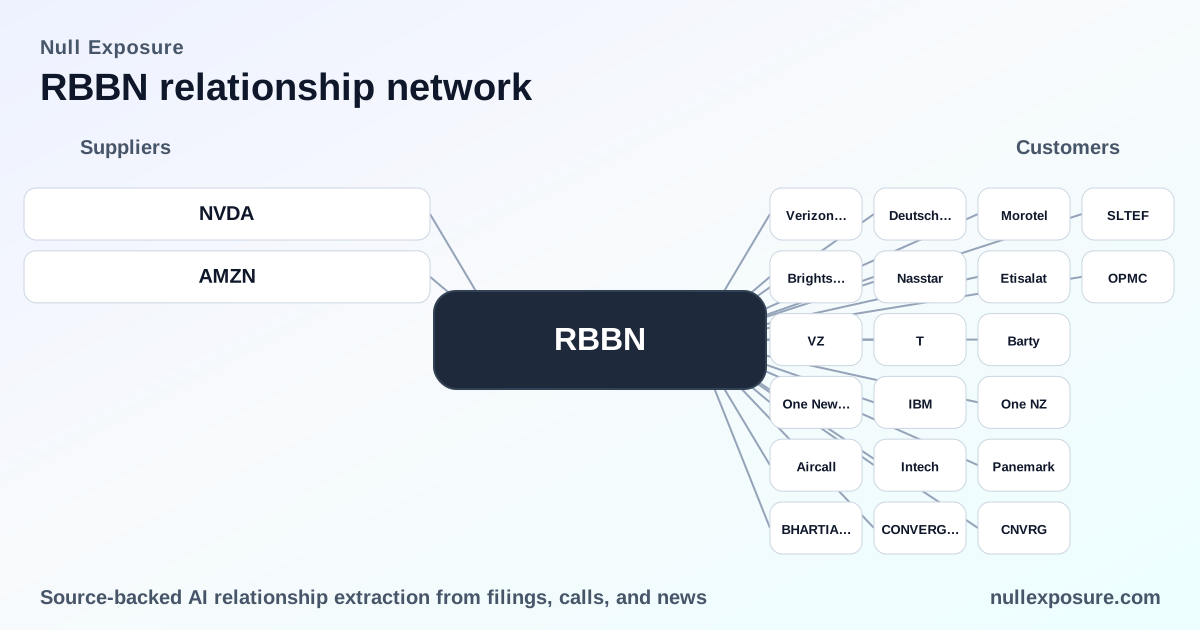
Ribbon Communications: supplier relationships that reshape revenue mix and operational risk
Ribbon Communications sells real‑time communications and IP optical networking products and increasingly monetizes through software, cloud‑native services, licensing and support contracts to service providers and enterprises. The company captures value both from hardware sales and recurring software/cloud deployments, and recent partner agreements with hyperscalers and AI platform providers accelerate that transition while changing distribution and go‑to‑market dynamics. For investors evaluating supplier relationships, the key question is how these partnerships shift Ribbon’s contracting posture, concentration of counterparty risk, and the criticality of third‑party vendors to delivery and revenue growth.
Explore more supplier intelligence at https://nullexposure.com/.
Why the new partnerships matter for the P&L and go‑to‑market
Ribbon’s business traditionally mixes product shipments with professional services and maintenance; moving solutions onto cloud marketplaces converts one‑time hardware sales into recurring software revenue and services opportunities. The firm’s fiscal profile—roughly $844.6 million in trailing revenue with positive operating margins and an EV/EBITDA around 11—supports investment in integration and go‑to‑market activities that come with hyperscaler listings and AI integrations. Strategic supplier relationships are therefore both revenue accelerants and operational dependencies: they broaden channel reach but increase reliance on third‑party cloud and AI ecosystems for distribution, certification and support.
Ribbon already discloses reliance on global contract manufacturers and licensors for product delivery and on third‑party managed detection & response for cybersecurity monitoring. Those disclosures signal a contracting posture that combines outsourced manufacturing with platform licensing and managed IT services—an arrangement that reduces capital intensity but concentrates execution risk on external partners.
What each named relationship contributes
NVIDIA — real‑time AI for contact centers
Ribbon collaborated with NVIDIA to build a solution that analyzes contact‑center calls in real time using advanced AI, enabling immediate business decisions based on AI observations. This integration positions Ribbon’s communications stack as the data ingress for AI analytics, increasing product stickiness when customers require low‑latency voice intelligence. According to NVIDIA’s developer blog, the work focuses on integrating telephone networks to enable real‑time AI services (developer.nvidia.com, reported March 2026).
Amazon Web Services (AWS) — cloud‑native voice on the marketplace
Ribbon announced a strategic collaboration to deliver a cloud‑native, secure voice communications solution available on AWS Marketplace, aligning Ribbon’s software with hyperscaler distribution and managed service consumption models. Multiple reports describe the partnership as designed to simplify cloud deployment for service providers and enterprises and to make Ribbon’s voice stack available as a cloud offering (FinViz and InsiderMonkey coverage of Ribbon/AWS partnership, February–March 2026; MarketScreener reporting on cloud‑based services, 2025–2026).
Operational constraints and company‑level signals investors should weigh
-
Global footprint and supply chain complexity. Ribbon’s suppliers and manufacturers operate across multiple geographies, which provides flexibility in production and distribution but increases exposure to geopolitical and logistics disruptions. This global posture is a company‑level signal of operational complexity and sourcing diversification.
-
Outsourced manufacturing and licensing posture. The company relies on contract manufacturers and licensors to deliver finished products and components. That contracting posture reduces fixed costs and speeds time‑to‑market, but it also creates single‑point execution risks where third‑party failure can delay shipments and service launches.
-
Third‑party security and service reliance. Ribbon uses an external 24x7 Managed Detection & Response provider for cybersecurity monitoring and quarterly risk assessments, which centralizes incident response expertise but places a critical operational function in the hands of a vendor.
-
Maturity of the product mix. Ribbon is transitioning from hardware to cloud‑native and software monetization, a maturation that changes gross margin dynamics and reduces cyclicality tied to physical shipments. Financially, the company shows a modest profit margin, positive operating margin, and an EV/EBITDA multiple consistent with mid‑market tech companies undergoing product transitions.
Taken together, these constraints describe a firm that is operationally lean, externally dependent for manufacturing and certain services, and strategically co‑located with hyperscalers and AI platform providers—a structure that supports scalable software revenue but requires active vendor management.
Risk, upside and what to watch next
-
Upside: Hyperscaler and AI integrations convert distribution and analytics opportunities into recurring revenue streams and increase sales velocity when service providers prefer cloud‑marketplace procurement. The AWS marketplace listing and NVIDIA AI integration create cross‑sell potential into Ribbon’s existing telco and enterprise accounts, and they reinforce Ribbon’s position as a software‑enabled gateway for voice and network intelligence.
-
Risk: Outsourced manufacturing and reliance on licensor relationships create execution risk and concentrate supplier dependency; any disruption to contract manufacturers or cloud partners could interrupt product delivery or certification timelines. Security monitoring via a third‑party MDR vendor centralizes capability but transfers operational control to an external provider—investors should monitor service agreements and SLAs.
-
Financial indicators to track: recurring revenue growth from cloud and marketplace channels, gross margin expansion if software sales replace hardware, the cadence of joint go‑to‑market announcements with hyperscalers/AI vendors, and any disclosures about manufacturing concentration or vendor incidents.
For detailed supplier mapping and ongoing monitoring of Ribbon’s counterparties, visit https://nullexposure.com/ to see how supplier relationships translate into operational risk and strategic opportunity.
Final takeaways and investor actions
Ribbon’s recent public relationships with NVIDIA and AWS are strategic moves that accelerate the company’s shift toward cloud‑delivered communications and AI‑driven analytics, strengthening recurring revenue prospects while simultaneously raising third‑party execution importance. Investors should price in both the upside from marketplace distribution and the operational risk from outsourced manufacturing and vendor‑delivered security services.
If you manage exposure to communications infrastructure or evaluate suppliers for enterprise deployments, follow Ribbon’s partnership milestones and vendor disclosures closely. For ongoing supplier intelligence and to track how these relationships evolve, start here: https://nullexposure.com/.