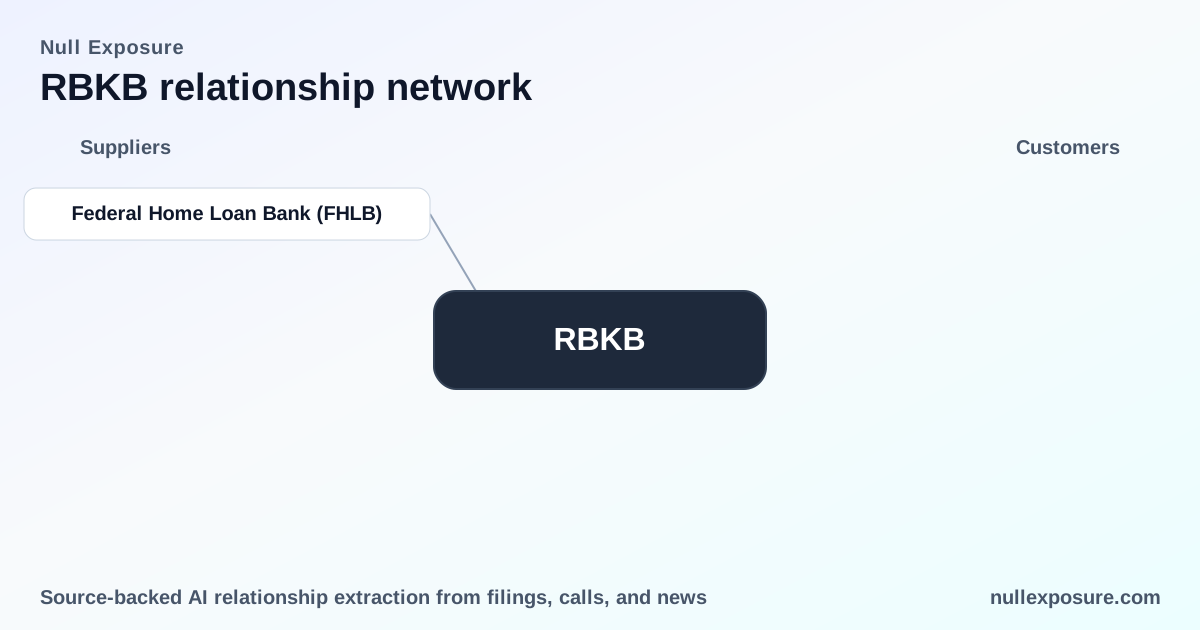
Rhinebeck Bancorp (RBKB) — Supplier relationships and what they mean for investors
Thesis: Rhinebeck Bancorp operates as a small regional bank serving the Hudson Valley, monetizing through net interest margin on consumer and commercial loans, fee income from loan origination and dealer participation, and interest-bearing liabilities. The bank’s operating profile combines a highly localized loan origination footprint, long-dated subordinated financing and property commitments, and a historically material—but recently reduced—reliance on Federal Home Loan Bank (FHLB) advances. For counterparties and investors, the critical signals are funding composition, dealer-sourced origination, and long-term contractual obligations, each of which drives funding flexibility and counterparty risk. Learn more at https://nullexposure.com/.
How Rhinebeck actually makes money and structures its obligations
Rhinebeck Bancorp is the holding company for Rhinebeck Bank, a regional bank focused on consumer and small-business lending in the Hudson Valley. Revenue derives primarily from interest income on a loan book that grows in the local market and from fees tied to loan origination and dealer participation for indirect auto loans. The balance sheet is small by regional-bank standards (market capitalization roughly $171 million and trailing revenue of $51.7 million), which concentrates the economic impact of individual supplier and funding relationships.
Two company-level operating characteristics matter for supplier risk and supplier management:
- Contracting posture is long-term. Company disclosures show long-dated subordinated debentures maturing in 2035 and a mix of owned and long-term leased properties, which creates predictable but persistent fixed obligations. Company filings state the subordinated debentures pay three‑month CME SOFR plus 2% with a relative spread adjustment; the effective rates reported were about 7.78% (2024) and 7.64% (2023).
- Origination channels are distributed through dealers. Rhinebeck acquires indirect automobile loans from a network of local dealerships, where dealers receive a flat referral fee (dealer participation), embedding a distribution model rather than direct origination. Company disclosures cite acquisition from 61 Hudson Valley dealers plus 30 in the Albany area.
These characteristics translate to a bank that is stable in obligations but dependent on external origination channels and wholesale funding availability.
The single supplier relationship investors should watch
Federal Home Loan Bank (FHLB)
Rhinebeck reduced its reliance on higher-cost FHLB advances by $44.6 million (a 64% reduction) during 2025, signaling a meaningful decline in wholesale funding dependence and a move to either deposit growth or alternative funding sources. According to a TradingView write-up summarizing Rhinebeck’s quarter and year ended December 31, 2025, the reduction in FHLB advances was a material line-item in FY2026 disclosures (TradingView, March 10, 2026: Rhinebeck Bancorp Inc reports results for the quarter and year ended December 31, 2025).
What the constraints tell you about counterparty risk
Company-level constraint signals give clarity on supplier criticality and maturity of obligations:
- Long-term contract exposure reduces refinancing frequency but raises structural interest expense. The subordinated debentures mature in 2035 and are SOFR-linked; this lowers near-term rollover risk but locks in a spread above market short rates, so future SOFR movements will materially affect interest costs. This is a company-level signal drawn from the firm’s financing disclosures.
- Property ownership and long-term leases indicate lower vendor churn but fixed cost commitments. Owning six and leasing nine properties (plus three buildings on leased land) reduces short-term rental vulnerability but increases fixed occupancy costs and capital exposure in a regional market.
- Dealer-distributor role creates operational concentration risk in origination. The bank sources indirect auto loans from 91 dealerships across two subregions under dealer participation arrangements; dealer behavior, local auto demand and competitive referral pricing are therefore meaningful drivers of originations and loan quality.
These constraints collectively show a mature contracting posture: obligations are long-dated and predictable, origination is outsourced to local distributors, and reliance on a wholesale funding source has recently been scaled back.
What to monitor next — practical signals for investors and operators
- Track FHLB advance balances and the speed of further reductions; a continued withdrawal from FHLB suggests stronger deposit traction or substitution to other funding sources, while any reversal would increase funding cost sensitivity.
- Monitor the subordinated debenture spread relative to SOFR and the bank’s ability to generate net interest margin above that cost; movements in SOFR directly affect interest-bearing obligations where rates are SOFR‑linked.
- Evaluate dealer concentration and performance metrics at the portfolio level—originations, delinquency and dealer fee trends—because dealer-distribution is central to Rhinebeck’s growth engine.
- Watch insider ownership and liquidity: a high insider ownership (~59% insiders) constrains publicly tradable float, which can limit market valuation dynamics and susceptibility to activist pressure.
For a concise operational scorecard and supplier-mapping tools, visit https://nullexposure.com/ to see how these signals fit into a broader counterparty analysis.
Risks that change the investment case
- Funding concentration risk if wholesale sources re-emerge as necessary. The FY2026 reduction in FHLB usage improved liquidity mix, but the bank remains exposed to future swings in deposit behavior and capital markets access.
- Rate sensitivity through SOFR-linked subordinated debt. Rising short-term rates increase interest expense on that debt and compress net interest margin if asset repricing lags.
- Distribution and geographic concentration. Reliance on local dealers and a single regional footprint concentrates credit, economic and origination risk in the Hudson Valley.
- Limited public float. With a high insider ownership percentage, institutional participation is modest, which limits liquidity and can amplify price moves when headline events occur.
Actionable conclusion — what this means for counterparty managers
Rhinebeck’s supplier map is compact but consequential. The reduction in FHLB advances is a positive liquidity signal, while long-term subordinated debentures and property commitments create predictable fixed obligations. The dealer-distributor model drives origination but also concentrates operational dependency. For counterparties and investors, the focus should be on funding mix, dealer channel health, and interest-rate pass-through on long-term liabilities.
If you manage relationships with regional banks, integrate these signals into your monitoring framework and re-evaluate exposures as FHLB usage and SOFR-based interest costs evolve. For additional analytical context and supplier intelligence, consult https://nullexposure.com/.