RBNEV supplier relationships: capital markets and related‑party vessel acquisitions in focus
Robin Energy Ltd. operates as an international ship‑owning company that monetizes through the ownership and operation of LPG carriers and periodic access to capital markets, funding fleet acquisitions and working capital via registered offerings and direct purchases of second‑hand tonnage. The supplier footprint in public reporting for FY2025 highlights two practical levers the company uses to scale and finance — placement agents for capital raises and direct vessel purchases from an affiliated Nasdaq‑listed entity — both of which shape cash flow timing, governance dynamics, and operational scalability. Learn more about how these signals affect counterparty risk and strategic optionality on our homepage: https://nullexposure.com/.
What the public supplier map reveals about RBNEV's operating model
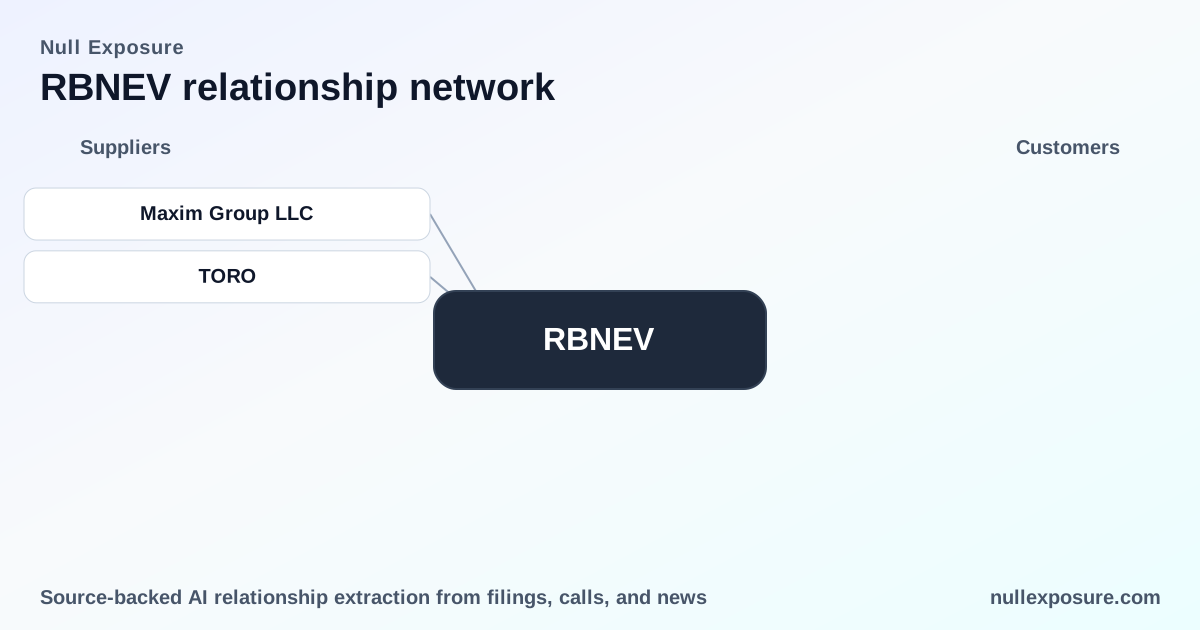
The disclosed relationships are concise but meaningful. One financial intermediary is serving as sole placement agent for a registered direct offering, signaling a concentrated capital‑markets contracting posture when raising equity or similar securities. One industrial counterparty — a company controlled by RBNEV’s CEO — is selling used LPG carriers to Robin, indicating the firm is sourcing second‑hand assets through related‑party transactions as a core growth mechanism.
These relationships imply several company‑level characteristics relevant to investors and operators:
- Contracting posture: RBNEV executes episodic, high‑value contracts (capital raises and used‑vessel purchases) rather than ongoing supply agreements, producing discrete counterparty risk windows around financing and acquisitions.
- Concentration: Acting with a single placement agent for a financing round denotes concentration risk in capital raising execution. That single point of failure can compress pricing or delay capital access if the agent encounters issues.
- Criticality: Vessels drive revenue; counterparty terms that affect timing or cost of asset acquisition are directly material to fleet capacity and near‑term EBITDA generation.
- Maturity and sourcing strategy: The purchase of used vessels (2015 and 2020 builds) signals a growth approach that favors opportunistic second‑hand purchases over newbuild programs, shortening lead times but introducing variability in maintenance and capex schedules.
No explicit contractual constraint excerpts were provided in the record; those company‑level signals above are drawn from the relationship disclosures themselves.
The relationships, one by one
Maxim Group LLC — sole placement agent for a FY2025 registered direct offering
Maxim Group acted as sole placement agent for Robin Energy’s registered direct offering in FY2025, a capital‑markets engagement used to raise immediate liquidity for corporate needs (press release dated Oct 24, 2025). According to a GlobeNewswire filing and syndication across financial outlets (GlobeNewswire, Oct 24, 2025: https://www.globenewswire.com/news-release/2025/10/24/3172846/0/en/Robin-Energy-Ltd-Announces-Pricing-of-7-0-Million-Registered-Direct-Offering.html; also reported on SahmCapital and Yahoo Finance), the arrangement gave a single broker responsibility for distribution and placement.
Toro Corp. — seller of used LPG carriers in related‑party transactions
Robin Energy purchased 5,000 cbm LPG carrier vessels from Toro Corp., a Nasdaq‑listed company controlled by RBNEV’s Chairman and CEO; the transactions reported include a 2020‑built vessel priced at $20 million and a 2015‑built vessel priced at $18 million (FY2025 reporting captured by Yahoo Finance: https://finance.yahoo.com/news/robin-energy-ltd-announces-acquisition-131500003.html and https://finance.yahoo.com/news/robin-energy-ltd-announces-vessel-123000813.html). These acquisitions illustrate a repeatable sourcing channel for fleet expansion that is structurally tied to the company’s executive leadership.
Why these supplier relationships matter to investors and operators
These two counterparties drive three investment‑grade considerations.
-
Capital execution risk and timing. A sole placement agent model concentrates execution risk; if Maxim underperforms or market windows close, RBNEV’s access to immediate equity liquidity is materially affected. That dynamic impacts runway and the ability to close asset deals on advertised timelines.
-
Governance and related‑party exposure. Purchasing vessels from a company controlled by the CEO crystallizes related‑party governance scrutiny. Price discovery, arms‑length documentation, and minority shareholder protections are central to valuation integrity when insiders transact with the issuer.
-
Fleet growth versus capex volatility. Relying on second‑hand vessels accelerates capacity additions and reduces lead times versus newbuilds, but transfers maintenance, refit, and residual‑value uncertainty into operating expense and capital expenditure profiles. Investors should budget for near‑term capex on acquired vintage tonnage and verify technical due diligence and warranty terms in acquisition agreements.
Midstream readers and underwriting teams can use this supplier intelligence to stress test financing scenarios, update counterparty limits, and refine due‑diligence checklists. For a deeper look at how supplier relationships compress risk and opportunity, visit our analytical hub: https://nullexposure.com/.
Practical next steps for engagement and monitoring
Investors and counterparties should prioritize three actions:
- Obtain the placement agreement term sheet and distribution schedule from the FY2025 offering paperwork to quantify underwriting fees, lockups, and termination rights with Maxim.
- Review the sale and purchase agreements (SPAs) and any independent valuations or technical surveys tied to the Toro transactions to confirm arm’s‑length pricing and post‑acquisition capex allowances.
- Monitor subsequent public filings and press releases for repeat use of the same placement agent or follow‑on vessel purchases from related parties, which would signal persistence of the observed operating pattern.
Bottom line: concentrated capital sourcing and related‑party fleet expansion are the dominant signals
The FY2025 public record for RBNEV conveys a clear, repeatable operating playbook: use a focused investment‑bank placement process to secure capital and acquire second‑hand LPG carriers through channels connected to management. That playbook accelerates fleet growth while concentrating execution and governance risk. Investors should price liquidity and related‑party governance into valuations and require transparent documentation on transaction economics and placement terms.
For more supplier‑level intelligence and to benchmark these relationships against industry peers, go to https://nullexposure.com/.