Rubrik (RBRK): supplier posture, concentration risks, and what contracts tell investors
Rubrik sells enterprise data management software and hardware, monetizing through subscription and support contracts for its cloud and appliance offerings and through appliance sales/contract-manufacturing arrangements. Revenue streams are anchored in recurring SaaS and support, while hardware economics depend on contract manufacturers and a narrow supplier base — a hybrid model that magnifies software-driven gross margins but leaves certain operational levers exposed to third-party manufacturers and vendor concentration.
Learn more about supplier exposure and supplier intelligence at https://nullexposure.com/.
How Rubrik makes money and why suppliers matter
Rubrik’s core business is recurring: customers pay for data protection, recovery, and lifecycle management across on-prem and cloud environments. That subscription-first model drives predictable top-line visibility and high gross-profit conversion on software, as reflected in $1.316B revenue and $1.054B gross profit over the trailing twelve months (FY ending January 2026). Hardware appliances remain an important go-to-market tool for on-prem customers and channel partners; however, Rubrik has transitioned appliance manufacturing to contract manufacturers, which changes the company’s operating posture from vertically-integrated manufacturer to a company that outsources production.
This outsourcing increases operational leverage on suppliers: concentration on a limited number of contract manufacturers and reliance on third-party vendors for SaaS delivery are strategic trade-offs — they lower fixed-capex and speed scaling, but they also introduce vendor counterparty, supply chain, and service continuity risks that investors must price.
What filings show about supplier and manufacturer relationships
Rubrik’s filings and disclosures make clear that the company uses third-party manufacturing and SaaS vendors as part of its operating model. These are company-level signals rather than single-counterparty guarantees.
- The company has explicitly shifted the sale of Rubrik-branded appliances to contract manufacturers and removed prior Refresh Rights from subscription offerings; this represents a deliberate move toward outsourced hardware production and distribution. (Excerpted from Rubrik regulatory filings, FY2025–FY2026 disclosures.)
- Rubrik relies on a limited number of suppliers for contract manufacturing and certain raw-material components, which indicates supplier concentration and a potential single-/few-source dependency for critical parts. (FY2025 company disclosures.)
- The company uses third-party vendors to deliver its SaaS, which creates operational dependencies around cloud operations, uptime, and security that are externally managed. (FY2025 disclosure language.)
These constraints are presented as company-level signals: they describe Rubrik’s operating model and concentration profile rather than attributing risk to any single named supplier unless the filing does so.
Named supplier relationships from the filings
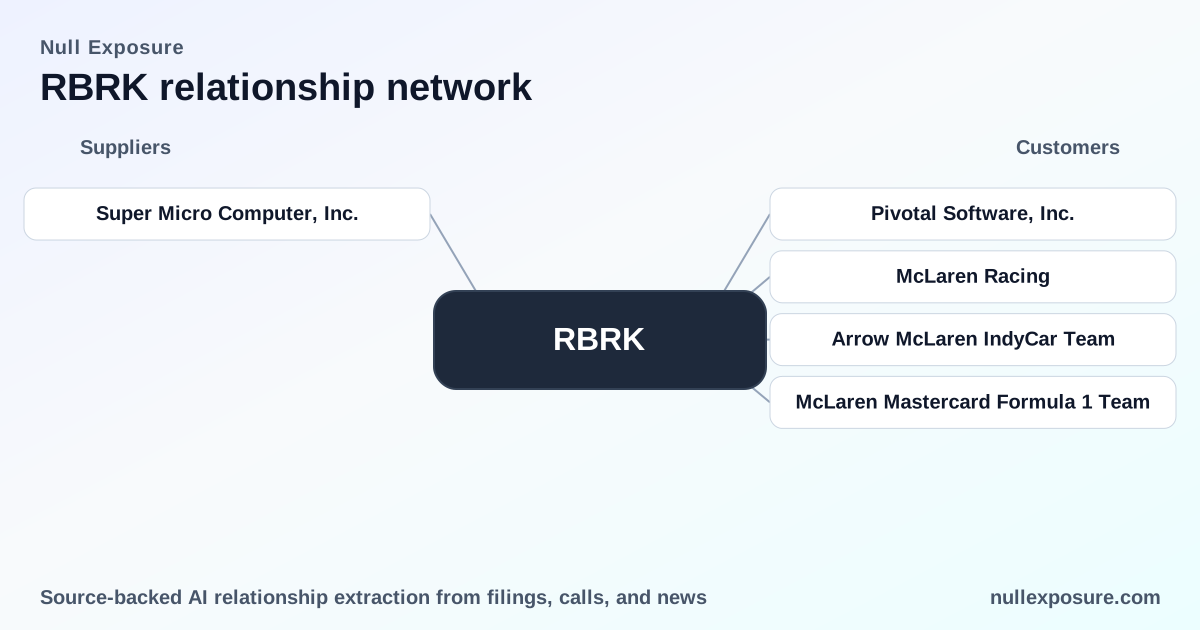
Super Micro Computer, Inc.: Rubrik has an OEM Purchase Agreement dated November 19, 2020, with Super Micro Computer, Inc., indicating a formal manufacturing or OEM supply arrangement for Rubrik-branded appliances. According to Rubrik’s FY2025 Form 10‑K, this OEM agreement underpins part of Rubrik’s outsourced appliance strategy and shows an established supplier relationship in hardware production (Rubrik 10‑K, FY2025).
How these supplier facts change investment and operational calculus
There are four practical implications for investors and operators:
- Contracting posture: Rubrik operates as a software-first company that outsources hardware production and some service delivery. That reduces capital intensity but increases vendor management and contract negotiation importance.
- Concentration risk: The reliance on a limited supplier set for manufacturing and components generates single-/few-source risk for appliances. Disruption to one key supplier could delay shipments and impact channel commitments.
- Criticality: Suppliers supporting appliance manufacturing and SaaS hosting are operationally critical. Outages, component shortages, or contract disputes directly affect Rubrik’s ability to deliver product and service SLAs.
- Maturity and transition: The company has completed a strategic transition away from selling appliances directly, which is a mature operating decision that trades control for scalability. That transition reduces inventory and capex but raises the bar on contract governance and quality assurance.
Use these points as a framework when assessing counterparty disclosures in Rubrik’s future filings and partner announcements.
Financial and valuation context that ties to supplier exposure
Rubrik’s financials reveal a business with healthy revenue growth but operating losses: $1.316B revenue, $1.054B gross profit, and negative operating margins (operating margin TTM: -21.8%, profit margin: -26.5%). Market valuation reflects growth expectations — Market Cap ~$10.34B and EV/Revenue ~7.44 — pricing significant future margin expansion and execution against the SaaS transition.
Supplier concentration and outsourced manufacturing raise two valuation-relevant risks:
- Execution shocks from supplier disruption could cause near-term revenue misses that amplification valuation multiple compression given current negative profitability.
- Outsourcing reduces fixed costs but creates recurring operational costs and counterparty risk that must be modeled into scenario-based margin recovery timelines.
Plan sensitivity analyses around supplier failure or capacity constraints and consider stress-testing revenue recognition and renewal rates against hypothetical supply interruptions.
Learn more about supplier risk signals and get deeper counterparty detail at https://nullexposure.com/.
Practical steps for investors and operators
- For investors: monitor future 10‑K and 10‑Q disclosures for supplier concentration metrics, material supply agreements, and termination/change-of-control provisions that could affect continuity. Pay attention to any changes in the OEM agreements and disclosures on supplier single-sourcing.
- For operators and procurement teams: prioritize supplier diversification and contractual protections (lead-time clauses, redundancy, penalties for non-performance) for manufacturing and cloud-hosting partners, and ensure robust service continuity plans are in place.
For a deeper read on supplier exposure across technology vendors, visit https://nullexposure.com/.
Bottom line
Rubrik’s business combines high-margin, recurring software revenue with outsourced appliance manufacturing. That operating choice accelerates scaling while concentrating risk with a small set of suppliers and third-party service providers. Investors should value Rubrik’s growth trajectory against the operational fragility that supplier concentration introduces and watch upcoming filings for any shifts in OEM and SaaS vendor arrangements.